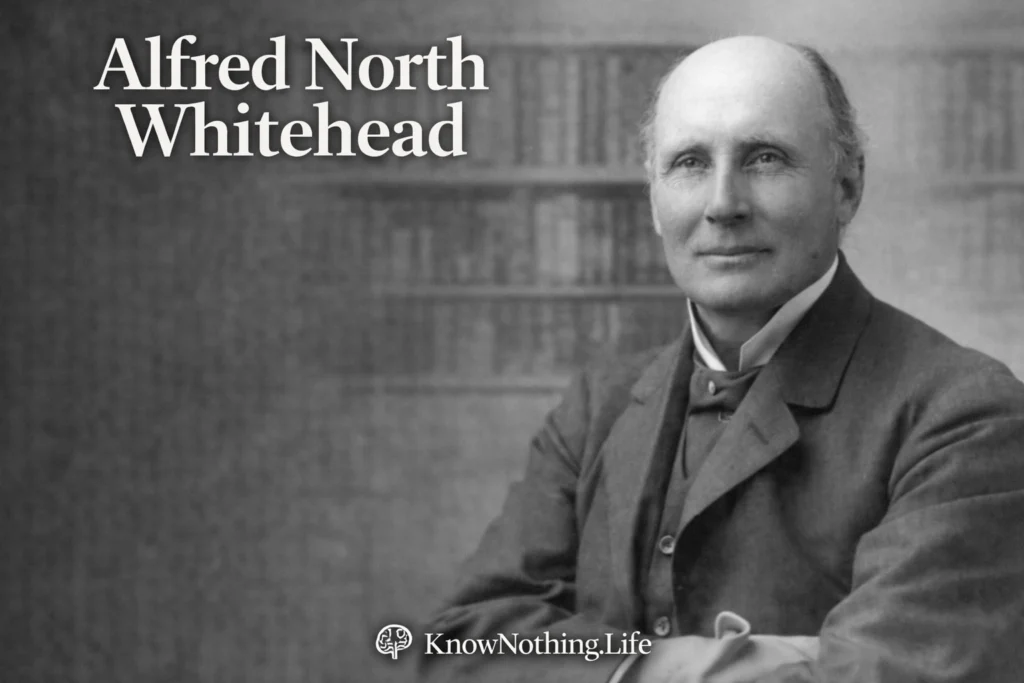
Alfred North Whitehead was born on February 15, 1861, in Ramsgate, Kent, England, into a family shaped by education, religion, and public service. His father was an Anglican clergyman and schoolmaster, and Whitehead grew up in an atmosphere where discipline, learning, and moral seriousness were taken for granted. He entered Trinity College, Cambridge, in 1880, studying mathematics at one of the great intellectual centers of the British world. Cambridge gave him the tools of formal reasoning, but it also placed him among thinkers who were beginning to question the foundations of knowledge, science, and mathematics.
Whitehead graduated from Cambridge in 1884 and was elected a fellow of Trinity College the same year. His early career was mathematical, technical, and rigorous. Yet even in his mathematical period, he was never merely a specialist. He was interested in how abstract structures relate to the real world, how symbols organize thought, and how knowledge develops over time. That lifelong concern would eventually lead him from mathematics to logic, from logic to science, from science to education, and finally to one of the most ambitious metaphysical systems of the twentieth century.
Mathematics, Logic, and Cambridge
Whitehead’s first major intellectual period was spent at Cambridge, where he worked on algebra, geometry, symbolic logic, and the foundations of mathematics. His A Treatise on Universal Algebra, published in 1898, showed his early ambition to unify different branches of mathematical thought. He was not interested only in calculation, but in the deeper architecture of mathematics itself. What are mathematical objects? How do systems of symbols gain power? Can the certainty of mathematics be grounded in logic?
These questions brought him into collaboration with Bertrand Russell, whom he met at Cambridge. Russell had been Whitehead’s student, but the two became intellectual partners in one of the most famous projects in modern logic. Their shared goal was logicism: the attempt to show that mathematics could be derived from logical principles. It was an enormous undertaking, and it required a level of symbolic discipline that few readers could follow easily. Yet its importance was not limited to mathematics. It helped change how philosophers thought about language, proof, systems, and the structure of reasoning itself.
Principia Mathematica
Whitehead and Russell’s three-volume Principia Mathematica, published between 1910 and 1913, became one of the landmark works of modern intellectual history. Its goal was to place mathematics on a logical foundation, especially by showing how arithmetic and other mathematical truths could be developed from formal symbolic principles. The project was difficult, controversial, and never completely free from philosophical problems, but its influence was immense. It helped popularize modern mathematical logic and demonstrated the power of formal systems.
Whitehead later moved beyond the strict logicist project, while Russell became more closely associated with analytic philosophy. Yet Principia Mathematica remained a crucial part of Whitehead’s legacy. It showed his commitment to precision, structure, and the disciplined pursuit of foundational questions. Even when his later philosophy became more metaphysical, poetic, and speculative, it retained the habits of a mathematician. Whitehead’s mature thought was never vague mysticism. It was the work of a logician who had come to believe that reality itself was more dynamic, relational, and creative than static systems could capture.
London, Science, and Education
After leaving Cambridge in 1910, Whitehead moved into a second major phase of his career in London. He taught at University College London and later at Imperial College, where he became professor of applied mathematics. During these years, his attention shifted from pure logic toward physics, science, nature, and education. The rise of relativity and the transformation of modern physics deeply affected him. Science no longer seemed to describe a universe of simple matter located in empty space. It revealed relations, events, fields, and changing structures.
Whitehead also wrote powerfully about education. In The Aims of Education, he warned against what he called “inert ideas,” knowledge stored in the mind but never used, tested, or connected to life. His famous statement, “Education is the acquisition of the art of the utilisation of knowledge,” summarized his view. Education was not the accumulation of disconnected facts. It was the formation of judgment, imagination, discipline, and practical wisdom. This made Whitehead one of the great educational philosophers of the modern period, especially for those who believe learning must remain alive, active, and connected to experience.
Harvard and the Turn to Metaphysics
In 1924, at an age when many scholars would have been nearing retirement, Whitehead accepted an appointment at Harvard University. This move began the most surprising phase of his career. In America, he became not merely a mathematician or philosopher of science, but a major metaphysician. His Harvard period produced works such as Science and the Modern World, Religion in the Making, Symbolism: Its Meaning and Effect, Process and Reality, The Function of Reason, Adventures of Ideas, and Modes of Thought.
Whitehead’s Harvard writings tried to rethink reality from the ground up. He believed that traditional philosophy had too often treated the world as a collection of static substances. Against this, he developed what became known as process philosophy. Reality, for Whitehead, is not made primarily of dead things that simply endure. It is made of events, occasions, relations, feelings, and acts of becoming. His famous remark that “the safest general characterization of the European philosophical tradition is that it consists of a series of footnotes to Plato” captured both his respect for the philosophical past and his desire to move beyond inherited assumptions.
Process and Reality
Whitehead’s most important philosophical book, Process and Reality, published in 1929, presented what he called the “philosophy of organism.” It is one of the most difficult and original works of twentieth-century metaphysics. Instead of beginning with isolated objects, Whitehead began with experience, relation, and becoming. The basic units of reality were not inert particles, but “actual occasions,” momentary events of experience that arise, integrate influences from the past, and perish into the conditions for future events.
At the center of this system was creativity. Whitehead saw the universe not as a finished machine, but as an ongoing process in which novelty emerges. His line, “The art of progress is to preserve order amid change and to preserve change amid order,” expresses one of his deepest convictions. Too much order becomes lifeless repetition; too much change becomes chaos. Reality itself is a balance of inheritance and novelty. This idea influenced theology, ecology, education, psychology, systems theory, and later process thought.
Religion, Civilization, and Human Experience
Whitehead’s metaphysics also opened into religion and civilization. In Religion in the Making, he treated religion not as a set of dogmas imposed from outside experience, but as a way human beings respond to value, order, depth, and ultimate concern. His idea of God was unusual: not an all-controlling ruler outside the world, but a persuasive and relational presence within the creative process. This made Whitehead especially important to process theology, which later developed through thinkers such as Charles Hartshorne and John Cobb.
In Adventures of Ideas, Whitehead explored civilization through ideals such as truth, beauty, adventure, peace, and freedom. He believed that ideas are not decorative abstractions; they shape institutions, habits, and possibilities of life. His famous warning that “it is the business of the future to be dangerous” reflects his sense that civilization survives by creative risk, not by clinging to safety alone. For Whitehead, reason was not cold calculation. It was the living power to guide change without destroying value.
Legacy and Lasting Importance
Alfred North Whitehead died on December 30, 1947, in Cambridge, Massachusetts. By then, he had lived several intellectual lives: Cambridge mathematician, coauthor of Principia Mathematica, philosopher of science, educational thinker, Harvard metaphysician, and founder of process philosophy. Few thinkers have moved across so many fields with such seriousness. His work influenced analytic philosophy, mathematical logic, education theory, theology, environmental thought, and speculative metaphysics.
Whitehead’s lasting importance lies in his refusal to let knowledge become narrow. He believed that mathematics, science, art, religion, and philosophy all reveal aspects of a living world. He warned against dead abstractions and insisted that reality is dynamic, relational, and creative. His philosophy asks us to see the universe not as a warehouse of objects, but as a drama of becoming. In that sense, Whitehead remains a philosopher for any age struggling to understand change, complexity, and the fragile art of progress.