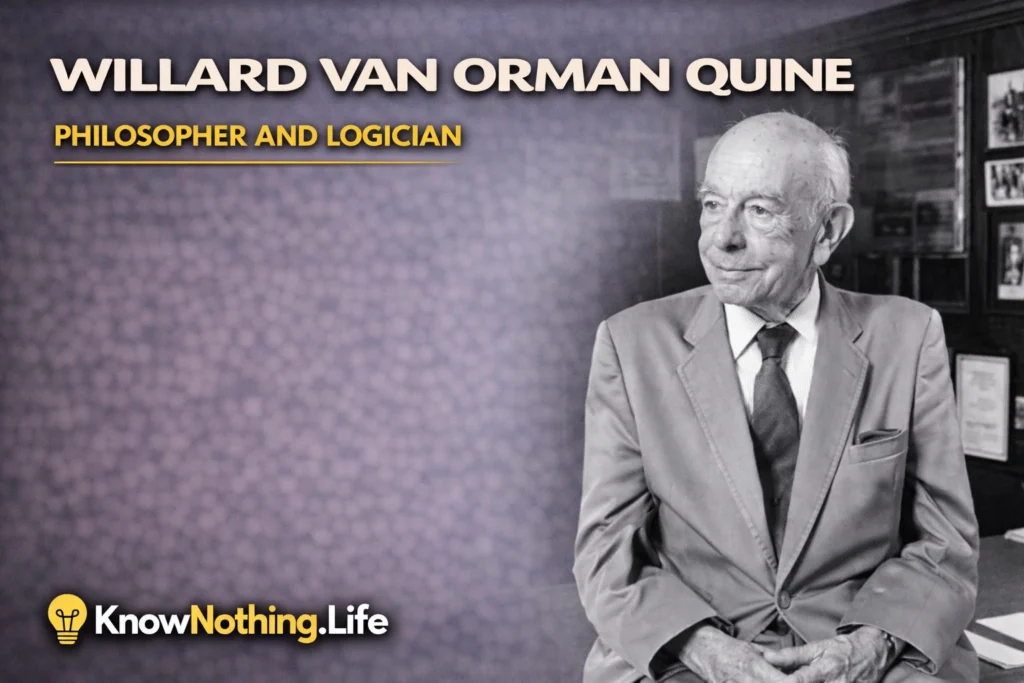
Willard Van Orman Quine was born on June 25, 1908, in Akron, Ohio, and became one of the most influential analytic philosophers of the twentieth century. Known professionally as W. V. Quine, he worked at the intersection of logic, language, ontology, epistemology, and the philosophy of science. His writing was often technical, but the questions behind it were enormous: What exists? What does language really refer to? Can meaning be separated from evidence? Is philosophy a special foundation for science, or is it part of science itself?
Quine studied mathematics at Oberlin College, graduating in 1930, then earned his Ph.D. in philosophy from Harvard University in 1932. His dissertation focused on the logic of Alfred North Whitehead and Bertrand Russell’s Principia Mathematica, placing him directly in the lineage of modern symbolic logic. After Harvard, he traveled in Europe on a Sheldon Fellowship, meeting major figures such as Rudolf Carnap and becoming deeply familiar with logical positivism. Yet Quine would later become one of logical positivism’s most devastating critics.
Harvard, Logic, and the Making of a Philosopher
Quine spent most of his academic life at Harvard, first as a Junior Fellow and later as a professor. His early work was centered on logic and set theory, including A System of Logistic in 1934 and Mathematical Logic in 1940. These works showed the technical discipline that would mark his entire career. Quine was not a philosopher of loose speculation. He believed philosophical claims should be sharpened through logic, clarified through language, and tested against the larger body of scientific knowledge.
During World War II, Quine served in the U.S. Navy, working in intelligence. After the war, he returned to Harvard and became one of the central figures in American analytic philosophy. His influence came not only from his books, but from the intellectual style he embodied: precise, naturalistic, suspicious of metaphysical extravagance, and unwilling to treat philosophy as a discipline floating above science. For Quine, philosophy was not a royal road to certainty. It was continuous with the same fallible, revisable inquiry that drives science.
Two Dogmas of Empiricism
Quine’s most famous essay, “Two Dogmas of Empiricism,” was published in 1951 and later included in From a Logical Point of View. The essay attacked two assumptions that had shaped modern empiricism. The first was the analytic-synthetic distinction: the idea that some truths are true purely by meaning, while others are true by fact. The second was reductionism: the idea that every meaningful statement can be translated into some construction based on immediate experience. Quine argued that both ideas were deeply unstable.
The essay’s most famous conclusion was that “the unit of empirical significance is the whole of science.” In other words, individual statements do not face experience alone. They belong to a network of beliefs, assumptions, definitions, measurements, and background theories. When experience conflicts with expectation, many revisions are possible. We might change a hypothesis, adjust a definition, reinterpret a measurement, or revise a supporting assumption. This became known as confirmation holism, and it shook the idea that knowledge could be divided neatly into truths of meaning and truths of fact.
Word and Object
In 1960, Quine published Word and Object, one of the major works of twentieth-century philosophy. The book developed his views on language, meaning, reference, and translation. Its most famous thought experiment is radical translation. Quine imagines a linguist encountering a completely unfamiliar language and trying to translate the word “gavagai” when a rabbit passes by. The obvious translation might be “rabbit,” but Quine pointed out that other interpretations, such as “undetached rabbit part” or “rabbit stage,” could fit the same observable evidence.
The point was not that translation is impossible in ordinary life. It was that meaning is not a hidden object attached to words. Language is learned and interpreted through behavior, context, theory, and use. Quine’s “indeterminacy of translation” challenged the idea that every word has a perfectly determinate meaning waiting to be discovered. This made him one of the most important critics of traditional theories of meaning. For Quine, reference and translation depend on the whole structure of language and theory, not on isolated mental meanings.
Ontology and What Exists
Quine also transformed modern ontology, the branch of philosophy concerned with what exists. His famous slogan, “To be is to be the value of a variable,” expressed his method for determining what a theory is committed to. Instead of asking vaguely whether numbers, properties, minds, or fictional objects exist, Quine asked what entities a well-formulated theory must quantify over in order to be true. If a theory says there are numbers, sets, electrons, or physical objects, then it carries commitments to those entities.
Another famous Quinean phrase is “No entity without identity.” He opposed careless metaphysics that admitted entities without clear criteria for when one such entity is the same as another. If philosophers want to claim that meanings, propositions, possible worlds, or abstract objects exist, they must say what counts as one rather than many. This did not make Quine a simple materialist who rejected everything abstract. He accepted mathematical entities because science appeared to need them. But he demanded ontological discipline: do not multiply entities unless your best theory genuinely requires them.
Naturalized Epistemology
Quine’s 1969 essay “Epistemology Naturalized,” included in Ontological Relativity and Other Essays, pushed his philosophy even further. Traditional epistemology often sought a foundation for science outside science itself. Quine rejected that project. He argued that the study of knowledge should become part of the scientific study of how human beings, starting from sensory stimulation, develop theories of the world. As he famously wrote, epistemology “falls into place as a chapter of psychology and hence of natural science.”
This view was controversial because it seemed to abandon the old philosophical dream of absolute justification. Quine did not think we could step outside our total scientific picture and justify it from a neutral standpoint. We are always already inside our best theory of the world, using parts of that theory to improve other parts. His naturalism replaced the search for certainty with the practice of disciplined revision. Philosophy becomes reflective science: science examining its own language, logic, methods, and commitments.
Major Works and Later Career
Quine’s major works include A System of Logistic, Mathematical Logic, From a Logical Point of View, Word and Object, Set Theory and Its Logic, Ways of Paradox, Ontological Relativity and Other Essays, Philosophy of Logic, The Roots of Reference, Theories and Things, Pursuit of Truth, From Stimulus to Science, and his autobiography The Time of My Life. Across these works, he returned again and again to the same deep concerns: logic, language, reference, evidence, ontology, and the continuity between philosophy and science.
He also influenced generations of philosophers, including students and critics who extended, revised, or resisted his ideas. Donald Davidson, Hilary Putnam, David Lewis, and many others worked in a philosophical world shaped by Quine’s questions. Even those who rejected his behaviorism, his naturalism, or his skepticism about meaning had to respond to him. Few philosophers changed the agenda of analytic philosophy so completely. After Quine, it became much harder to speak casually about meaning, necessity, analyticity, or existence.
Legacy and Lasting Importance
Willard Van Orman Quine died on December 25, 2000, in Boston, Massachusetts. By then, his influence had reached across logic, philosophy of language, epistemology, metaphysics, philosophy of science, cognitive science, and linguistics. He had challenged the analytic-synthetic distinction, redefined ontology through logic, questioned determinate meaning, and argued that philosophy must live within the scientific worldview rather than hover above it.
Quine’s lasting importance lies in his relentless demand for clarity. He did not destroy philosophy; he disciplined it. He forced philosophers to ask what their theories require, how their words attach to evidence, and whether their distinctions can survive serious pressure. His work can feel austere, but its ambition was enormous. He wanted philosophy to give up illusions of certainty and become more honest about how knowledge works. In doing so, Quine became one of the great architects of modern analytic thought: rigorous, skeptical, naturalistic, and permanently influential.