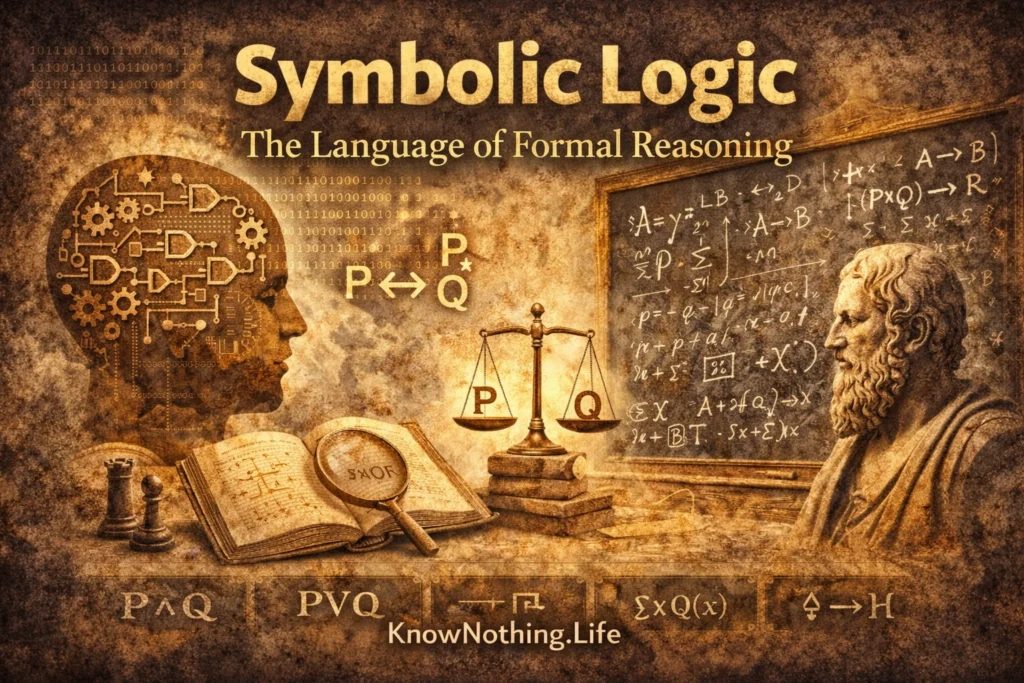
Symbolic logic is the study of reasoning through formal symbols and structured systems, transforming arguments into precise expressions that can be analyzed with mathematical rigor. Unlike ordinary language, which is often ambiguous and context-dependent, symbolic logic employs a carefully defined notation to represent propositions, relations, and inferences. This transformation allows reasoning to be examined with clarity, revealing patterns that might otherwise remain hidden.
The rise of symbolic logic in the 19th and early 20th centuries marked a turning point in the history of philosophy and mathematics. Pioneers such as Gottlob Frege, George Boole, and Bertrand Russell sought to replace the limitations of traditional logic with a formal system capable of expressing complex reasoning. Their work laid the foundation for modern logic, computer science, and the analytic tradition in philosophy. Symbolic logic thus represents not merely a technical innovation but a profound shift in how reasoning itself is understood.
The Origins of Symbolic Representation
The development of symbolic logic emerged from dissatisfaction with the constraints of classical logic, particularly the syllogistic framework inherited from Aristotle. While Aristotle’s system was powerful for its time, it struggled to represent more complex forms of reasoning, especially those involving multiple quantifiers and relations. The need for a more expressive system became increasingly apparent as mathematics and science advanced.
George Boole was among the first to address this need, introducing an algebraic approach to logic in The Laws of Thought. Boole demonstrated that logical operations could be treated mathematically, using symbols to represent truth values and logical relationships. He famously wrote, “The laws of thought are the laws of reason,” suggesting that reasoning itself could be captured through formal systems.
The true breakthrough came with Gottlob Frege, whose Begriffsschrift (1879) introduced a formal language capable of representing complex logical structures. Frege’s system went beyond Boolean algebra by incorporating quantifiers and functions, allowing for the precise expression of mathematical statements. His work established the foundation of modern symbolic logic, transforming it into a rigorous and systematic discipline.
Syntax, Semantics, and Formal Systems
Symbolic logic operates within formal systems defined by three key components: syntax, semantics, and rules of inference. Syntax specifies the symbols and the rules for combining them into well-formed expressions. Semantics assigns meaning to these expressions, determining their truth or falsity within a given interpretation. Rules of inference govern how new statements can be derived from existing ones.
This tripartite structure allows symbolic logic to function as a self-contained system of reasoning. By separating form from content, it ensures that arguments can be evaluated purely on the basis of their structure. This level of abstraction is one of the defining features of symbolic logic, enabling it to be applied across a wide range of domains.
Alfred Tarski made significant contributions to the semantic aspect of symbolic logic, developing a formal definition of truth. In his work on the semantic conception of truth, Tarski argued that truth should be defined in terms of satisfaction within a model. As he stated, “The concept of truth… is to be defined in terms of satisfaction,” providing a rigorous framework for understanding the relationship between language and reality.
Logical Notation and Expression
The hallmark of symbolic logic is its use of formal notation to represent logical relationships. Propositions are represented by symbols such as p and q, while logical connectives—such as ∧ (and), ∨ (or), ¬ (not), and → (if…then)—define how these propositions are combined. In predicate logic, additional symbols such as ∀ (for all) and ∃ (there exists) allow for the expression of generality and existence.
This notation provides a level of precision that is difficult to achieve in natural language. Ambiguities are eliminated, and complex arguments can be represented in a compact and systematic way. For example, the statement “All humans are mortal” can be expressed as ∀x (Human(x) → Mortal(x)), making its logical structure explicit.
Bertrand Russell and Alfred North Whitehead extended this approach in Principia Mathematica, where they attempted to derive all of mathematics from logical principles. Russell remarked, “Mathematics may be defined as the subject in which we never know what we are talking about,” highlighting the abstract nature of symbolic reasoning. Their work demonstrated the power of symbolic logic to unify diverse areas of knowledge under a common formal framework.
Proof, Derivation, and Logical Systems
Symbolic logic provides systematic methods for constructing proofs, ensuring that conclusions follow logically from premises. These methods include axiomatic systems, natural deduction, and sequent calculus, each offering a different approach to formal reasoning. Proofs in symbolic logic are sequences of statements, each justified by a rule of inference, leading from premises to conclusion.
The formalization of proof was a central goal of David Hilbert, who sought to establish a complete and consistent foundation for mathematics. Hilbert believed that all mathematical truths could be derived from a finite set of axioms using formal rules. He famously declared, “We must know—we will know,” expressing confidence in the power of formal systems.
However, this optimism was challenged by Kurt Gödel, whose incompleteness theorems demonstrated that no sufficiently powerful formal system can be both complete and consistent. Gödel showed that there are true statements that cannot be proven within a given system, revealing fundamental limits to symbolic logic. This result reshaped the philosophy of mathematics and highlighted the boundaries of formal reasoning.
Applications in Mathematics and Computer Science
Symbolic logic has had a profound impact on mathematics, providing the foundation for formal proof and the axiomatization of theories. Systems such as set theory and number theory are expressed within the framework of symbolic logic, enabling rigorous analysis and verification. The precision of symbolic notation ensures that mathematical arguments can be communicated and evaluated without ambiguity.
In computer science, symbolic logic plays a central role in the design of programming languages, algorithms, and verification systems. Boolean logic, derived from the work of George Boole, underpins digital circuits and computation. Logical systems are also used in artificial intelligence for knowledge representation and automated reasoning.
The influence of symbolic logic extends into fields such as linguistics, where it is used to analyze the structure of language and meaning. The formalization of language through logical systems allows for the precise modeling of semantic relationships, bridging the gap between language and logic. This interdisciplinary impact underscores the versatility and importance of symbolic logic in modern thought.
Philosophical Significance
Beyond its technical applications, symbolic logic has deep philosophical implications. It has shaped the analytic tradition in philosophy, emphasizing clarity, precision, and logical analysis. Philosophers such as Gottlob Frege and Bertrand Russell used symbolic logic to address fundamental questions about language, meaning, and knowledge.
Symbolic logic also raises important questions about the nature of truth and reasoning. By formalizing logic, it reveals both the power and the limitations of rational thought. The work of Kurt Gödel, in particular, showed that there are inherent limits to what can be achieved through formal systems, challenging the idea that all truths can be captured symbolically.
At the same time, symbolic logic provides a framework for understanding the structure of reasoning itself. It demonstrates that arguments can be analyzed and evaluated independently of their content, revealing universal patterns that underlie diverse forms of thought. This insight has had a lasting impact on philosophy, shaping how reasoning is studied and understood.
Conclusion
Symbolic logic stands as one of the most transformative developments in intellectual history, providing a precise and systematic language for reasoning. From the pioneering work of George Boole and Gottlob Frege to the profound insights of Kurt Gödel, it has reshaped our understanding of logic, mathematics, and philosophy.
By abstracting reasoning into symbolic form, symbolic logic reveals the underlying structure of arguments, enabling rigorous analysis and verification. Its applications span mathematics, computer science, linguistics, and beyond, demonstrating its versatility and enduring relevance.
Ultimately, symbolic logic is more than a technical tool; it is a lens through which we can better understand the nature of thought itself. It shows that reasoning can be made precise, systematic, and transparent—while also reminding us of the limits of formalization. In this balance between power and limitation lies the true significance of symbolic logic as a cornerstone of modern intellectual inquiry.