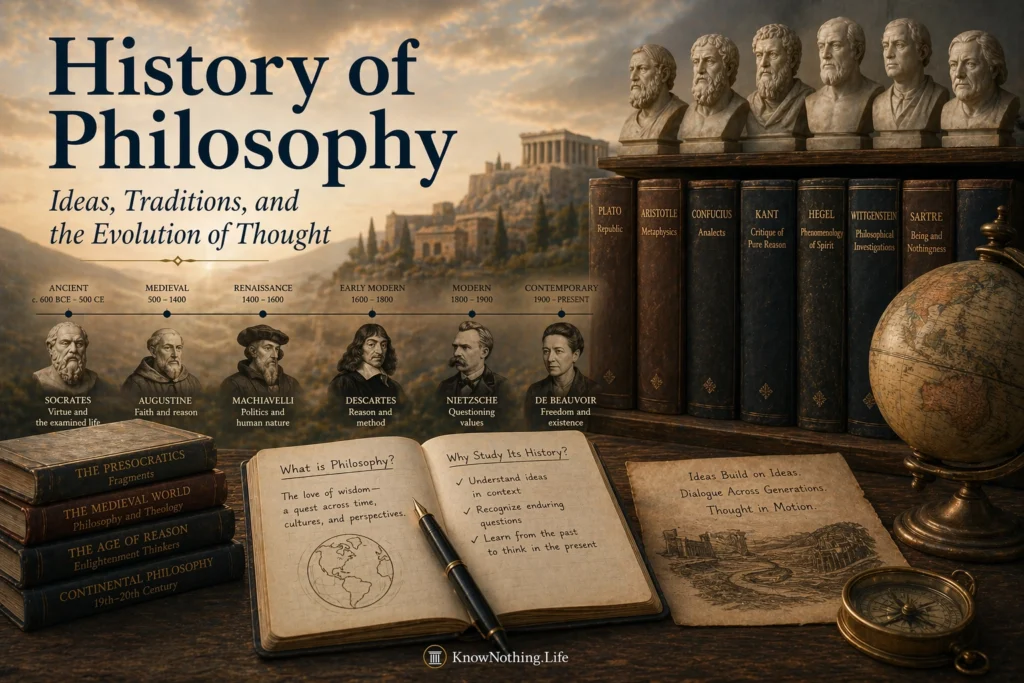
The history of philosophy is the story of humanity’s attempt to understand itself and the world through reasoned reflection. Across cultures and centuries, philosophers have asked enduring questions about reality, knowledge, morality, and meaning. While the specific answers have varied widely, the questions themselves reveal a continuous thread of inquiry that connects ancient thinkers with contemporary debates. The history of philosophy is not merely a chronological record of ideas; it is an evolving conversation shaped by context, conflict, and reinterpretation.
What makes the history of philosophy unique is its cumulative yet critical nature. Each generation inherits concepts and frameworks from the past but also challenges and refines them. Philosophical traditions develop through dialogue—sometimes cooperative, sometimes adversarial—where new ideas emerge in response to earlier ones. This dynamic process ensures that philosophy remains relevant, continually adapting to new intellectual and social conditions while preserving its core commitment to understanding fundamental aspects of existence.
Ancient Philosophy: Foundations of Thought
The origins of philosophy are often traced to ancient civilizations, where early thinkers began to move beyond mythological explanations toward rational inquiry. In ancient Greece, philosophers sought to understand the natural world, the nature of knowledge, and the principles of ethical life. Figures such as Socrates, Plato, and Aristotle laid the groundwork for Western philosophical traditions, each contributing distinct approaches to inquiry.
Socrates emphasized ethical questioning and self-examination, encouraging individuals to reflect critically on their beliefs. Plato developed a comprehensive philosophical system centered on the theory of forms, proposing that true knowledge involves understanding abstract and eternal realities. Aristotle, in turn, focused on empirical observation and logical classification, establishing foundations in fields ranging from metaphysics to ethics. Together, these thinkers shaped the trajectory of philosophical inquiry, influencing subsequent generations in profound ways.
Philosophical Traditions Beyond the West
While Greek philosophy is often highlighted, rich philosophical traditions also developed in other parts of the world. In ancient India, philosophical systems such as Vedanta and Buddhism explored questions of consciousness, suffering, and liberation. Thinkers like Siddhartha Gautama examined the nature of existence and proposed paths toward enlightenment, emphasizing introspection and ethical living.
In China, philosophers such as Confucius and Laozi developed systems that addressed social harmony, moral conduct, and the relationship between humanity and nature. Confucianism focused on ethical relationships and societal order, while Daoism emphasized balance, spontaneity, and alignment with the natural world. These traditions demonstrate that philosophical inquiry is a global phenomenon, shaped by diverse cultural contexts and perspectives.
Medieval Philosophy: Faith and Reason
The medieval period saw philosophy deeply intertwined with religious thought, as scholars sought to reconcile faith with reason. In the Islamic world, thinkers such as Avicenna and Averroes engaged with Greek philosophy, preserving and expanding upon its ideas while integrating them into Islamic theology.
In Christian Europe, philosophers like Thomas Aquinas developed scholasticism, a method that combined rigorous logical analysis with theological inquiry. Aquinas sought to demonstrate that faith and reason are compatible, using Aristotelian philosophy to support religious doctrine. This period illustrates how philosophical methods can be adapted to address questions of belief, authority, and the nature of divine reality.
The Renaissance and Early Modern Philosophy
The Renaissance marked a revival of classical learning and a renewed emphasis on human potential. This period saw the emergence of humanism, which focused on the study of classical texts and the value of individual experience. Philosophical inquiry began to shift toward questions of knowledge and scientific method, laying the groundwork for modern philosophy.
Early modern philosophers such as René Descartes, John Locke, and David Hume explored the nature of knowledge, perception, and certainty. Descartes emphasized rationalism, seeking indubitable foundations for knowledge, while Locke and Hume developed empiricism, focusing on experience as the source of understanding. These debates between rationalism and empiricism shaped the development of modern epistemology.
Enlightenment and the Idea of Progress
The Enlightenment was characterized by a belief in reason, progress, and the potential for human improvement. Philosophers sought to apply rational principles to social and political life, advocating for individual rights, scientific advancement, and secular governance. This period saw the development of new ideas about freedom, equality, and the organization of society.
Thinkers such as Immanuel Kant played a central role in synthesizing earlier debates, proposing that knowledge arises from the interaction between sensory experience and the structures of the mind. Kant’s work influenced subsequent developments in both metaphysics and ethics, shaping modern philosophical thought. The Enlightenment’s emphasis on reason and progress continues to influence contemporary discussions about science, politics, and human rights.
Nineteenth-Century Philosophy: Reaction and Transformation
The 19th century witnessed significant shifts in philosophical thought, as thinkers responded to the optimism of the Enlightenment and the social changes brought about by industrialization. G. W. F. Hegel developed a comprehensive system that emphasized the dialectical development of ideas and history, viewing reality as a dynamic process of change.
Other philosophers challenged and reinterpreted these ideas. Karl Marx applied dialectical thinking to material conditions, focusing on class conflict and economic structures as drivers of historical change. Friedrich Nietzsche critiqued traditional morality and emphasized the role of power, individuality, and perspective. These diverse approaches reflect the complexity of philosophical responses to modernity.
Twentieth-Century Philosophy: Divergence and Innovation
The 20th century saw the emergence of distinct philosophical traditions, particularly analytic and continental philosophy. Analytic philosophy, influenced by figures such as Bertrand Russell, focused on logical analysis, language, and clarity of argument. This approach emphasized precision and sought to resolve philosophical problems through rigorous examination of concepts.
Continental philosophy, on the other hand, explored themes such as existence, meaning, and culture. Thinkers like Martin Heidegger and Jean-Paul Sartre examined the nature of human existence, freedom, and authenticity. Later developments, including structuralism and postmodernism, further expanded the scope of philosophical inquiry, addressing issues of language, power, and interpretation.
Contemporary Philosophy: Global and Interdisciplinary
In the contemporary period, philosophy has become increasingly global and interdisciplinary. Philosophers engage with a wide range of fields, including science, technology, politics, and cultural studies, reflecting the complexity of modern life. The boundaries between philosophical traditions have become more fluid, with increased dialogue between analytic and continental approaches as well as between Western and non-Western philosophies.
Current debates address issues such as artificial intelligence, environmental ethics, and social justice, demonstrating the continued relevance of philosophical inquiry. The history of philosophy is not a closed chapter but an ongoing process, with new questions and perspectives continually reshaping the field. This dynamic evolution underscores the adaptability and enduring significance of philosophical thought.
Conclusion
The history of philosophy is a rich and complex narrative that reflects humanity’s enduring quest for understanding. From ancient foundations to contemporary debates, philosophical inquiry has evolved through dialogue, critique, and innovation. Each period contributes to a broader conversation, building upon and challenging the ideas that came before.
By studying the history of philosophy, we gain insight not only into past ideas but also into the methods and perspectives that shape our current understanding. This historical awareness encourages critical reflection and openness to new possibilities, ensuring that philosophy remains a vibrant and evolving discipline. Ultimately, the history of philosophy reveals the depth and diversity of human thought, highlighting the ongoing pursuit of meaning and truth.