Few thinkers have influenced human civilization as deeply and enduringly as Confucius. Living during a time of political fragmentation and social instability in ancient China, he developed a philosophical system centered on morality, social harmony, and ethical leadership. Unlike philosophers who sought to explain the cosmos in abstract terms, Confucius focused on how human beings should live—how they should act, govern, and relate to one another.
His teachings, later known as Confucianism, became the foundation of Chinese cultural, political, and educational systems for over two millennia. What distinguishes Confucius is not only the depth of his ideas but their practicality. He believed that a well-ordered society begins with virtuous individuals, and that ethical behavior is cultivated through discipline, education, and self-reflection. Through this approach, he transformed philosophy into a guide for everyday life and governance.
Early Life and Historical Context
Confucius was born in 551 BCE in the state of Lu, located in present-day Shandong Province during the Spring and Autumn Period. This era was marked by political instability, as regional states vied for power while the authority of the Zhou dynasty declined. Social order was deteriorating, and traditional values were increasingly ignored by rulers and officials.
Raised in modest circumstances after the early death of his father, Confucius experienced both hardship and opportunity. His mother ensured that he received an education, exposing him to classical texts, rituals, and history. From a young age, he demonstrated a deep interest in learning and a commitment to moral development. Unlike many of his contemporaries, he did not pursue knowledge for status alone, but for the purpose of self-cultivation and societal improvement.
As he matured, Confucius became increasingly concerned with the moral decay he observed around him. He believed that the chaos of his time was not merely political, but ethical. Leaders lacked virtue, and individuals had lost sight of their responsibilities. This conviction would drive his lifelong mission: to restore order through the cultivation of moral character and the revival of traditional values.
Career and Role as a Teacher
Confucius held various minor government positions during his life, including roles related to administration and justice. Although he aspired to implement his ideas on a larger scale, he struggled to find a ruler willing to fully embrace his philosophy. His time in official positions provided valuable insight into governance, but also reinforced his belief that ethical leadership was rare.
Unable to achieve lasting political influence, Confucius turned his attention to teaching. He established a school that attracted students from diverse backgrounds, emphasizing that education should be accessible to all who were willing to learn. This was a radical idea in a society where education was often reserved for the elite. Through his teaching, he sought to cultivate individuals who could embody and spread his principles.
His approach to education was deeply personal and interactive. Rather than delivering rigid doctrines, he engaged students in dialogue, encouraging them to think critically and reflect on their actions. Many of his teachings were preserved by his disciples in the Analects, a collection of sayings and conversations that provide insight into his philosophy and character.
Core Philosophy and Ethical Framework
At the heart of Confucius’s philosophy is the concept of ren, often translated as humaneness or benevolence. This principle represents the ideal moral disposition—compassion, empathy, and a genuine concern for others. For Confucius, ren is not an abstract virtue but a practical guide for behavior, shaping how individuals interact within families, communities, and society at large.
Closely related to ren is the concept of li, or ritual propriety. Li encompasses the customs, traditions, and social norms that structure human relationships. Confucius believed that these rituals, when practiced sincerely, cultivate discipline and reinforce ethical behavior. By adhering to li, individuals learn to act with respect and consideration, contributing to social harmony.
Another key principle is xiao, or filial piety—the respect and care for one’s parents and ancestors. Confucius viewed the family as the foundation of society, with moral development beginning in the home. By honoring familial relationships, individuals develop the qualities necessary for broader social responsibility. These interconnected concepts form a comprehensive ethical framework that emphasizes both personal virtue and collective order.
The Ideal of the Junzi
Central to Confucius’s teachings is the concept of the junzi, often translated as the “gentleman” or “superior person.” Unlike traditional notions of nobility based on birth, the junzi is defined by character and conduct. This ideal represents an individual who embodies virtue, wisdom, and integrity, serving as a model for others.
The junzi is characterized by self-discipline, humility, and a commitment to continuous improvement. Confucius emphasized that becoming such a person is not a matter of innate ability, but of deliberate effort. Through study, reflection, and ethical practice, anyone can aspire to this ideal. This perspective democratizes virtue, placing responsibility on the individual rather than on social status.
In contrast, Confucius described the xiaoren, or “small person,” as someone driven by selfish interests and immediate gratification. The distinction between these two types is not fixed but dynamic, reflecting the choices individuals make in their daily lives. By striving to become a junzi, individuals contribute to a more just and harmonious society.
Key Teachings and Quotes
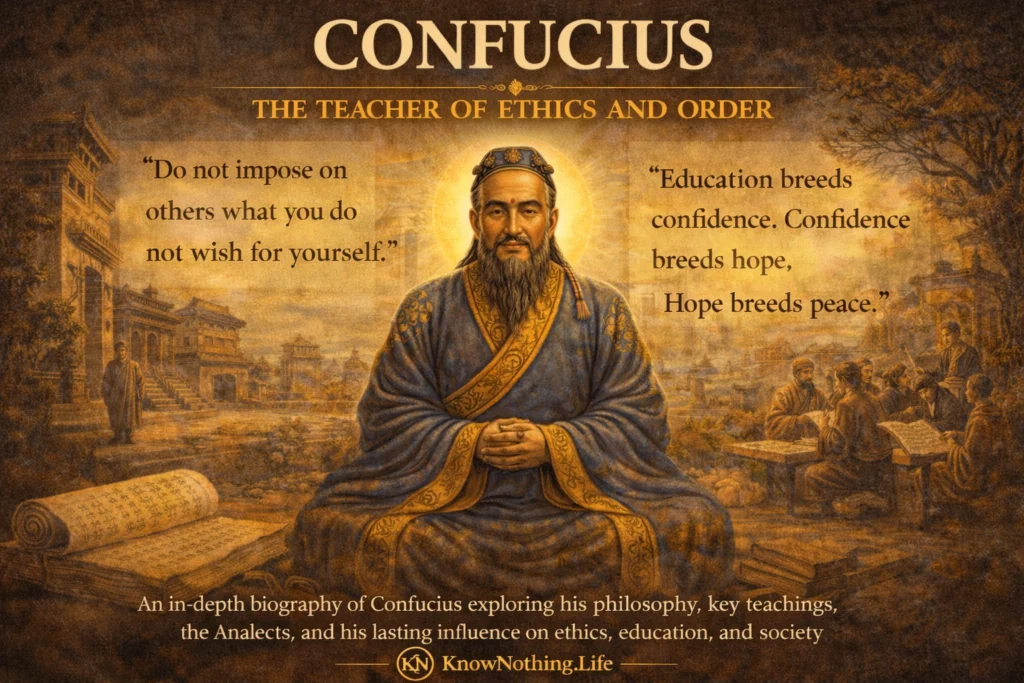
Confucius’s teachings are often conveyed through concise statements that capture the essence of his philosophy. One of his most well-known sayings is: “Do not impose on others what you do not wish for yourself.” This principle, sometimes referred to as the negative form of the Golden Rule, emphasizes empathy and mutual respect as the basis of ethical behavior.
Another significant teaching is: “The superior man is modest in his speech, but exceeds in his actions.” This reflects Confucius’s emphasis on integrity and the alignment of words and deeds. For him, true virtue is demonstrated through consistent behavior rather than grand declarations.
He also offered insight into the importance of education: “Education breeds confidence. Confidence breeds hope. Hope breeds peace.” This statement highlights his belief in the transformative power of learning, not only for individuals but for society as a whole. Through education, people develop the skills and values necessary to create a stable and prosperous community.
Influence on Chinese Society and Beyond
The impact of Confucius on Chinese civilization is unparalleled. His teachings became the foundation of the imperial examination system, which determined entry into government service for centuries. By emphasizing merit and education, this system helped shape a bureaucratic tradition that valued knowledge and ethical conduct.
Confucianism also influenced social structures, reinforcing the importance of family, hierarchy, and duty. These values became deeply embedded in Chinese culture, affecting everything from interpersonal relationships to political organization. Even during periods of change and modernization, Confucian principles continued to provide a moral framework.
Beyond China, Confucius’s ideas spread to other parts of East Asia, including Korea, Japan, and Vietnam. In each context, his teachings were adapted to local traditions, demonstrating their flexibility and enduring relevance. In modern times, his philosophy has gained global attention, offering insights into ethics, leadership, and social cohesion.
Legacy and Modern Relevance
The legacy of Confucius extends far beyond his historical context. His emphasis on ethical leadership, education, and social responsibility remains highly relevant in contemporary society. In a world often characterized by rapid change and moral uncertainty, his teachings provide a stable foundation for navigating complex challenges.
Modern interpretations of Confucian thought often focus on its applicability to leadership and governance. The idea that rulers should lead by example, cultivating virtue rather than relying solely on laws and punishment, continues to resonate in discussions of political ethics. This perspective challenges leaders to prioritize integrity and accountability.
On an individual level, Confucius’s teachings encourage self-reflection and personal growth. By emphasizing the importance of continuous improvement, he offers a pathway for individuals seeking to live meaningful and ethical lives. His philosophy reminds us that societal change begins with personal transformation.
Conclusion
Confucius’s life and teachings represent a profound commitment to ethical living and social harmony. Through his emphasis on virtue, education, and responsibility, he developed a philosophy that has shaped civilizations and continues to influence thought around the world. His insights into human behavior and relationships remain as relevant today as they were over two thousand years ago.
Rather than offering abstract theories, Confucius provided practical guidance for living with integrity and purpose. His vision of a harmonious society, built on the foundation of virtuous individuals, continues to inspire those seeking to understand and improve the human condition. In this enduring legacy, Confucius stands not only as a philosopher, but as a teacher whose lessons transcend time.