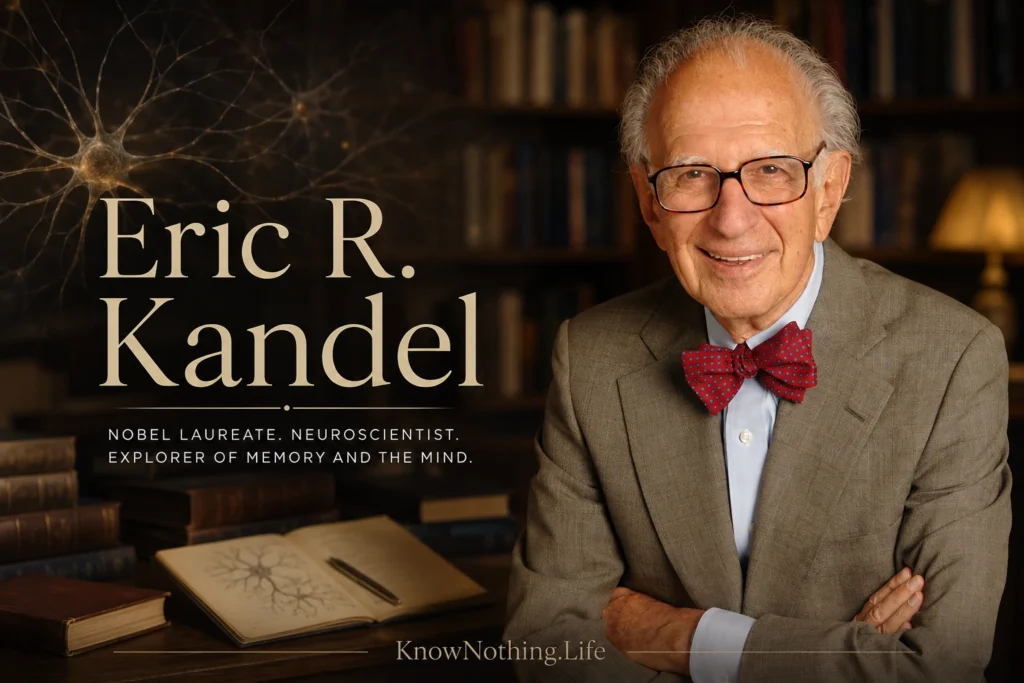
Eric R. Kandel is an Austrian-born American neuroscientist whose experiments helped reveal how learning changes nerve cells. By studying a defensive reflex in the marine snail Aplysia, he demonstrated that experience alters communication at particular synapses and that repetition can activate genes, stimulate protein synthesis, and support structural changes associated with long-term memory. This work helped unite psychology with cellular and molecular neuroscience and earned Kandel a share of the 2000 Nobel Prize in Physiology or Medicine.
Kandel’s career has also bridged disciplines commonly treated as separate. Trained initially for psychiatry and strongly influenced by psychoanalysis, he has explored how the biological brain produces memory, identity, emotion, creativity, and mental illness. His major works include Principles of Neural Science, In Search of Memory, The Age of Insight, Reductionism in Art and Brain Science, The Disordered Mind, There Is Life After the Nobel Prize, and Essays on Art and Science. Together, they present neuroscience as a meeting ground for biology, psychology, medicine, history, and art.
Childhood in Vienna and the Search for Mind
Eric Richard Kandel was born in Vienna on November 7, 1929, into a Jewish family that operated a toy store. His childhood was shattered after Nazi Germany annexed Austria in 1938. He witnessed antisemitic persecution, saw the family business taken from his parents, and watched familiar institutions become instruments of exclusion. In 1939, he and his older brother fled to the United States, followed later by their parents. The family settled in New York, while Kandel retained vivid memories of fear, humiliation, and displacement.
Those experiences contributed to the question that first drew him toward the study of mind: how could educated and apparently civilized people become capable of brutality? At Harvard College, he majored in history and literature and examined German intellectual responses to National Socialism. Psychoanalytic ideas then redirected him toward medicine. Kandel entered New York University School of Medicine intending to become an analyst, but he increasingly wanted to understand how memory and motivation were implemented in the brain. His search for unconscious meaning gradually became a search for biological mechanism.
From Psychoanalysis to Aplysia
During medical school, Kandel sought research experience with Columbia neurophysiologist Harry Grundfest. He later trained at the National Institutes of Health, where he learned cellular electrophysiology and recorded from neurons in the hippocampus, a region associated with memory. The mammalian brain, however, proved too complicated to reveal the basic sequence by which an experience becomes stored. That difficulty produced a defining methodological insight: a complex question may require a deliberately simple experimental system.
Kandel chose Aplysia californica, a marine mollusk with a relatively small nervous system and unusually large, identifiable neurons. Some colleagues considered the decision professionally risky because a sea slug appeared remote from human thought. Kandel saw experimental clarity. Its gill-withdrawal reflex could be modified through habituation, sensitization, and classical conditioning, allowing researchers to connect behavior with particular cells and synapses. Looking back on his original hippocampal experiments, he concluded, “You need something that is much simpler.” The simplicity of Aplysia made the cellular logic of learning visible.
Discovering How Synapses Store Experience
Kandel and his collaborators found that learning changes the effectiveness of existing synaptic connections. During habituation, repeated harmless stimulation weakens the sensory neuron’s effect on the motor circuit, reducing withdrawal. During sensitization, a strong stimulus activates modulatory neurons that release serotonin and strengthen communication. Classical conditioning combines timing and association, producing enhanced change when one stimulus predicts another. These studies demonstrated that elementary memories arise through plastic changes in specific neural pathways rather than being deposited in a single, isolated memory center.
The research also distinguished short-term from long-term memory. Short-term change can result from temporary modification of existing proteins through signaling involving cyclic AMP and protein kinase A. Repetition recruits the nucleus and activates transcription factors such as CREB, initiating gene expression and new protein synthesis. These processes help create or stabilize synaptic connections, allowing change to persist. Kandel observed that although anatomical connections develop according to a plan, their effectiveness “can be altered by experience.” Learning therefore leaves a physical trace using biological machinery conserved across evolution.
From Sea Slugs Back to Mammals
After establishing principles of implicit memory in Aplysia, Kandel returned to the mammalian hippocampus in the 1990s. Using genetically modified mice, his laboratory investigated long-term potentiation, a persistent strengthening of synaptic transmission studied as a cellular model of learning. The work indicated that pathways involving cyclic AMP, protein kinase A, CREB, and protein synthesis contribute not only to long-term facilitation in mollusks but also to spatial memory in mammals. Important molecular components of memory had been preserved across species with profoundly different brains and behaviors.
This continuity did not mean that remembering a person, place, or life event could be reduced completely to one molecule. Kandel’s reductionism was strategic: isolate a tractable component, establish its mechanism, and then reconnect it to higher levels of organization. His research moved from molecules and synapses to circuits, behavior, attention, and representations of space. Aplysia revealed conserved mechanisms of plasticity, while human autobiographical memory also requires language, emotion, culture, and conscious interpretation. His work supplied a biological foundation rather than a complete replacement for psychological explanation.
Columbia, the Nobel Prize, and Scientific Leadership
Kandel joined Columbia University in 1974 as the founding director of its Center for Neurobiology and Behavior. He later became a University Professor, senior investigator of the Howard Hughes Medical Institute, founding director of Columbia’s Kavli Institute for Brain Science, and founding codirector of the Zuckerman Institute. He also helped organize neuroscience education at Columbia and served as a principal editor of Principles of Neural Science, the influential textbook that integrated cellular biology, anatomy, cognition, and clinical neurology for generations of students.
In 2000, Kandel shared the Nobel Prize in Physiology or Medicine with Arvid Carlsson and Paul Greengard for discoveries concerning signal transduction in the nervous system. The Nobel committee emphasized his demonstration that phosphorylation and related signaling mechanisms participate in the formation of short- and long-term memory. The award recognized a research program linking learning to synaptic plasticity, intracellular messengers, gene regulation, and structural change. Kandel retired from Columbia in August 2022 and now holds multiple emeritus titles. Reflecting on his continuing motivation, he said, “When I have a new idea, it fills me with joy.”
Major Works, Art, and Lasting Influence
Kandel became one of neuroscience’s leading public interpreters. In Search of Memory combines autobiography with the history of brain science, connecting his childhood in Vienna to his investigation of remembering. The Disordered Mind uses conditions including depression, schizophrenia, addiction, dementia, and autism to show how disrupted systems can illuminate ordinary mental life. There Is Life After the Nobel Prize reflects on research, institutions, mentorship, and the opportunities created by recognition, while Essays on Art and Science continues his attempt to bring scientific and humanistic inquiry into conversation.
In The Age of Insight and Reductionism in Art and Brain Science, Kandel examines how artists and scientists simplify complex reality to reveal underlying structures. He connects Vienna around 1900, psychoanalysis, modernism, portraiture, abstract art, perception, emotion, and the “beholder’s share”—the viewer’s contribution to an artwork’s meaning. Biology cannot settle artistic interpretation, but it can enrich understanding of how perception and memory shape aesthetic experience. These books complete an intellectual circle: history led Kandel to psychoanalysis, psychoanalysis to neuroscience, and neuroscience back toward art and the human search for meaning.
Eric Kandel changed the study of memory by showing how a psychological process could be analyzed from behavior down to molecules without losing sight of the larger question. His experiments established that synapses are dynamic, that short- and long-term memory involve distinguishable mechanisms, and that lasting memory depends partly on gene expression and structural plasticity. His broader legacy is equally methodological: choose the simplest system capable of answering a difficult question, but eventually return the explanation to the complexity of the organism. By tracing experience into the synapse, Kandel helped explain how life changes the brain—and how those changes allow the past to remain active within the present.