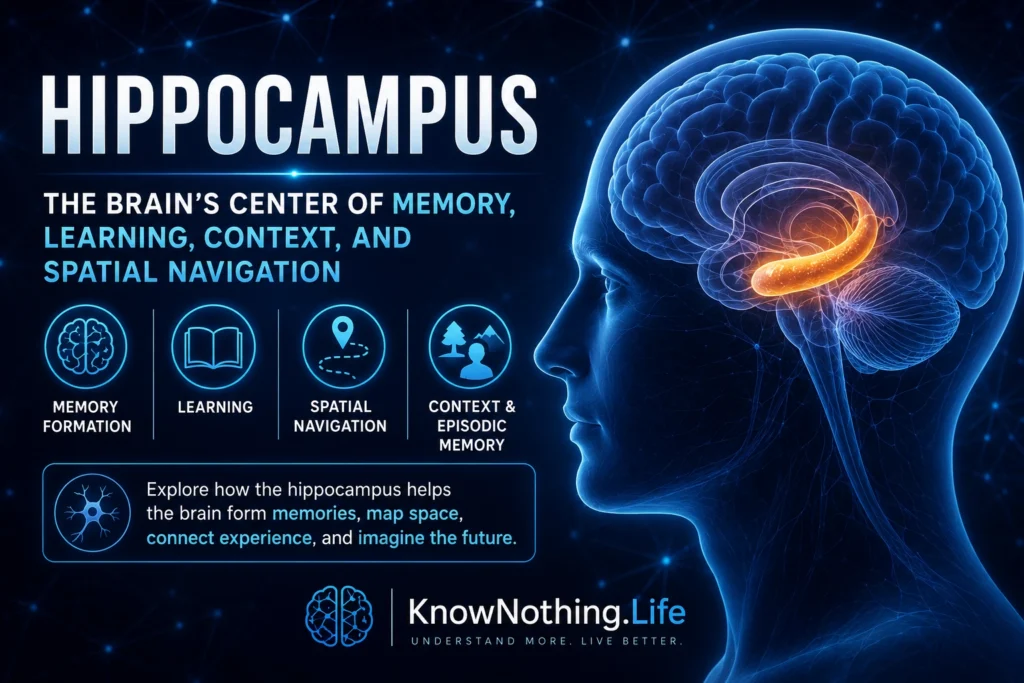
The hippocampus is a curved structure located deep within the medial temporal lobe, one on each side of the brain. Its name comes from the Greek word for “seahorse,” because early anatomists thought its shape resembled the small sea animal. The hippocampus is best known for its role in forming new memories, especially memories of facts, events, places, and personal experiences. It is also central to spatial navigation, context processing, learning, imagination, and the ability to connect separate details into a meaningful episode. A medical overview in StatPearls describes the hippocampus as a curved cortical sheet folded into the medial temporal lobe and closely associated with memory consolidation and decision-making.
The hippocampus is not a storage box where all memories are permanently kept. Instead, it helps bind together information from different parts of the brain so that an experience can become a memory. When someone remembers a birthday party, for example, the hippocampus helps link the place, people, sounds, emotions, sequence of events, and personal meaning into a retrievable episode. Over time, many memories become increasingly supported by broader cortical networks, but the hippocampus remains especially important for forming new declarative memories and for navigating both physical and mental spaces. It is one of the brain’s great organizers of experience.
Anatomy and Major Regions
The hippocampus is part of the medial temporal-lobe memory system and is closely connected with the entorhinal cortex, parahippocampal cortex, perirhinal cortex, amygdala, thalamus, hypothalamus, and prefrontal cortex. Its major internal regions include the dentate gyrus, CA3, CA2, CA1, and subiculum. These areas form a highly organized circuit that helps process incoming information, separate similar experiences, complete partial memories, and send processed signals back to the cortex. The entorhinal cortex acts as a major gateway between the hippocampus and widespread cortical regions, making it essential for memory and navigation.
The hippocampus also has a distinctive internal flow of information. Signals often enter through the entorhinal cortex, pass into the dentate gyrus, continue through CA3 and CA1, and then move toward the subiculum and back out to cortical and subcortical networks. This circuitry helps explain why the hippocampus is so effective at binding experience. It receives information from many sensory and association areas, compares new input with past patterns, and helps determine whether something is familiar, novel, important, or worth storing. The hippocampus works as a bridge between present experience and remembered life.
Memory Formation and Patient H.M.
The hippocampus became one of the most famous brain structures in neuroscience because of patient H.M., whose real name was Henry Molaison. In the 1950s, H.M. underwent surgery for severe epilepsy that removed parts of both medial temporal lobes, including hippocampal regions. After surgery, he could still hold a conversation and remember much of his earlier life, but he could not form many new long-term declarative memories. William Scoville and Brenda Milner’s landmark report showed that bilateral medial temporal-lobe damage could produce persistent impairment of recent memory, especially when removal extended far enough to damage the anterior hippocampus and hippocampal gyrus.
H.M.’s case transformed neuroscience because it showed that memory is not one single faculty spread evenly across the brain. Short-term memory, long-term declarative memory, procedural learning, and older autobiographical memory can be partly dissociated. Larry Squire later described H.M.’s legacy as foundational for modern memory research because it established memory as a distinct cerebral function and helped identify the medial temporal lobe as essential for forming new memories. The hippocampus does not contain the whole self, but it helps the self continue through time by allowing new experiences to become part of remembered identity.
Episodic Memory and Context
The hippocampus is especially important for episodic memory, the memory of personally experienced events. Episodic memory includes not only what happened, but where it happened, when it happened, and how different elements fit together. Remembering that one ate breakfast is different from remembering the taste of coffee, the morning light, the conversation at the table, and the feeling of being there. The hippocampus helps bind these separate details into a unified scene. This is why hippocampal damage can leave a person with knowledge and skills but impair the ability to form rich new autobiographical memories.
Context is one of the hippocampus’s deepest functions. The same object can mean different things in different settings. A loud bang at a fireworks show differs from a loud bang in an empty parking lot. A familiar face in a family home differs from the same face in an unexpected place. The hippocampus helps situate information within a larger setting, allowing the brain to understand not only isolated facts, but relations among people, places, objects, and events. This contextual function also helps explain the hippocampus’s role in fear learning, trauma, imagination, and future planning.
Spatial Navigation and Cognitive Maps
The hippocampus is central to spatial navigation. In 1971, John O’Keefe and Jonathan Dostrovsky published preliminary evidence that certain hippocampal neurons in freely moving rats fired in relation to specific places in the environment. These neurons became known as place cells, and they helped establish the idea that the hippocampus contributes to an internal map of space. O’Keefe’s work later became part of the scientific foundation for understanding the brain’s navigation system, alongside later discoveries of grid cells in the entorhinal cortex.
Spatial navigation is not limited to remembering streets or rooms. It is closely related to how the brain organizes relationships. The hippocampus helps map where things are in relation to one another, whether those things are physical locations, events in time, or ideas in memory. Eleanor Maguire’s well-known study of London taxi drivers found that the posterior hippocampi of taxi drivers were significantly larger relative to control subjects, suggesting that extensive navigation experience may be associated with structural differences in hippocampal anatomy. This research became influential because it showed how demanding real-world learning may relate to the brain’s capacity for adaptation.
Learning, Pattern Separation, and Pattern Completion
The hippocampus helps the brain learn by distinguishing similar experiences and retrieving incomplete ones. Pattern separation is the process of keeping similar memories distinct. For example, remembering where one parked today rather than yesterday requires the brain to separate overlapping experiences. The dentate gyrus and related hippocampal circuitry are often discussed in relation to this function. Without effective pattern separation, similar memories can blur together. This may contribute to confusion, false memory, or difficulty distinguishing one event from another.
Pattern completion is almost the opposite process. It allows a partial cue to bring back a larger memory. A smell may evoke a childhood kitchen, a song may bring back a summer, or a street corner may trigger the memory of a conversation. The hippocampus helps reconstruct the whole from the part. This is one reason memory is not like replaying a video. It is reconstructive. The hippocampus helps assemble stored fragments into a coherent experience, but that process can be influenced by emotion, expectation, attention, and later knowledge. Memory is powerful because it is flexible, but that flexibility also makes it imperfect.
Emotion, Stress, and the Amygdala
The hippocampus works closely with the amygdala, a neighboring medial temporal-lobe structure involved in emotional salience and threat learning. The amygdala helps mark events as emotionally important, while the hippocampus helps encode the context in which those events occurred. This partnership helps explain why emotionally charged memories can be so vivid. A frightening experience is not only remembered as fear; it is remembered as happening in a specific place, with particular sights, sounds, and circumstances. The hippocampus helps provide that contextual frame.
Stress can strongly affect hippocampal function. Short-term arousal may strengthen memory for important events, but chronic stress and prolonged exposure to stress hormones can impair hippocampal plasticity and memory function. This is one reason the hippocampus is frequently discussed in relation to trauma, depression, anxiety, aging, and neurodegenerative disease. The hippocampus is highly plastic, meaning it can change with experience, but it is also vulnerable. Its health depends on sleep, stress regulation, exercise, learning, and broader brain-body conditions.
The Hippocampus and Future Imagination
The hippocampus is not only about the past. It also contributes to imagining the future. To picture a possible future event, the brain often recombines pieces of past experience: places, people, emotions, goals, and likely outcomes. The hippocampus helps construct these imagined scenes. This ability connects memory with planning. A person can avoid danger, make decisions, and pursue goals partly because the brain can simulate what might happen next. The hippocampus supports this mental time travel by helping organize scenes that are not currently present.
This function shows why memory is not simply a record of what has happened. Memory gives the brain material for prediction. Remembering where one has been helps guide where one might go. Remembering past mistakes helps prepare for future choices. Remembering social experiences helps anticipate other people’s reactions. The hippocampus therefore helps connect past, present, and future into a continuous mental landscape. It gives experience a temporal and spatial structure.
Clinical Importance of the Hippocampus
Hippocampal dysfunction can affect memory, orientation, learning, emotional regulation, and navigation. Damage may result from epilepsy, stroke, traumatic brain injury, oxygen deprivation, infections, tumors, chronic stress, or neurodegenerative diseases. The hippocampus is one of the early brain regions affected in Alzheimer’s disease, which helps explain why new memory formation and spatial orientation are often among the earliest symptoms. Hippocampal sclerosis is also strongly associated with temporal-lobe epilepsy, where abnormal activity in medial temporal structures can produce seizures, memory symptoms, and emotional experiences.
Clinically, the hippocampus matters because memory is central to daily identity. Forgetting appointments is one issue; losing the ability to form new personal memories is far deeper. The hippocampus allows life to accumulate. It lets a person learn from yesterday, recognize familiar places, remember relationships, and update the story of who they are. When hippocampal function is impaired, intelligence may remain, language may remain, and personality may partly remain, yet the continuity of lived experience can be disrupted.
Why the Hippocampus Matters
The hippocampus matters because it helps turn experience into memory and memory into meaning. It allows the brain to bind details into events, place events in context, map environments, distinguish similar experiences, and imagine possible futures. It is essential not because it stores every memory forever, but because it helps create the structure through which new experiences can become part of a person’s life.
The hippocampus also reveals that memory is active, embodied, and constructive. Remembering is not simply retrieving a file. It is rebuilding a scene from distributed traces, guided by context, emotion, attention, and expectation. The hippocampus helps make that reconstruction possible. To understand the hippocampus is to understand one of the brain’s most important bridges between place and memory, past and future, experience and identity.