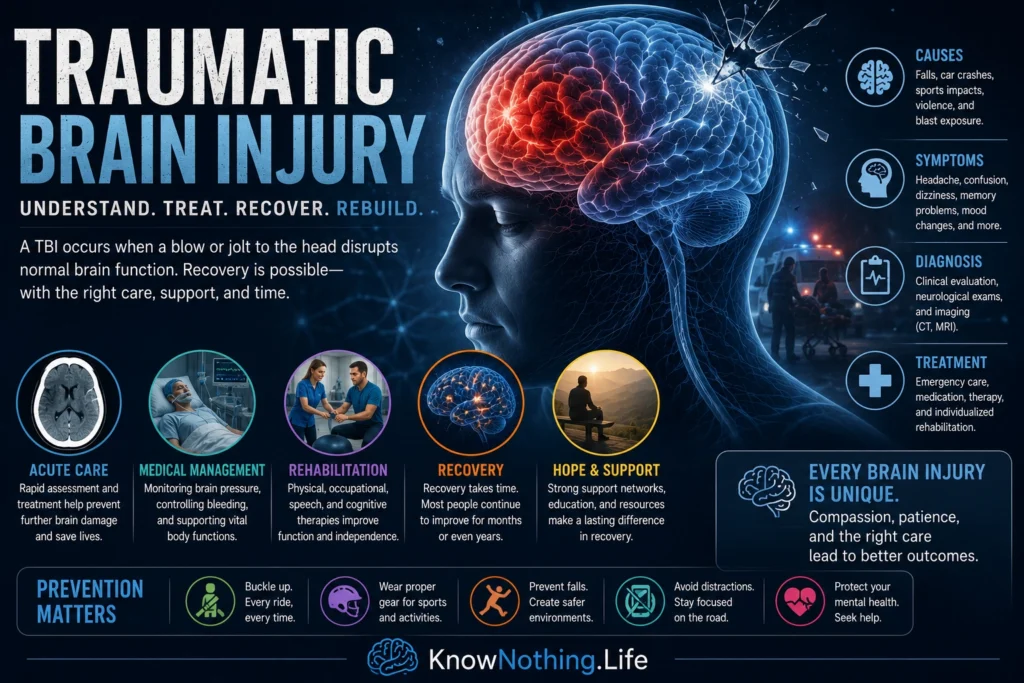
Traumatic brain injury, commonly called TBI, occurs when an external mechanical force disrupts normal brain function. It may result from a fall, vehicle collision, sports impact, assault, blast exposure, or penetrating wound. A concussion is a form of mild TBI, but the word “mild” describes the initial clinical classification rather than guaranteeing a minor experience. Some people recover within days or weeks, whereas others develop persistent headaches, dizziness, fatigue, sleep disturbance, emotional changes, or problems with concentration and memory. Moderate and severe injuries can produce prolonged unconsciousness, permanent disability, or death.
Clinicians commonly describe severity using the Glasgow Coma Scale, duration of unconsciousness, length of post-traumatic amnesia, and findings on brain imaging. These measures are useful but incomplete. A person can have a normal computed tomography scan and still experience significant post-concussive symptoms, while another patient with visible bleeding may recover better than initially expected. The prospective CENTER-TBI project demonstrated wide variation in the causes, treatment pathways, and outcomes of patients receiving hospital care. TBI is therefore not one uniform disease but a collection of injuries differing in mechanism, location, complications, psychological effects, and recovery trajectory.
Primary Injury and Secondary Damage
The primary injury occurs at the moment of impact. Direct contact can bruise brain tissue, tear blood vessels, fracture the skull, or produce epidural, subdural, subarachnoid, or intracerebral bleeding. Rapid acceleration, deceleration, and rotation can also stretch axons connecting distant brain regions. In their influential 1982 analysis of 45 human cases, J. H. Adams and colleagues described diffuse axonal injury as widespread damage to white-matter pathways after non-missile head trauma. Related experimental work by Thomas Gennarelli and colleagues linked the severity of diffuse axonal injury and coma to rotational head motion.
Damage continues after impact through a secondary cascade involving altered blood flow, inflammation, excitotoxic signaling, mitochondrial dysfunction, swelling, and disruption of the blood-brain barrier. Bleeding or edema can raise pressure within the skull, compress vessels, reduce cerebral perfusion, and injure additional tissue. Fever, seizures, low oxygen, low blood pressure, and metabolic disturbances can intensify this process. Acute neurocritical care cannot reverse the original event; its purpose is to prevent avoidable secondary injury by maintaining oxygenation and circulation, controlling dangerous pressure, treating expanding hematomas, and correcting systemic complications before vulnerable tissue is lost.
Symptoms and Diagnosis
Symptoms depend on the structures affected and the severity of injury. Mild TBI may cause headache, nausea, light or noise sensitivity, dizziness, blurred vision, slowed thinking, forgetfulness, irritability, anxiety, or altered sleep. More serious warning signs include worsening headache, repeated vomiting, unequal pupils, seizures, weakness, slurred speech, increasing confusion, unusual agitation, or difficulty waking. Loss of consciousness is not required for a concussion, and symptoms may become more noticeable hours after the event. Older adults, young children, and people taking anticoagulant medication may require especially careful assessment following a head injury.
Emergency evaluation combines the injury history, neurological examination, Glasgow Coma Scale, and imaging when indicated. Computed tomography is the standard rapid test for detecting acute bleeding, fractures, swelling, and mass effect, while magnetic resonance imaging may reveal smaller contusions or white-matter abnormalities that are less visible on CT. A normal scan does not prove that the brain is unaffected, and imaging does not function as a universal concussion test. Diagnosis must also distinguish TBI from intoxication, stroke, seizure, medication effects, and other causes of altered behavior or consciousness. Follow-up evaluation becomes particularly important when symptoms persist or interfere with work, education, driving, or ordinary daily tasks.
Acute Treatment and Major Clinical Trials
Treatment depends on anatomy and severity. A patient with mild TBI may need observation, symptom management, and a gradual return to activity, while severe injury can require airway support, ventilation, intensive monitoring, neurosurgery, and prolonged critical care. Intracranial-pressure monitoring is used in selected severe cases, although the BEST randomized trial found that a protocol focused on maintaining monitored pressure at 20 millimeters of mercury or lower was not superior to structured treatment based on imaging and clinical examination in the settings studied. The finding did not prove that intracranial pressure is unimportant; it demonstrated that monitoring is only as useful as the clinical decisions built around the information.
Major trials have also identified treatments that can cause harm or involve difficult tradeoffs. The MRC CRASH trial found that corticosteroid treatment following significant head injury increased mortality and unfavorable outcomes, overturning a therapy once considered potentially protective. Decompressive craniectomy can lower refractory pressure and save lives, but it does not guarantee meaningful neurological recovery. The DECRA trial found worse functional outcomes with early bifrontal decompression under its treatment criteria, while RESCUEicp found lower mortality when surgery was used as a last-tier intervention for sustained intracranial hypertension. That survival benefit included more patients living with both dependent and independent disability, making informed discussions about acceptable outcomes essential.
Recovery and Rehabilitation
Recovery is influenced by injury severity, age, prior neurological and psychiatric health, medical complications, family support, rehabilitation access, and the demands of work or school. Rest can be useful during the earliest period after concussion, but prolonged complete inactivity may worsen sleep, mood, physical conditioning, and symptom sensitivity. Current care generally favors a gradual, symptom-guided return to cognitive and physical activity following a brief period of relative rest. Persistent problems may require vestibular therapy, headache or sleep treatment, psychological care, vision assessment, or structured support for returning to education and employment.
Contemporary research challenges the assumption that every mild injury resolves rapidly. A TRACK-TBI study found that many patients treated at level I trauma centers reported continuing injury-related difficulties one year after mild TBI. Another analysis found poor one-year cognitive outcomes in 13.5 percent of participants with mild TBI, compared with 4.5 percent of uninjured controls. At the same time, long-term impairment is not inevitable. TRACK-TBI research on moderate and severe injury documented substantial functional improvement over the first year, including among some patients who initially appeared unlikely to regain independence. Prognosis should therefore be realistic but repeatedly reassessed rather than treated as fixed during the first days after injury.
Long-Term Effects and Life After TBI
Rehabilitation helps people regain function, learn compensatory strategies, and participate meaningfully in daily life. Physical therapy may address mobility, balance, strength, and endurance; occupational therapy supports daily tasks and environmental adaptations; speech-language therapy treats communication, cognition, and swallowing; and neuropsychological care evaluates memory, attention, executive function, mood, and behavior. A randomized trial of holistic neuropsychological rehabilitation found improvements in community functioning and quality of life, while other research suggests that coordinated rehabilitation may remain beneficial even when introduced years after severe injury.
Long-term concerns can include post-traumatic epilepsy, chronic pain, hormonal dysfunction, sleep disorders, depression, anxiety, impulsivity, substance misuse, and later cognitive decline. Some difficulties become apparent only after a patient returns to an environment requiring multitasking, emotional control, rapid decision-making, or sustained concentration. Recovery can continue for years, and changes in employment, relationships, identity, and independence may require as much attention as visible neurological impairments. Effective care must therefore consider the person’s emotional health, family situation, living environment, financial pressures, and access to community support.
Repetitive Head Impacts, Prevention, and Future Care
Repetitive head impacts have received particular attention because chronic traumatic encephalopathy, or CTE, has been identified in postmortem brain tissue from some former contact-sport athletes and military veterans. A 2017 study led by Jesse Mez reported CTE pathology in a high proportion of donated brains from former American football players, but the study used a highly selected brain-donation sample and could not establish how common CTE is among all athletes. CTE currently requires neuropathological confirmation after death, and symptoms such as memory loss, depression, aggression, or irritability are not specific enough to prove that the disease is present during life.
Prevention remains fundamental through fall reduction, seat-belt and child-restraint use, safe driving, protective equipment, workplace practices, violence prevention, and cautious return-to-play decisions. Helmets can reduce the risk of certain serious head injuries, but they cannot make the brain immune to concussion because rapid movement can still occur within the skull. Future care will increasingly use advanced imaging, blood biomarkers, physiological monitoring, and individual recovery patterns to classify injuries more precisely. No medication can yet reverse the full biological cascade of TBI, so the strongest current strategy remains rapid recognition, prevention of secondary damage, individualized rehabilitation, and sustained follow-up that treats the injured person rather than only the scan.