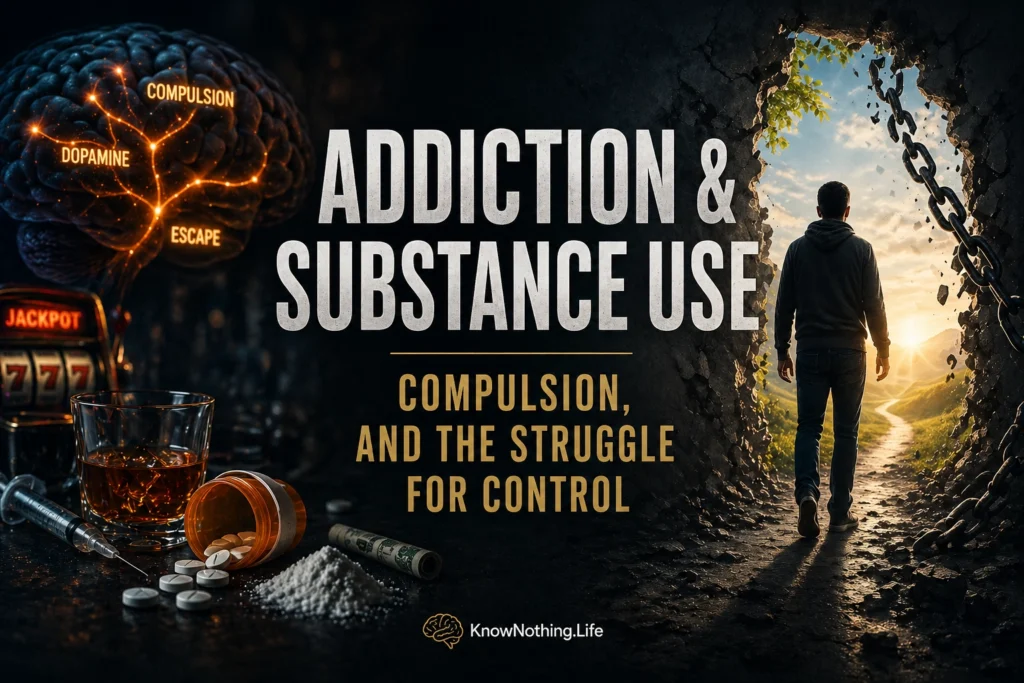
Addiction is one of the most complex and contested phenomena in psychology and psychiatry. It involves a pattern of compulsive engagement with substances—such as alcohol, opioids, or stimulants—despite harmful consequences. While often framed as a failure of willpower or moral character, contemporary research has increasingly emphasized its biological, psychological, and social dimensions. Addiction reveals a fundamental tension within human behavior: the capacity for choice alongside the experience of compulsion.
The modern clinical understanding of addiction has evolved from earlier moral and criminal models to a medical and psychological framework. Psychiatrist George E. Vaillant, in The Natural History of Alcoholism, described addiction as a chronic condition shaped by both vulnerability and environment, noting that “addiction is not a disgrace, it is an illness.” This shift in perspective has had profound implications for treatment and public policy, reframing substance use disorders as conditions requiring care rather than punishment.
Defining Addiction and Substance Use Disorders
Substance use exists along a continuum, ranging from casual or controlled use to problematic patterns that meet the criteria for a substance use disorder. The Diagnostic and Statistical Manual of Mental Disorders defines these disorders based on patterns of impaired control, social impairment, risky use, and physiological dependence. Importantly, addiction is not limited to physical dependence; individuals may continue using substances even in the absence of withdrawal symptoms, driven by psychological and behavioral factors.
Central to addiction is the concept of loss of control. Individuals often describe an inability to regulate their use, despite intentions to cut down or stop. This paradox—wanting to quit while continuing to use—has been a focal point of both clinical and philosophical inquiry. Psychologist Gene M. Heyman, in Addiction: A Disorder of Choice, argues that addictive behavior reflects patterns of decision-making rather than complete loss of agency, challenging the idea that addiction eliminates free will entirely.
Craving is another defining feature, characterized by intense desire or urge to use a substance. Cravings can be triggered by environmental cues, emotional states, or physiological changes, making relapse a persistent risk. These features highlight that addiction is not simply about the substance itself but about the interaction between the substance, the individual, and their environment.
Neurobiology of Addiction
The neurobiology of addiction centers on the brain’s reward system, particularly pathways involving dopamine. Substances of abuse increase dopamine release in regions such as the nucleus accumbens, reinforcing behaviors associated with pleasure and reward. Over time, repeated exposure alters the sensitivity of this system, leading to tolerance—where greater amounts of the substance are required to achieve the same effect—and diminished response to natural rewards.
Neuroscientist Nora D. Volkow has been instrumental in advancing the understanding of addiction as a brain disorder. Her research demonstrates that chronic substance use can impair the prefrontal cortex, the region responsible for decision-making, impulse control, and self-regulation. This impairment contributes to the compulsive nature of addiction, as individuals become less able to evaluate consequences and resist urges.
At the same time, the stress and memory systems of the brain are also involved. The amygdala and hippocampus encode associations between substances and environmental cues, creating powerful conditioned responses. These associations can persist long after cessation of use, contributing to relapse. As Volkow has noted, “Addiction is a disease of the brain, but it is also a disease of behavior,” emphasizing the interplay between neural changes and lived experience.
Psychological and Behavioral Dimensions
Beyond its biological basis, addiction is deeply embedded in psychological processes. Substances are often used as coping mechanisms for managing stress, trauma, or emotional pain. This self-medication hypothesis suggests that individuals may turn to substances to regulate internal states, even when doing so creates additional problems.
Psychiatrist Edward J. Khantzian developed this perspective in his work on addiction, arguing that different substances may be chosen for their specific psychological effects. For example, stimulants may be used to counteract depression or fatigue, while depressants may be used to reduce anxiety. Khantzian wrote that “the choice of drug is not random,” highlighting the functional role substances can play in an individual’s life.
Learning and habit formation also contribute to addiction. Behavioral reinforcement, both positive (pleasure) and negative (relief from discomfort), strengthens substance use over time. As habits become more ingrained, they may operate automatically, with little conscious deliberation. This shift from voluntary to habitual behavior underscores the difficulty of breaking addictive patterns, as it involves not only changing decisions but restructuring deeply embedded routines.
Social and Environmental Influences
Addiction cannot be fully understood without considering the social and environmental contexts in which it occurs. Factors such as poverty, social isolation, trauma, and availability of substances all influence the likelihood of developing a substance use disorder. Cultural norms and peer influences also shape patterns of use, determining what is considered acceptable or risky behavior.
Psychologist Bruce K. Alexander, in his “Rat Park” experiments, demonstrated that environmental conditions play a significant role in addiction. Rats housed in enriched environments with social interaction showed far less interest in drug-laced water compared to isolated rats, suggesting that addiction is not solely a pharmacological phenomenon but also a response to context. Alexander later argued that addiction reflects a form of “dislocation,” a lack of meaningful connection within society.
Stigma remains a major barrier to treatment and recovery. Individuals with substance use disorders are often judged harshly, reinforcing shame and discouraging help-seeking. This stigma can be compounded by legal and policy frameworks that prioritize punishment over treatment, particularly in the context of illicit drug use. Addressing addiction therefore requires not only clinical interventions but also broader social change.
Treatment and Recovery
Treatment for addiction is multifaceted, reflecting the complexity of the condition. Pharmacological interventions, such as methadone or buprenorphine for opioid use disorder, help manage withdrawal and reduce cravings. Medications like naltrexone can block the rewarding effects of substances, supporting abstinence. These approaches are often combined with psychosocial treatments to address behavioral and emotional factors.
Psychotherapy plays a central role in treatment, with approaches such as cognitive-behavioral therapy (CBT), motivational interviewing (MI), and contingency management demonstrating effectiveness. Motivational interviewing, developed by William R. Miller, focuses on resolving ambivalence and enhancing intrinsic motivation for change. Miller emphasized that “people are better persuaded by the reasons which they have themselves discovered,” highlighting the importance of autonomy in the recovery process.
Recovery is increasingly understood as a long-term and nonlinear process. Relapse is common and does not necessarily indicate failure but rather reflects the chronic nature of addiction. Support systems, including peer groups such as Alcoholics Anonymous, provide ongoing community and accountability. The recovery model emphasizes not only abstinence but also the development of a meaningful and fulfilling life beyond substance use.
Philosophical and Ethical Perspectives
Addiction raises profound philosophical questions about free will, responsibility, and the nature of desire. If behavior is driven by altered brain states and conditioned responses, to what extent can individuals be held accountable for their actions? At the same time, recognizing agency is essential for recovery, as change requires some degree of choice and commitment.
Philosopher Herbert Fingarette, in Heavy Drinking, challenged the disease model of alcoholism, arguing that addiction involves patterns of behavior that can be understood within the framework of ordinary human action. This perspective contrasts with medical models that emphasize loss of control, highlighting the tension between viewing addiction as a disease and as a form of behavior.
These debates have practical implications for policy and treatment. Approaches that emphasize punishment may reinforce stigma and discourage recovery, while those that focus exclusively on biology may overlook the importance of personal meaning and social context. A balanced perspective recognizes both the constraints imposed by addiction and the capacity for change, acknowledging the complexity of human behavior.
Conclusion
Addiction and substance use disorders represent a convergence of biological vulnerability, psychological need, and social context. They challenge simplistic explanations, revealing how deeply intertwined choice and compulsion can be. Understanding addiction requires moving beyond moral judgment to a nuanced appreciation of the factors that sustain it and the processes that enable recovery.
As research continues to evolve, so too does the approach to treatment, integrating neuroscience, psychology, and social intervention. Ultimately, addressing addiction involves not only reducing harm but also fostering connection, meaning, and resilience. In doing so, it offers insight into the broader human struggle to navigate desire, control, and the pursuit of well-being.