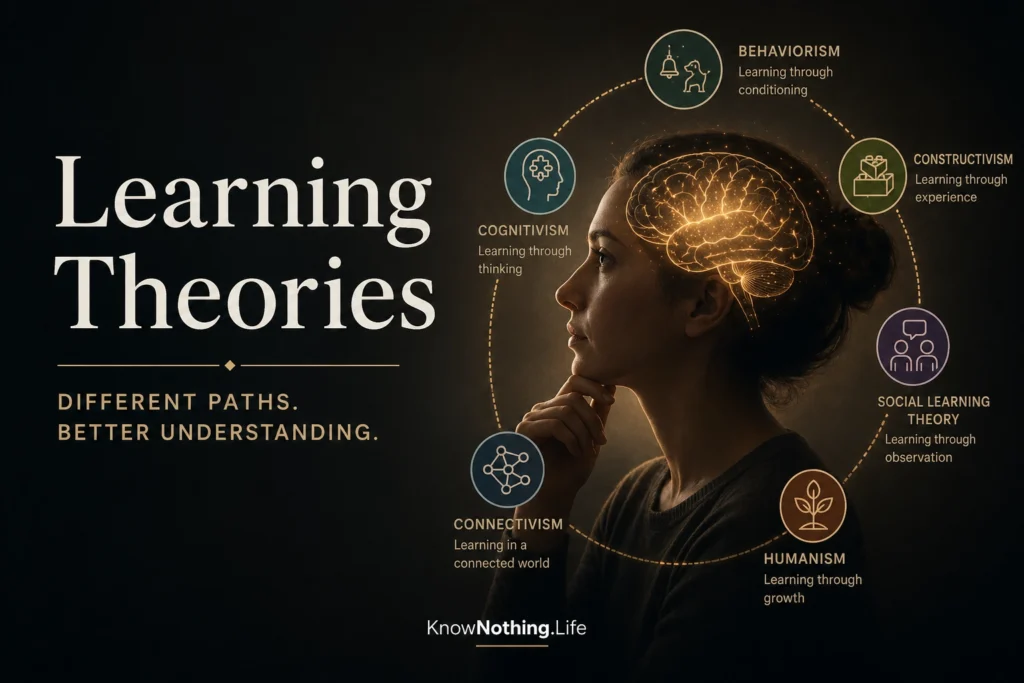
Learning theories are systematic frameworks that explain how knowledge is acquired, processed, and retained. They provide the intellectual foundation for education, training, and human development by offering models of how individuals change through experience. From early behaviorist accounts of stimulus-response associations to contemporary perspectives emphasizing cognition, social interaction, and context, learning theories reflect evolving understandings of the human mind. Their significance lies not only in theoretical explanation but in practical application, shaping how educators design instruction and how learners engage with knowledge.
The study of learning has always been central to psychology, but it gained particular momentum in the late 19th and early 20th centuries as researchers sought to apply scientific methods to human behavior. Early theorists attempted to reduce learning to observable processes, while later scholars emphasized internal mental activity and social context. As psychologist Jerome Bruner observed, “Knowing is a process, not a product,” highlighting that learning is dynamic and ongoing rather than a static accumulation of facts. This shift toward process-oriented thinking has defined the development of modern learning theories.
Behaviorism and Associative Learning
Behaviorism represents one of the earliest and most influential approaches to learning, focusing on observable behavior rather than internal mental states. The core assumption of behaviorism is that learning occurs through interactions with the environment, particularly through associations between stimuli and responses. This perspective was shaped by the work of Ivan Pavlov, whose experiments on classical conditioning demonstrated that organisms can learn to associate neutral stimuli with significant events. Pavlov famously showed that dogs could be conditioned to salivate at the sound of a bell, illustrating how learning can occur through repeated pairings.
Building on these findings, B. F. Skinner developed the theory of operant conditioning, which emphasizes the role of reinforcement and punishment in shaping behavior. In Science and Human Behavior, Skinner argued that “behavior is a function of its consequences,” suggesting that actions followed by rewards are more likely to be repeated, while those followed by negative outcomes are less likely. Behaviorist principles have been widely applied in education, particularly in the use of reinforcement, practice, and feedback. However, critics have argued that behaviorism oversimplifies learning by neglecting the role of cognition and internal processes.
Cognitivism and Information Processing
Cognitivism emerged as a response to the limitations of behaviorism, shifting the focus from external behavior to internal mental processes. This perspective views learning as the acquisition and organization of knowledge within the mind, emphasizing processes such as attention, memory, and problem-solving. Cognitive theorists argue that learners are not passive recipients of information but active processors who interpret and organize experiences.
The work of Jean Piaget was central to the development of cognitivism. Piaget proposed that children construct knowledge through stages of cognitive development, using processes of assimilation and accommodation to adapt to new information. He famously stated, “To understand is to invent,” emphasizing that learning involves active construction rather than mere absorption. Similarly, George A. Miller’s research on memory highlighted the limitations of working memory, influencing instructional design and the presentation of information. Cognitivism has had a profound impact on education, leading to strategies that emphasize organization, scaffolding, and meaningful learning.
Constructivism and Active Learning
Constructivism builds on cognitive theories by emphasizing that knowledge is constructed through interaction with the environment and social context. Rather than viewing learning as the transmission of information, constructivists argue that learners actively create meaning based on their experiences and prior knowledge. This perspective has influenced modern educational practices, particularly those that emphasize inquiry, exploration, and collaboration.
Lev Vygotsky played a key role in the development of constructivist theory, particularly through his concept of the zone of proximal development (ZPD). Vygotsky argued that learning occurs most effectively when individuals are supported in tasks that are just beyond their current abilities. He wrote, “What a child can do with assistance today, she will be able to do by herself tomorrow,” highlighting the importance of guided learning. Constructivism has led to teaching approaches that prioritize student engagement, problem-solving, and the integration of knowledge across contexts.
Social Learning Theory
Social learning theory expands the understanding of learning by incorporating observation, imitation, and modeling. It suggests that individuals can learn not only through direct experience but also by observing others. This perspective bridges behaviorist and cognitive approaches, recognizing both external influences and internal processes.
The most prominent figure in this area is Albert Bandura, whose experiments demonstrated that children could learn aggressive behaviors by observing adults. Bandura introduced the concept of observational learning, as well as the idea of self-efficacy—the belief in one’s ability to succeed. In Social Learning Theory, he stated, “Learning would be exceedingly laborious… if people had to rely solely on the effects of their own actions,” emphasizing the efficiency of learning through observation. Social learning theory has been widely applied in education, media studies, and organizational behavior, highlighting the role of social context in shaping behavior.
Humanistic and Experiential Learning
Humanistic learning theories emphasize personal growth, self-actualization, and the intrinsic motivation to learn. Unlike behaviorist and cognitive approaches, which focus on mechanisms of learning, humanistic theories prioritize the learner’s subjective experience and emotional well-being. This perspective views education as a means of fostering autonomy, creativity, and self-expression.
Carl Rogers, a central figure in humanistic psychology, argued that “the only person who is educated is the one who has learned how to learn and change.” Rogers emphasized the importance of a supportive learning environment in which individuals feel safe to explore and take risks. Similarly, experiential learning theory, developed by David Kolb, highlights the role of experience in learning. Kolb’s model describes a cycle of concrete experience, reflective observation, abstract conceptualization, and active experimentation. These approaches underscore the importance of engagement and personal relevance in the learning process.
Connectivism and Digital Learning
In the digital age, new learning theories have emerged to address the impact of technology on knowledge acquisition. Connectivism, proposed by George Siemens and Stephen Downes, suggests that learning occurs through networks of information, individuals, and digital tools. This perspective reflects the reality that knowledge is increasingly distributed across systems rather than confined to individual minds.
Connectivism emphasizes the ability to access, evaluate, and apply information in a rapidly changing environment. Siemens argued that “the capacity to know more is more critical than what is currently known,” highlighting the importance of adaptability in the digital era. This theory has influenced online learning, collaborative platforms, and the use of technology in education, emphasizing skills such as information literacy and networked thinking.
Comparative Perspectives and Integration
While each learning theory offers unique insights, no single framework fully captures the complexity of learning. Behaviorism provides valuable tools for shaping behavior, cognitivism explains mental processes, constructivism emphasizes active engagement, and social learning theory highlights the importance of observation and context. Humanistic and experiential approaches address emotional and motivational dimensions, while connectivism reflects the realities of modern information systems.
In practice, educators often draw on multiple theories to design effective learning experiences. This integrative approach recognizes that learning is multifaceted, involving interactions between behavior, cognition, emotion, and environment. As educational theorist John Dewey observed, “Education is not preparation for life; education is life itself,” suggesting that learning cannot be reduced to a single process or model. The integration of diverse perspectives allows for more flexible and responsive approaches to education.
Future Directions in Learning Theories
The future of learning theories is being shaped by advances in neuroscience, technology, and global connectivity. Research on brain function is providing new insights into how learning occurs at a biological level, while digital tools are transforming how information is accessed and shared. Personalized learning, artificial intelligence, and adaptive systems are creating opportunities for more tailored educational experiences.
At the same time, there is growing recognition of the importance of social and emotional learning, cultural context, and lifelong learning. As the pace of change accelerates, the ability to learn continuously and adapt to new situations becomes increasingly important. Learning theories will continue to evolve in response to these challenges, integrating new knowledge and perspectives to better understand the complexities of human development.
Conclusion
Learning theories provide essential frameworks for understanding how individuals acquire and apply knowledge. From behaviorist principles of reinforcement to constructivist models of active engagement and connectivist perspectives on digital networks, these theories reflect the richness and diversity of human learning. Each offers valuable insights into different aspects of the process, contributing to a more comprehensive understanding of how learning occurs.
Ultimately, the study of learning theories highlights that learning is not a single, uniform process but a dynamic interaction between individuals and their environments. By drawing on multiple perspectives, educators and researchers can develop more effective strategies for fostering growth, creativity, and understanding in an ever-changing world.