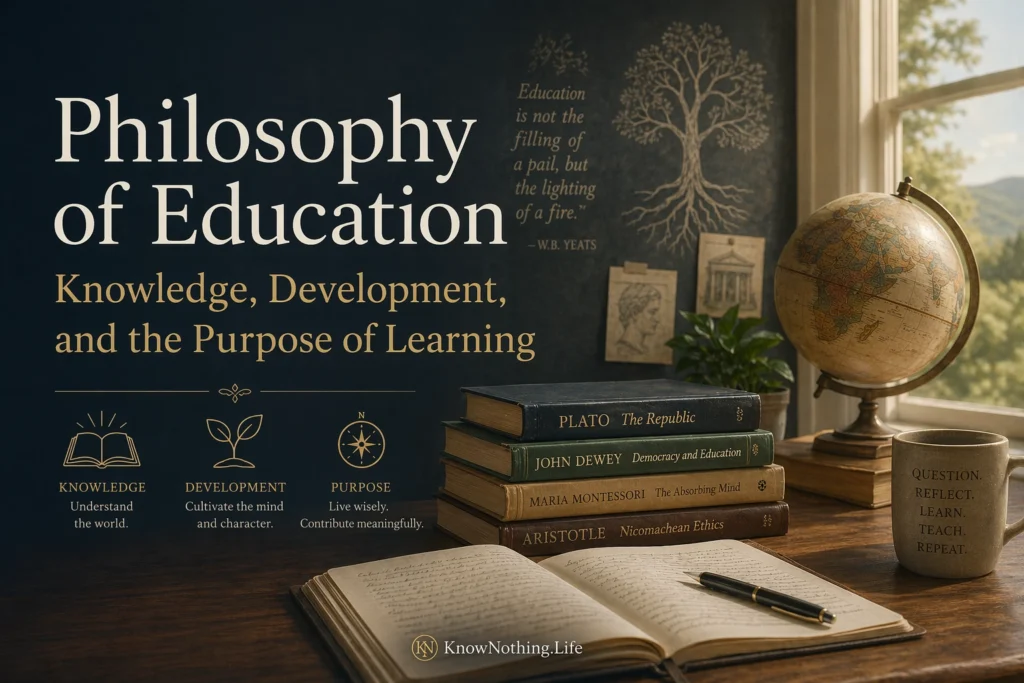
The philosophy of education examines one of the most fundamental human practices: the cultivation of knowledge, understanding, and character through teaching and learning. At its core, it asks enduring questions—What is the purpose of education? What should be taught, and how should it be taught? What kind of individuals and societies should education aim to produce? These questions extend far beyond classrooms, shaping cultural values, political systems, and conceptions of human flourishing.
Education is never neutral. It reflects assumptions about truth, human nature, and the good life. Philosophers from Plato to John Dewey have explored how education can cultivate reason, virtue, and democratic participation. Their insights reveal that education is not merely about transferring information but about shaping the intellectual and moral capacities that define individuals and communities.
The Aims and Purposes of Education
One of the central concerns of the philosophy of education is the question of purpose. Is education primarily about acquiring knowledge, developing skills, fostering critical thinking, or cultivating moral character? Different answers to this question reflect broader philosophical commitments about what it means to live well.
In classical thought, education was closely tied to the development of virtue and the pursuit of truth. Plato envisioned education as a process of guiding the soul toward knowledge of the good, emphasizing the transformative power of learning. For Plato, education was not simply a means to practical ends but a pathway to intellectual and moral enlightenment.
Modern perspectives often emphasize a broader range of aims, including personal development, social integration, and economic productivity. Philosophers like John Dewey argued that education should prepare individuals for active participation in democratic life, fostering critical thinking and adaptability. This shift reflects the changing role of education in complex, modern societies, where learning must address both individual aspirations and collective needs.
Knowledge, Truth, and Curriculum
The question of what should be taught is deeply connected to theories of knowledge and truth. Educational systems must decide which subjects and forms of knowledge are most valuable, a task that involves both philosophical reflection and practical judgment. Should education prioritize scientific understanding, cultural heritage, practical skills, or a balanced combination of these elements?
Different philosophical traditions offer varying answers. Essentialist approaches emphasize the transmission of core knowledge and cultural traditions, arguing that certain subjects are fundamental to intellectual development. In contrast, more progressive perspectives advocate for a flexible curriculum that responds to students’ interests and experiences, promoting engagement and creativity.
Philosophers such as Jean Piaget have highlighted the importance of aligning curriculum with cognitive development. Piaget’s work suggests that learning is an active process in which individuals construct knowledge through interaction with their environment. This insight has influenced educational practices that emphasize exploration, problem-solving, and experiential learning, challenging more rigid models of instruction.
Teaching, Learning, and Pedagogy
The philosophy of education also examines how learning occurs and how teaching should be structured to support it. Pedagogy—the art and science of teaching—reflects underlying assumptions about human cognition, motivation, and development. Should teaching be directive or facilitative? Should it focus on memorization or understanding?
Traditional approaches often emphasize the role of the teacher as an authority figure who transmits knowledge to students. This model prioritizes structure, discipline, and the mastery of established content. While it can be effective in certain contexts, critics argue that it may limit creativity and critical thinking.
Progressive educators, including John Dewey, advocate for a more student-centered approach. Dewey emphasized learning through experience, arguing that education should connect with students’ lives and encourage active engagement. This perspective views students not as passive recipients of information but as participants in a dynamic process of inquiry and discovery, reshaping the relationship between teacher and learner.
Education and Moral Development
Education is not only about intellectual growth but also about moral formation. Schools play a significant role in shaping values, attitudes, and social behaviors, raising questions about the relationship between education and ethics. Should education explicitly teach moral principles, or should it focus on developing the capacity for ethical reasoning?
Philosophers such as Immanuel Kant emphasized the importance of autonomy and rationality in moral development. From this perspective, education should cultivate the ability to think independently and act according to principles that can be universally justified. Moral education, then, is not about imposing values but about fostering the capacity for ethical judgment.
Other approaches emphasize the role of community and social context in moral development. Education can promote empathy, cooperation, and a sense of responsibility toward others, contributing to the formation of ethical citizens. These perspectives highlight the interconnected nature of intellectual and moral growth, suggesting that education must address the whole person rather than isolated aspects of development.
Equality, Access, and Social Justice
The philosophy of education also engages with issues of equality and social justice. Who has access to education, and under what conditions? How can educational systems address disparities related to socioeconomic status, race, gender, and other factors? These questions are central to the role of education in promoting fairness and opportunity.
Thinkers like John Rawls have argued that education is a key component of a just society, providing individuals with the tools needed to pursue their goals and participate fully in social life. From this perspective, ensuring equal access to quality education is not merely a policy issue but a moral imperative.
At the same time, achieving educational equality is a complex challenge. Structural inequalities, resource disparities, and cultural differences can all affect educational outcomes. Addressing these issues requires not only philosophical insight but also practical strategies, highlighting the interplay between theory and practice in the philosophy of education.
Education, Society, and Democracy
Education plays a crucial role in shaping societies, particularly in democratic contexts. It prepares individuals to engage with political institutions, participate in public discourse, and contribute to collective decision-making. This function raises important questions about the relationship between education and citizenship.
For John Dewey, education and democracy are deeply interconnected. He argued that schools should serve as microcosms of democratic society, fostering collaboration, critical thinking, and mutual respect. By engaging students in shared inquiry and problem-solving, education can cultivate the skills and dispositions necessary for democratic life.
However, the relationship between education and society is not without tension. Educational systems can also reinforce existing power structures, shaping beliefs and behaviors in ways that maintain the status quo. This dual role highlights the importance of critical reflection on the aims and practices of education, ensuring that it serves as a force for empowerment rather than conformity.
The Future of Education
The future of education is being shaped by rapid technological, social, and cultural changes. Digital technologies are transforming how information is accessed and shared, creating new opportunities for learning while also raising questions about attention, engagement, and equity. Online education, artificial intelligence, and personalized learning systems are redefining traditional models of teaching and learning.
These developments challenge educators and philosophers to rethink fundamental assumptions about education. What does it mean to be educated in an age of information abundance? How can education foster deep understanding in a world of constant distraction? Addressing these questions requires a balance between innovation and reflection, ensuring that new approaches align with enduring educational values.
At the same time, global challenges such as climate change, social inequality, and cultural conflict underscore the importance of education in preparing individuals to navigate an increasingly complex world. The philosophy of education provides a framework for thinking about these issues, guiding the development of systems that promote both individual growth and collective well-being.
Final Thoughts
The philosophy of education offers a rich and multifaceted exploration of one of humanity’s most important practices. By examining the aims, methods, and implications of education, it reveals the deep connections between learning, personal development, and social organization.
No single theory can capture the full complexity of education. Different perspectives highlight different aspects, from the pursuit of knowledge to the cultivation of virtue, from individual autonomy to social responsibility. Together, they provide a comprehensive framework for understanding what education is and what it can become.
Ultimately, education is about more than acquiring information; it is about shaping the minds and lives of individuals in ways that enable them to thrive and contribute to society. By engaging with its philosophical foundations, we gain insight into how education can fulfill this transformative role, fostering a more thoughtful, just, and informed world.