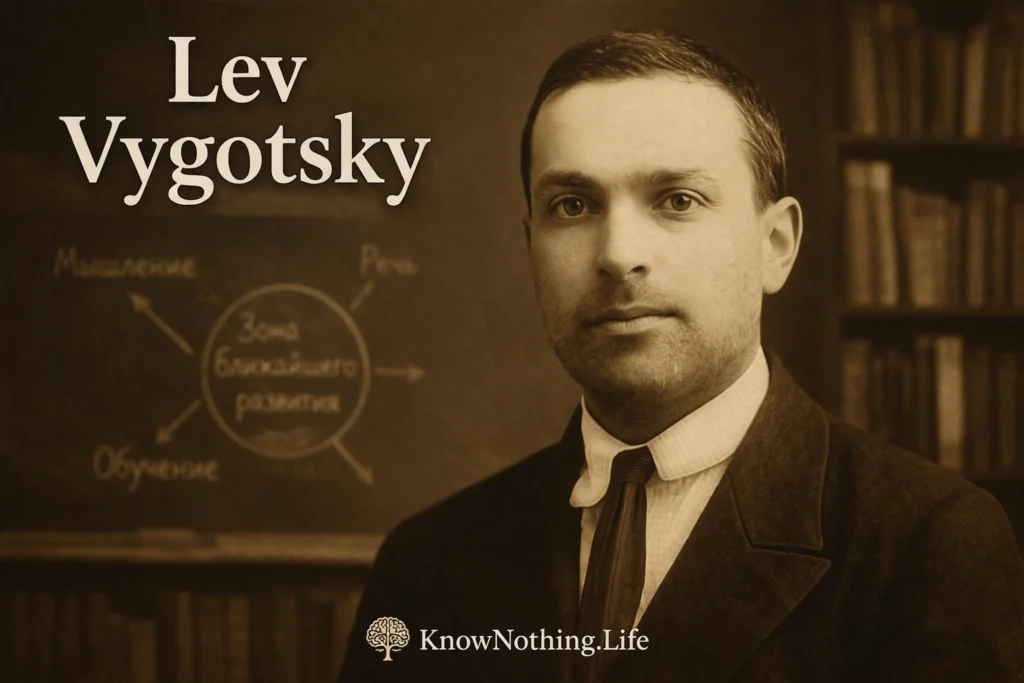
Among the most transformative thinkers in developmental psychology, Lev Vygotsky stands as one of the earliest psychologists to fundamentally challenge the idea that intelligence develops solely from individual experience. While many psychologists of the early twentieth century focused on internal cognition, biological maturation, or behavioral conditioning, Vygotsky argued that human thought itself is deeply shaped by social interaction. According to his revolutionary view, learning does not begin inside the isolated mind. Instead, cognitive development emerges first through relationships with others, language, culture, and collaborative experience before becoming internalized as independent thought.
Though his life was tragically brief, Vygotsky permanently reshaped psychology, education, and theories of child development. His work laid the foundation for modern constructivist education, collaborative learning models, cognitive development theory, and the understanding that culture profoundly shapes intelligence itself. Concepts such as the zone of proximal development and scaffolding remain central to modern educational psychology. Decades after his death, Vygotsky’s ideas continue influencing classrooms, developmental research, language acquisition theory, and broader questions surrounding how human beings learn, think, and develop within society.
Early Life and Intellectual Formation
Lev Semyonovich Vygotsky was born on November 17, 1896, in Orsha, within the Russian Empire, though he grew up primarily in Gomel, in present-day Belarus. Raised in a highly educated Jewish family, Vygotsky grew up surrounded by literature, philosophy, intellectual debate, and a strong cultural emphasis on learning. From an early age, he demonstrated extraordinary intellectual curiosity, developing interests not only in psychology but also philosophy, linguistics, literature, history, and political theory.
Initially, Vygotsky pursued legal studies at Moscow University, though his intellectual interests stretched far beyond law. He became increasingly fascinated with philosophy and literature, especially questions concerning consciousness, language, and the relationship between society and individual thought. Unlike many psychologists who entered the field through biology or medicine, Vygotsky approached psychology through philosophy and culture, which gave his later theories a distinctive interdisciplinary depth.
The social and political upheaval surrounding the Russian Revolution deeply influenced his worldview. Vygotsky believed human development cannot be understood independently from historical and cultural conditions. Society shapes thought itself. This conviction became the foundation of his life’s work and sharply distinguished him from many Western psychologists who focused more heavily on biological development or individual cognition.
Challenging Traditional Views of Intelligence
During Vygotsky’s era, psychological theories often treated intelligence as a largely individual process. Developmental theorists increasingly focused on internal cognitive maturation, while behaviorists such as John B. Watson and B. F. Skinner emphasized external conditioning and reinforcement. Intelligence was frequently viewed as either biologically inherited or shaped through isolated learning experiences.
Vygotsky rejected both frameworks as incomplete. He believed human cognition is fundamentally social. Before children learn to think independently, they first learn through interactions with parents, teachers, caregivers, and peers. Skills initially exist between people before eventually becoming internalized within the individual mind. Cognitive development, in his view, begins socially and only later becomes personal.
This idea represented a radical shift in developmental psychology. Rather than seeing the child as an isolated learner gradually discovering the world alone, Vygotsky argued children develop through participation in culturally structured environments. Language, communication, imitation, and guided learning all actively shape the architecture of thought itself.
Social Development Theory
At the center of Vygotsky’s work lies what later became known as social development theory. Its central principle is elegantly simple: all higher mental functions originate first within social interaction before becoming internal psychological processes. In other words, learning begins externally before becoming internal thought.
For example, a child learning arithmetic initially performs tasks with help from adults or teachers. Over repeated interaction, the child gradually internalizes both the knowledge and the mental strategies involved, eventually performing independently. The process is not merely acquiring information but transforming social experience into personal cognition.
Vygotsky famously summarized this principle by writing, “Every function in the child’s cultural development appears twice: first on the social level, and later on the individual level.” This insight fundamentally changed developmental psychology by positioning social interaction not as secondary influence but as the very foundation of thinking itself.
The Zone of Proximal Development
Perhaps Vygotsky’s most famous contribution is the concept known as the Zone of Proximal Development, often abbreviated as ZPD. The concept describes the difference between what a learner can accomplish independently and what that same learner can achieve with guidance from someone more knowledgeable, such as a teacher, parent, or experienced peer.
Traditional education often focused narrowly on measuring what students could already do independently. Vygotsky argued this approach misunderstood how learning actually occurs. The most meaningful learning happens not when individuals repeat what they already know but when they engage tasks slightly beyond their current ability while receiving support that enables progress.
This insight transformed modern education. Rather than simply testing existing knowledge, effective teaching involves identifying developmental potential and guiding learners through increasingly difficult challenges. Learning is maximized when instruction targets abilities still in formation rather than abilities already fully developed.
Language as the Engine of Thought
Unlike many psychologists who treated language primarily as a communication tool, Vygotsky believed language plays a far deeper role in cognitive development. He argued language fundamentally structures thought itself. Children first use language externally to communicate with others, but over time speech becomes internalized as inner dialogue guiding reasoning, planning, self-control, and problem-solving.
He observed young children often talk aloud while solving problems, a behavior many adults dismiss as meaningless. Vygotsky argued this “private speech” represents a critical developmental stage during which external communication gradually transforms into internal thought. Over time, spoken language becomes silent internal dialogue that organizes cognition itself.
This theory strongly challenged the work of Jean Piaget, who viewed private speech largely as immature egocentrism. Vygotsky instead argued such speech represents an essential cognitive tool. Thought and language are deeply interconnected, and intellectual development depends heavily on linguistic interaction with others.
He wrote, “Thought is not merely expressed in words; it comes into existence through them.” Few psychological statements better capture his revolutionary view that language actively constructs consciousness.
Culture and Cognitive Development
Vygotsky believed culture profoundly shapes intelligence. Different societies develop unique tools for thinking, communicating, solving problems, and organizing knowledge. Children do not simply inherit biological cognitive capacities. They learn culturally specific methods for understanding reality through participation in social systems.
This perspective introduced what later became known as cultural psychology. Cognitive development varies because societies transmit different intellectual tools, values, and systems of knowledge. Literacy, mathematics, memory strategies, social norms, and reasoning styles all emerge through cultural participation rather than universal biological maturation alone.
This idea sharply contrasted with theories proposing universal developmental stages independent of culture. Vygotsky argued intelligence is always historically and socially situated. Human cognition evolves not only biologically but through cultural inheritance transmitted across generations through education and communication.
Major Works and Intellectual Contributions
Although Vygotsky died young, his intellectual output was remarkably influential. His most famous work, Thought and Language (1934), explored the intimate relationship between language development and cognitive growth. The book became one of psychology’s foundational texts for understanding how communication structures consciousness itself.
Another major contribution came through Mind in Society, a posthumously assembled collection of his writings that introduced many Western psychologists to his developmental theories decades after his death. Because Soviet political conditions initially restricted widespread distribution of his work, much of the Western world discovered his ideas long after he had died.
Vygotsky also contributed substantially to special education, believing children with developmental challenges could learn effectively when educational systems emphasized guided support rather than fixed assumptions about intellectual limitations. His ideas helped inspire more flexible and socially interactive approaches to education for diverse learners.
Early Death and Delayed Recognition
Tragically, Vygotsky’s career was extraordinarily brief. He died of tuberculosis in 1934 at only thirty-seven years old, cutting short what many historians believe would have become one of psychology’s greatest careers. Much of his work remained obscure for decades, particularly outside the Soviet Union, where political conditions limited international academic exchange.
Because Western psychology during the mid-twentieth century was dominated by behaviorism and later cognitive psychology, Vygotsky’s socially centered theories initially received far less attention than thinkers like Piaget. Only decades later did educators and psychologists begin fully recognizing the profound importance of his ideas.
Ironically, despite his short life and delayed recognition, Vygotsky’s influence today rivals many psychologists who enjoyed far longer careers. His theories became increasingly important as education shifted toward collaborative learning, active teaching methods, and understanding the role of environment in cognitive development.
Legacy and Lasting Influence
Lev Vygotsky permanently transformed developmental psychology by demonstrating that learning is fundamentally social before it becomes individual. His work shifted educational philosophy away from passive memorization and toward guided interaction, collaborative learning, dialogue, and active cognitive development supported by relationships.
His ideas strongly influenced later educational theorists and psychologists studying cognition, language acquisition, and developmental science. Modern teaching methods involving scaffolding, peer collaboration, guided practice, and developmental instruction all trace directly back to Vygotsky’s insights. Alongside thinkers like Jean Piaget and Jerome Bruner, he helped build modern developmental psychology.
Vygotsky once observed, “Through others, we become ourselves.” Few psychological statements summarize his philosophy more beautifully. Identity, intelligence, and cognition do not emerge in isolation. They are built through relationship, communication, and participation in shared human culture.
Final Thoughts
To study Lev Vygotsky is to understand one of psychology’s most transformative insights: the mind is never developed alone. Human beings learn, think, and grow through interaction with others long before thought becomes independent. Society itself becomes part of the architecture of consciousness.
His legacy remains profoundly relevant because modern education increasingly recognizes that learning is not passive information transfer but active social participation. In explaining how culture, language, and relationships shape cognition, Vygotsky expanded psychology beyond the individual mind and revealed the deeply collective nature of human intelligence itself. His work remains one of the strongest arguments ever made that to understand thought, we must first understand the social world that gives thought its shape.