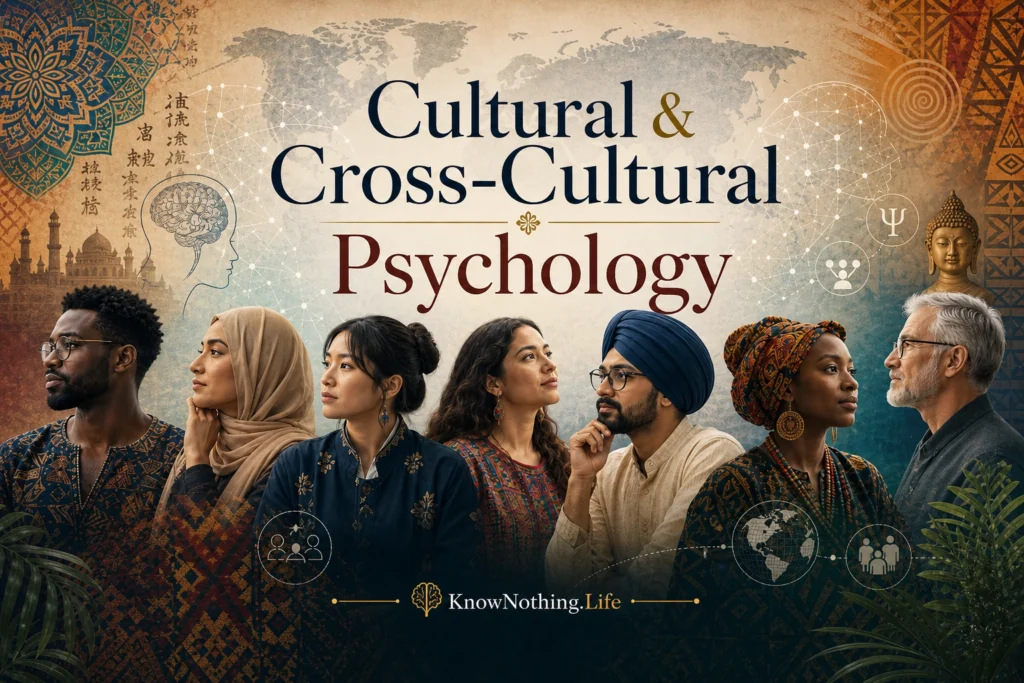
Cultural and cross-cultural psychology examine one of the most important questions in the human sciences: how much of the mind is universal, and how much is shaped by the cultural worlds people inhabit? Traditional psychology often tried to discover general laws of behavior by studying individuals as if they were separable from history, language, religion, family structure, economic conditions, and social norms. Cultural psychology challenges that assumption. It argues that people do not simply “have” minds inside cultures; rather, culture helps form the categories, values, emotions, habits, and self-understandings through which the mind operates. Clifford Geertz famously described human beings as “suspended in webs of significance” they themselves have spun, and cultural psychology begins from that insight: meaning is not decoration added to behavior after the fact, but part of the structure that makes behavior intelligible.
Cross-cultural psychology overlaps with cultural psychology but has a slightly different emphasis. Where cultural psychology often studies the mutual formation of mind and culture, cross-cultural psychology compares psychological processes across societies to identify both similarities and differences. John W. Berry, Ype H. Poortinga, Marshall H. Segall, Pierre R. Dasen, and later collaborators helped define the field through works such as Cross-Cultural Psychology: Research and Applications, which presents cross-cultural research as a way to test whether psychological theories developed in one population apply elsewhere. Together, these fields reveal that perception, emotion, morality, identity, development, mental health, and social behavior cannot be fully understood without asking where people live, what they have learned to value, and what cultural practices organize their lives.
Culture, Meaning, and the Human Mind
Culture is more than nationality, ethnicity, or tradition. It includes shared symbols, moral expectations, family systems, social roles, institutions, rituals, languages, and everyday practices. A culture teaches people what counts as polite, shameful, intelligent, mature, masculine, feminine, sacred, successful, selfish, or normal. These categories then influence how people interpret themselves and others. A child raised in a society that prizes independence, verbal self-expression, and personal choice may learn to understand maturity as “being yourself.” A child raised in a society that prizes family obligation, respect for elders, and relational harmony may learn to understand maturity as knowing one’s place within a network of responsibilities. Neither pattern is simply natural or artificial; each is a psychologically real way of organizing personhood.
Richard Shweder’s work was central in arguing that cultural psychology should not treat culture as a surface variable layered on top of universal mental machinery. In Thinking Through Cultures: Expeditions in Cultural Psychology, Shweder emphasized that psyche and culture make each other up: minds are shaped through local worlds of meaning, and those worlds are sustained by the actions of minded persons. His definition of cultural psychology as the study of how “cultural traditions and social practices regulate, express, transform, and permute the human psyche” captures the field’s central claim. Human psychology is therefore not only inside the skull. It is distributed across language, customs, moral codes, institutions, and patterns of social interaction.
The Self Across Cultures
One of the most influential areas of cultural psychology concerns the self. In many Western societies, especially in middle-class European American contexts, the self is often imagined as independent: a bounded individual with personal preferences, inner traits, private goals, and a right to self-expression. In this view, authenticity means acting consistently with one’s internal desires. Success is often described as standing out, choosing freely, building self-esteem, and becoming a unique person. This model has deeply influenced mainstream psychology, especially theories of motivation, personality, and well-being.
Hazel Rose Markus and Shinobu Kitayama’s landmark article “Culture and the Self: Implications for Cognition, Emotion, and Motivation” argued that other societies often cultivate a more interdependent self. In interdependent contexts, the person is understood through relationships, duties, roles, and social connectedness. Identity is not merely what one privately feels but how one participates in family, community, and social order. Markus and Kitayama argued that independent and interdependent self-construals can systematically influence cognition, emotion, and motivation. For example, pride may be encouraged where individual achievement is central, while modesty may be valued where social harmony matters more. This does not mean every American is independent or every Asian person is interdependent. It means cultures provide different default models of what a person is supposed to be.
Individualism, Collectivism, and Social Life
Harry C. Triandis’s work on individualism and collectivism gave psychology one of its most widely used frameworks for comparing cultures. In Individualism and Collectivism, Triandis explored how societies differ in the relative priority they give to personal goals and group goals, autonomy and obligation, uniqueness and belonging. Individualistic cultures tend to emphasize personal choice, self-reliance, individual rights, and direct self-expression. Collectivistic cultures tend to emphasize family loyalty, group harmony, reciprocal duty, and sensitivity to social context. These patterns influence friendship, work, parenting, conflict, leadership, and moral judgment.
Still, the individualism–collectivism distinction must be used carefully. It is a broad map, not a full description of any person or society. Triandis himself developed more refined distinctions, such as horizontal and vertical forms of individualism and collectivism. Horizontal individualism values uniqueness while stressing equality; vertical individualism accepts competition and hierarchy. Horizontal collectivism emphasizes cooperation among equals; vertical collectivism emphasizes duty within hierarchical relationships. This refinement matters because two societies may both be “collectivist” yet differ greatly in authority, gender roles, family structure, and political organization. Cultural psychology is strongest when it avoids stereotypes and treats cultural models as living patterns rather than rigid labels.
Cognition, Perception, and Ways of Thinking
Cultural psychology also shows that cognition is not always as culturally neutral as once assumed. Richard Nisbett’s The Geography of Thought popularized research suggesting that East Asian and Western traditions have often encouraged different styles of attention and reasoning. Nisbett argued that many East Asian contexts tend to foster holistic cognition, with greater attention to relationships, background, context, and change, while many Western contexts tend to foster analytic cognition, with greater attention to objects, categories, formal logic, and individual attributes. These are tendencies, not biological destinies, but they show that even perception and reasoning can be shaped by social practice.
This research complicates the assumption that the mind naturally sees the world in one universal way. People learn what to notice. In some cultural environments, a person may be encouraged to explain behavior by referring to internal traits: “She spoke up because she is confident.” In others, the same behavior may be explained through context: “She spoke up because the situation required it.” These habits affect judgment, communication, conflict, and misunderstanding. A workplace, classroom, or therapy session can go wrong when one cultural style is mistaken for intelligence itself, while another is misread as passivity, evasiveness, arrogance, or dependence.
Emotion, Morality, and Mental Health
Emotions are biologically grounded, but cultures shape how emotions are named, expressed, valued, and regulated. Anger may be treated as honest self-assertion in one setting and as dangerous immaturity in another. Shame may be considered destructive humiliation in one culture and an important moral emotion in another. Happiness itself varies culturally: some societies emphasize high-arousal positive states such as excitement and enthusiasm, while others prize calmer states such as peace, balance, and contentment. Cultural psychology therefore asks not only whether people feel emotions, but what emotions mean within particular moral worlds.
Mental health is equally cultural. Symptoms, diagnoses, coping styles, stigma, and healing practices are shaped by local meanings. A clinical model developed in one society may not fully capture distress in another. Arthur Kleinman’s work in medical anthropology, especially Patients and Healers in the Context of Culture, helped show that illness is never only a biological event; it is also interpreted through family expectations, religious beliefs, social status, and available explanations of suffering. In cross-cultural clinical work, this insight is essential. A therapist who ignores culture may misread spiritual language as pathology, family obligation as dependency, restraint as repression, or emotional expressiveness as instability.
Research Methods and the WEIRD Problem
One of the strongest recent challenges in psychology concerns the populations used to build psychological theory. Joseph Henrich, Steven J. Heine, and Ara Norenzayan’s influential article “The Weirdest People in the World?” argued that much psychological research relied heavily on participants from Western, Educated, Industrialized, Rich, and Democratic societies, often abbreviated as WEIRD. Their point was not that such participants are unimportant, but that they are not automatically representative of humanity. A theory based mostly on North American college students may describe one culturally specific population while presenting itself as universal human nature.
This critique has transformed research standards. Cross-cultural psychologists must consider translation, sampling, measurement equivalence, response bias, and local interpretation. A survey item about “self-esteem,” “family support,” or “life satisfaction” may not mean the same thing across cultures. Even experimental tasks can carry hidden assumptions about schooling, test-taking, individual performance, and communication style. Good cross-cultural research does not simply export a questionnaire and compare averages. It asks whether the concept being measured exists in the same way, whether participants understand the task similarly, and whether the research design respects local realities.
Hofstede, Cultural Dimensions, and Their Limits
Geert Hofstede’s Culture’s Consequences became especially influential in organizational psychology, international business, and intercultural communication. Hofstede’s model compared national cultures using dimensions such as power distance, uncertainty avoidance, individualism–collectivism, masculinity–femininity, long-term orientation, and indulgence–restraint. Later summaries of the model emphasize these six dimensions as tools for understanding broad cultural tendencies in authority, risk, competition, time orientation, and gratification. The model remains useful because it gives researchers and practitioners a vocabulary for discussing predictable differences in institutions, leadership, communication, and workplace expectations.
At the same time, Hofstede’s framework has clear limits. Nations are not cultures in any simple sense. A country may contain multiple languages, religions, regions, classes, ethnic groups, and historical experiences. Cultural averages can conceal inequality, conflict, migration, generational change, and individual variation. Cultural dimensions are best used as starting points for inquiry, not as final explanations. The danger is that a model meant to reduce misunderstanding can become a new form of stereotyping. Mature cross-cultural psychology balances comparison with humility: it recognizes patterns without turning people into examples of a category.
Conclusion
Cultural and cross-cultural psychology deepen the study of human behavior by refusing to separate mind from meaning. They show that people develop through cultural worlds that shape identity, attention, emotion, morality, family life, communication, and mental health. They also challenge psychology to test its theories beyond narrow samples and familiar assumptions. The result is not relativism in the shallow sense that “everything is different everywhere.” Rather, it is a more disciplined universalism: the search for human commonalities that does not erase cultural variation.
The field’s greatest contribution is its insistence that human beings are both biological organisms and meaning-making persons. We inherit nervous systems, but we also inherit languages, rituals, institutions, stories, kinship systems, religious traditions, and moral vocabularies. To understand the mind, psychology must study both. Cultural and cross-cultural psychology therefore make psychology more accurate, more humane, and more global. They remind us that the question “What is human nature?” cannot be answered from one society alone.