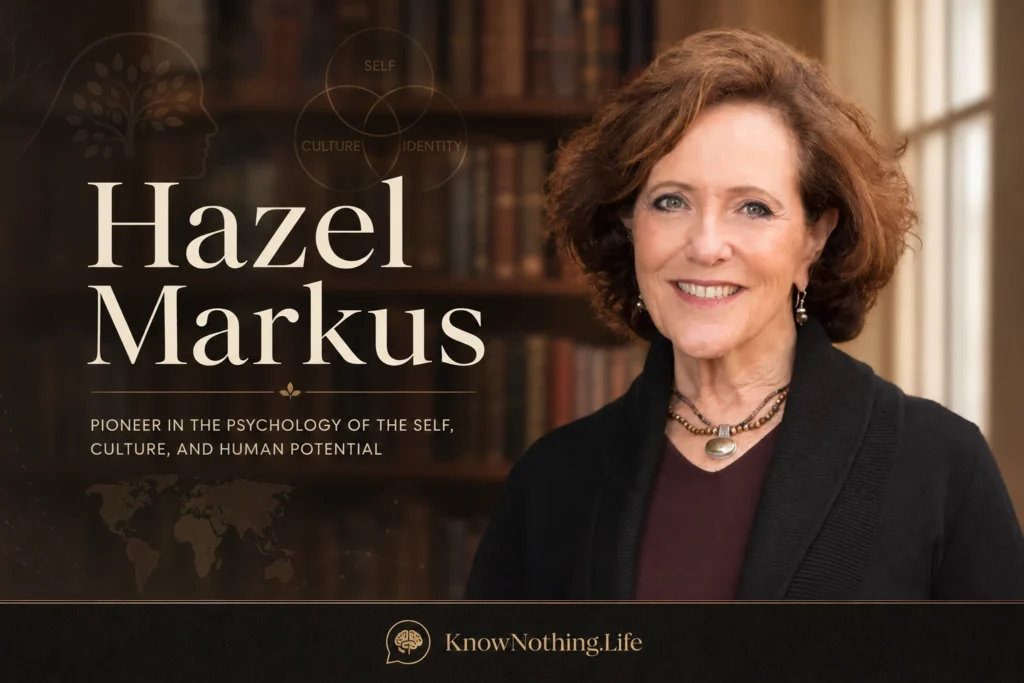
Hazel Rose Markus is an American social psychologist and cultural scientist whose research changed how psychology understands identity, motivation, and human difference. Her central insight is that the self is neither an isolated inner object nor a universal structure functioning identically everywhere. People become particular kinds of selves through families, schools, workplaces, nations, racial systems, social classes, and other cultural settings. Those selves then help reproduce or transform the environments that shaped them. This reciprocal view showed that cognition, emotion, and choice are always situated within social worlds.
Markus developed the concepts of self-schemas and possible selves, helped establish the distinction between independent and interdependent models of selfhood, and advanced the culture-cycle model of social change. Her work has influenced social and cultural psychology, education, health, and public policy. Reflecting on the lesson that drew her toward psychology, she said, “as people we are creating the world.” The phrase captures her central theme: people interpret reality through culturally formed selves while helping make the realities that future selves will inhabit.
From Journalism to Social Psychology
Markus was born in England to English parents and moved to the United States while young. Both parents were teachers, and she later remembered family conversations centered on students, classrooms, and human behavior. Growing up in Southern California, she initially imagined becoming a journalist. A college demonstration changed that plan. Students primed with different topics heard the same sound differently, showing that perception depends partly on what an observer brings to an event. The experience persuaded Markus that facts are not simply received; they are interpreted through expectations and prior knowledge.
She earned a bachelor’s degree in psychology from California State University at San Diego and a doctorate from the University of Michigan. Markus joined Michigan’s psychology faculty and Research Center for Group Dynamics in 1975, remaining until 1994. Although warned that studying race or gender could marginalize her professionally, she persisted in asking how social position shapes thought and action. In 1994, she moved to Stanford University, where she became the Davis-Brack Professor in the Behavioral Sciences and built an influential program linking psychology with culture, inequality, and practical intervention.
Self-Schemas and the Organized Self
Markus’s foundational 1977 article, “Self-Schemata and Processing Information About the Self,” grew from her doctoral research and gave psychology a precise way to study self-knowledge. She proposed that people form organized cognitive structures in personally important domains. In her definition, “Self-schemata are cognitive generalizations about the self,” built from experience and used to organize self-relevant information. A person may possess a developed schema around independence, competence, sociability, body weight, or gender while remaining comparatively “aschematic” in areas carrying little personal importance.
Her experiments showed that self-schemas influence what people notice, how quickly they decide whether a trait describes them, which memories they retrieve, and how confidently they predict future behavior. Schemas provide coherence but also create selectivity. People may process supporting evidence efficiently while resisting information that contradicts an established self-understanding. This work moved identity into experimental social cognition without reducing the self to a fixed trait. Markus presented the self as an active knowledge system formed through social experience and used to guide interpretation and action.
Possible Selves and the Psychology of the Future
With Paula Nurius, Markus extended her theory beyond present identity in the 1986 article “Possible Selves.” Possible selves are the people individuals imagine they might become, hope to become, or fear becoming. A student may envision becoming a physician, an admired parent, an unemployed adult, or someone who never fulfills a talent. These images connect identity with motivation because they give goals a personal form. Rather than pursuing an abstract outcome called success, someone can act toward a vivid representation of a desired future self. Feared possibilities similarly represent futures to avoid.
Possible selves are not merely fantasies; their motivational value depends on whether people can connect them to strategies, opportunities, and support. They are also culturally patterned. Families, schools, media, and institutions make some futures easier to imagine than others, while prejudice and inequality can narrow the identities that seem attainable. Markus and collaborators applied the concept to education, aging, health, delinquency, and social mobility. The theory remains influential because it joins cognition and emotion with a practical question: how does an image of who I may become organize what I do today?
Culture and Independent or Interdependent Selves
Markus’s collaboration with Shinobu Kitayama helped establish modern cultural psychology. Their landmark 1991 article, “Culture and the Self: Implications for Cognition, Emotion, and Motivation,” challenged theories built largely from Western populations and presented as universal. They contrasted an independent model of self, emphasizing uniqueness, personal choice, and expression, with an interdependent model, emphasizing relationships, social roles, responsiveness, and fitting appropriately within a context. These are not rigid personality types or simple divisions between nations. They are culturally supported forms of agency that can coexist within individuals and vary across situations.
The distinction explains why identical behavior can carry different meanings. Choosing without influence may signify maturity in a setting organized around independence, while adjusting to others may signify competence in one organized around interdependence. Emotions, motivation, attention, and well-being also vary with the model of self a context supports. Markus has warned against treating culture as fixed, stating that “Cultures themselves are not monolithic or static.” Her work asks which ways of being are encouraged by particular histories, institutions, relationships, and practices rather than assigning one psychology to entire nations.
Race, Social Class, and the Culture Cycle
Markus increasingly applied cultural psychology to race, ethnicity, class, and inequality. With Paula Moya, she edited Doing Race: 21 Essays for the 21st Century, which presents race not as a biological possession but as a historically produced system enacted through ideas, institutions, identities, and practices. With Susan Fiske, she edited Facing Social Class: How Societal Rank Influences Interaction, examining how class shapes authority, opportunity, self-understanding, and encounters in schools, workplaces, medicine, and family life. These works oppose explanations that locate disadvantage entirely within individuals while ignoring environments that structure their choices.
The culture-cycle model, developed through Markus’s collaborations and presented to a broad audience in Clash!: Eight Cultural Conflicts That Make Us Who We Are, organizes culture into four interacting levels: ideas, institutions, interactions, and individuals. Ideas influence institutional rules; institutions structure encounters; encounters shape minds; and individuals reinforce, resist, or alter the larger cycle. The model makes cultural change concrete. An organization cannot create lasting inclusion by changing attitudes while its policies reward exclusion. Yet people are not powerless products of structure; coordinated action can modify practices and create new conditions for behavior.
Major Works and Lasting Influence
Markus’s major publications include “Self-Schemata and Processing Information About the Self,” “Possible Selves,” “The Dynamic Self-Concept,” and “Culture and the Self,” along with Emotion and Culture: Empirical Studies of Mutual Influence, Doing Race, Facing Social Class, Clash!, and the textbook Social Psychology. Her honors include the American Psychological Association Award for Distinguished Scientific Contributions, the Donald T. Campbell Award, the William James Fellow Award, membership in the American Academy of Arts and Sciences, and election to the National Academy of Sciences.
At Stanford, Markus helped create SPARQ, an initiative connecting social psychological research with challenges in education, health, organizations, and community relations. This work reflects her conviction that psychology should not explain people after removing them from their environments. It should examine how environments enable particular selves and how institutions can remove barriers to agency. Markus’s lasting contribution is a psychology broad enough to include both mind and world. She showed that people are culturally formed agents whose identities and possibilities emerge from the worlds they inherit—and whose actions help determine what those worlds become.