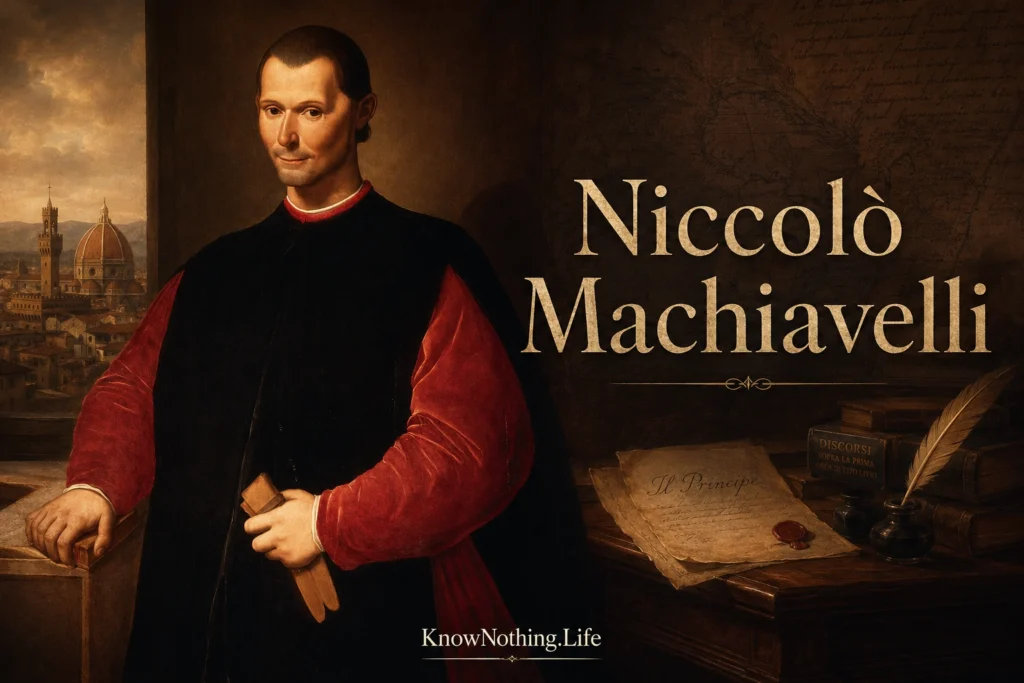
Niccolò Machiavelli was a Florentine diplomat, historian, playwright, and political thinker whose name became synonymous with ruthless ambition. That reputation rests largely on a simplified reading of The Prince, a compact work about how rulers acquire, preserve, and lose power. Yet his thought is broader than the adjective “Machiavellian” suggests. He studied republics as seriously as principalities, praised civic liberty, criticized corruption, distrusted mercenary armies, and treated conflict as a permanent feature of political life. He asked how leaders and institutions actually behave when confronted by war, ambition, instability, and changing fortune.
His major works include The Prince, Discourses on Livy, The Art of War, Florentine Histories, and the comedy The Mandrake. Across these texts, Machiavelli examined force and law, appearance and reality, liberty and authority, agency and circumstance. Scholars still disagree over whether The Prince offers sincere advice, a warning about tyranny, or an unsettling exposure of political rule. Machiavelli described practices that moral philosophy often preferred not to see, which helps explain why interpretations of his intentions remain sharply divided.
Early Life and Government Service
Niccolò di Bernardo dei Machiavelli was born in Florence on May 3, 1469, into an old but not wealthy family. His father, Bernardo, was trained in law and maintained a modest library. Florence was culturally brilliant but politically unstable. The Medici dominated public life until 1494, when a French invasion helped drive them from power. The preacher Girolamo Savonarola then led a republic shaped by religious reform. His execution in 1498 opened the way for a different republican administration.
That year, at twenty-nine, Machiavelli was appointed second chancellor of the Florentine Republic and secretary to the council responsible for diplomacy and war. His service lasted until November 1512. He wrote reports, negotiated, assessed rulers, and anticipated political change. Missions took him to the court of Louis XII of France, the papacy, the Holy Roman Emperor Maximilian I, and numerous Italian states. He learned politics by observing negotiations, military crises, betrayals, and the ambitions of powerful men.
Cesare Borgia, War, and the Fall of the Republic
Machiavelli’s most famous encounters were with Cesare Borgia, the ambitious son of Pope Alexander VI. Borgia used speed, deception, selective violence, and administrative control to conquer territory in central Italy. Machiavelli admired his decisiveness without overlooking his dependence on papal favor and fortune. In The Prince, Borgia appears as a ruler who took intelligent precautions but could not survive the death of his father and his own sudden illness. His fall showed that political skill can never eliminate uncertainty.
Machiavelli also sought to replace Florence’s mercenaries with a citizen militia. The force helped recover Pisa in 1509 but failed against Spanish troops at Prato in 1512. The defeat enabled the Medici to return and destroy the republican government. Machiavelli was dismissed and later arrested after his name appeared in connection with an anti-Medici conspiracy. He denied involvement but endured imprisonment and torture before an amnesty secured his release in 1513.
Exile and The Prince
Machiavelli withdrew to his family property near San Casciano. By day he supervised farm work, drank and gambled with local people, and worried about poverty. At night he entered his study, changed into formal clothes, and read ancient historians. In a celebrated letter to Francesco Vettori, he wrote that he entered “the ancient courts of ancient men,” questioned them about their actions, and forgot his troubles. During this period he composed the treatise originally titled On Principalities, later known as The Prince, to demonstrate his political knowledge to the Medici.
The book’s scandal arose from its insistence that a ruler must learn “how not to be good” when necessity demands it. Machiavelli did not claim that cruelty or deception are always desirable. He argued that leaders who practice conventional virtue inflexibly may destroy themselves and their states, while actions condemned in private life may sometimes preserve political order. His concept of virtù means effectiveness, courage, intelligence, adaptability, and the capacity to shape events rather than conventional goodness. A prince must understand when to keep faith, when to use force, and how to maintain a convincing public image.
Fortune, Fear, and Political Necessity
Machiavelli paired virtù with fortuna, the unpredictable force of chance and historical change. In chapter twenty-five of The Prince, he compares fortune to a destructive river that overwhelms communities where defenses have not been prepared. People cannot master everything, but foresight can create barriers before the flood arrives. Political ability requires recognizing change and altering one’s conduct. Leaders fail when a method that once succeeded becomes habitual after circumstances have changed.
His discussion of love and fear is similarly conditional. Machiavelli writes that it is “much safer to be feared than loved” when a ruler cannot be both, because affection may disappear when self-interest changes. Yet fear must not become hatred. A prince should avoid needless interference with property and family, restrain cruelty, and make punishment appear necessary. Violence is presented as a dangerous instrument whose timing and limits determine whether it establishes order or revenge.
Republican Liberty and Major Works
Readers who know only The Prince may mistake Machiavelli for a defender of dictatorship. Discourses on Livy, written during roughly the same period, reveals his engagement with republican government. Using ancient Rome as his principal example, he argues that freedom depends on laws, military independence, civic participation, and institutions capable of channeling conflict. Rome became free and powerful partly because struggles between nobles and common citizens produced offices and laws that restrained domination.
Machiavelli maintained that citizens often make better guardians of freedom than elites because the people generally desire “not to be dominated over,” whereas the powerful seek to command. Yet he distrusted every class when unchecked. Republics need institutional balances, public accountability, civic education, and periodic renewal. The Art of War expanded his case for citizen armies, while Florentine Histories examined how faction weakened his city. His comedy The Mandrake used deception, appetite, and clerical corruption to reveal how respectable appearances can conceal self-interest.
Final Years and Lasting Influence
The Medici gradually gave Machiavelli minor assignments, but he never regained the influential office he had lost. In 1527, after the sack of Rome weakened Medici power, Florence again expelled the family and restored a republic. Machiavelli’s work for Medici patrons now made him suspect to returning republicans. He died in Florence on June 21, 1527. The Prince and Discourses on Livy were published after his death, and his name became a label for political immorality, despite his republican commitments.
Machiavelli changed political thought by separating the analysis of power from idealized accounts of moral authority. He showed that good intentions do not guarantee good outcomes, that institutions must be designed for ambitious and imperfect people, and that political survival depends on force, persuasion, timing, reputation, and consent. His deepest lesson is not that the ends justify the means—a sentence he never wrote—but that political choices must be judged in a world of consequences. His work forces readers to ask how liberty and order can be defended without becoming corrupted by the instruments used to protect them.