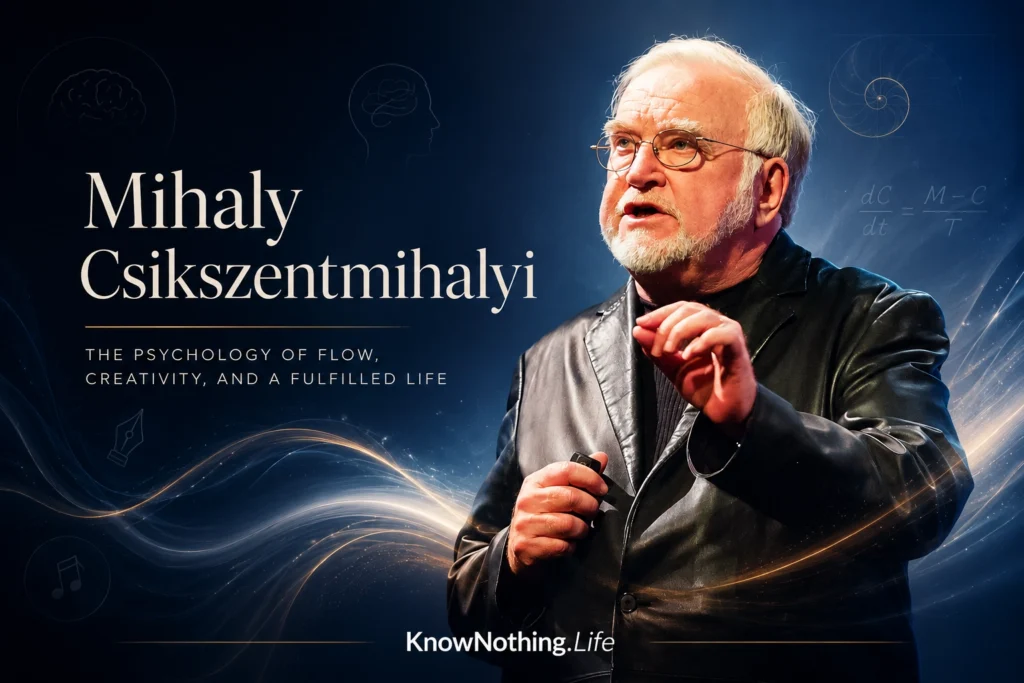
Mihaly Csikszentmihalyi was a Hungarian American psychologist whose research changed how scholars understand happiness, creativity, motivation, and meaningful work. He is best known for developing the concept of flow, a state of deep involvement in which attention becomes organized around an activity and ordinary self-consciousness recedes. Flow can occur while painting, composing music, playing chess, climbing, teaching, performing surgery, or completing demanding work. What matters is not the prestige of the activity but the quality of engagement it makes possible. His work redirected psychology from asking only what causes disorder toward examining the conditions under which people function at their best.
Csikszentmihalyi also developed methods for studying everyday experience, created a systems approach to creativity, and explored how schools and workplaces could support intrinsic motivation. Books including Beyond Boredom and Anxiety, Flow: The Psychology of Optimal Experience, The Evolving Self, Creativity: Flow and the Psychology of Discovery and Invention, Finding Flow, and Good Business carried his ideas into education, management, athletics, and public life. His central message was demanding rather than comforting: a satisfying life is not passively received. It is built through disciplined attention, worthwhile challenges, and activities that enlarge the self.
War, Displacement, and an Education in Psychology
Csikszentmihalyi was born on September 29, 1934, in Fiume, then an Italian city and now Rijeka, Croatia. His father was a Hungarian diplomat, and his childhood was disrupted by the Second World War. One older brother was killed during the siege of Budapest, while another was sent to a Soviet labor camp. After communists took control of Hungary, his father resigned from diplomatic service and the family remained in Italy. The collapse around him left Csikszentmihalyi with a lasting question: why did some people retain purpose during catastrophe while others became defeated, cruel, or empty?
As a teenager, he attended a free lecture in Switzerland delivered by Carl Jung, although he did not initially recognize the speaker. Jung discussed the psychological wounds left by war and the human effort to impose meaning on chaos. The encounter persuaded Csikszentmihalyi that psychology might address the problems he had witnessed. He moved to the United States in 1956 and supported himself while studying at the University of Chicago. He earned a bachelor’s degree in 1960 and a doctorate in human development in 1965, developing an approach that joined observation, philosophical questions, and empirical research.
Artists, Intrinsic Motivation, and Flow
Csikszentmihalyi’s early research centered on artists and creativity. Working with Jacob Getzels, he studied how painters approached open-ended problems and became fascinated by their absorption in creation. Artists could work for hours while ignoring hunger, fatigue, and external rewards, yet lose interest in a painting soon after completing it. Recalling this pattern, he said, “They weren’t really interested in the finished painting.” The reward was not simply the completed object, money, or recognition. It was the experience of creating, in which challenge, skill, attention, and action became tightly integrated.
This observation led to the concept he called flow. People interviewed across different activities described a similar condition: concentration became intense, goals were clear, feedback was immediate, and action unfolded without constant conscious correction. Their sense of time altered, worries receded, and the activity became autotelic—worth doing for its own sake. Flow was not mere relaxation or effortless pleasure. It usually emerged when a difficult task matched or slightly exceeded a person’s abilities. Too little challenge encouraged boredom; too much produced anxiety. Development occurred where skills were repeatedly stretched by manageable demands.
Measuring Experience and Writing Flow
One of Csikszentmihalyi’s most important methodological contributions was the Experience Sampling Method, developed with colleagues to investigate daily consciousness outside the laboratory. Participants carried electronic pagers and were signaled at unpredictable times. When prompted, they recorded what they were doing, where they were, whom they were with, and how they felt. This approach captured experience as it unfolded rather than depending entirely on distant recollection. It also revealed gaps between what people believed should make them happy and how they actually felt during different parts of the day.
Csikszentmihalyi introduced his theory in Beyond Boredom and Anxiety in 1975, but Flow: The Psychology of Optimal Experience brought it to a worldwide audience in 1990. The book described attention as limited psychic energy and argued that the way people invest it shapes the self. During flow, intentions, thoughts, emotions, and actions support one another until, in his phrase, “nothing else seems to matter.” Happiness could not be guaranteed by comfort. As he wrote, “People who learn to control inner experience will be able to determine the quality of their lives.” Optimal experience was created through focused participation.
Creativity, Complexity, and Good Work
In Creativity: Flow and the Psychology of Discovery and Invention, Csikszentmihalyi rejected the idea that creativity belongs entirely inside an exceptional individual. His systems model described creativity as an interaction among a person, a cultural domain, and a social field. A composer works within or against an existing tradition, while teachers, critics, institutions, and audiences help decide whether an innovation becomes part of it. Creative achievement therefore depends on talent and persistence, but also on access, recognition, historical timing, and communities capable of preserving new ideas.
His later books widened the moral implications of flow. The Evolving Self argued that growth involves increasing complexity: differentiation makes people more capable and distinctive, while integration connects those capacities to larger purposes. Finding Flow applied his research to routines, relationships, and leisure. In Good Business, he examined workplaces where excellence, responsibility, and fulfillment could reinforce one another. With Howard Gardner and William Damon, he also helped lead the GoodWork Project, studying how professionals maintain quality and integrity under institutional pressure. Meaningful work, in this view, should cultivate skill without abandoning conscience.
Academic Career and Positive Psychology
After completing his doctorate, Csikszentmihalyi taught at Lake Forest College before joining the University of Chicago faculty in 1970. He later chaired its Department of Psychology and spent nearly three decades there, influencing research on creativity, adolescence, education, and human development. In 1999, he moved to Claremont Graduate University as a distinguished professor of psychology and management. With Jeanne Nakamura, he founded the Quality of Life Research Center, supporting research on flow, engagement, creativity, and institutions that enable people to flourish.
Csikszentmihalyi also helped establish positive psychology as a recognizable field. His collaboration with Martin Seligman contributed to an influential 2000 American Psychologist article calling for research on positive experience, character, and healthy institutions. His work supplied the movement with evidence that well-being involved more than pleasure or the absence of illness. It included skill, absorption, purpose, and participation in activities larger than the self. His honors included election to the American Academy of Arts and Sciences, Hungary’s Széchenyi Prize, and the Grand Cross of the Order of Merit of Hungary.
Final Years and Lasting Legacy
Csikszentmihalyi continued writing, teaching, and speaking internationally into his later years. He died at his home in Claremont, California, on October 20, 2021, at the age of eighty-seven, with his wife, Isabella, beside him. Their marriage had lasted sixty years, and they had two sons, Mark and Christopher. Colleagues remembered not only his scholarship but his attentiveness, humor, warmth, and generosity. These qualities gave personal credibility to a career devoted to understanding presence, engagement, and the life well lived.
His legacy appears whenever athletes speak of being “in the zone,” educators design challenging but attainable lessons, or organizations try to make work intrinsically rewarding. Yet the popularity of flow can obscure the breadth of his thought. Csikszentmihalyi was not offering a productivity trick or promising constant bliss. He was explaining how attention creates experience and how repeated experiences create a life. Flow mattered because it showed that people can order consciousness around difficult, meaningful activity. His deepest contribution was the idea that fulfillment emerges when skill, concentrated attention, ethical purpose, and worthwhile challenge meet.