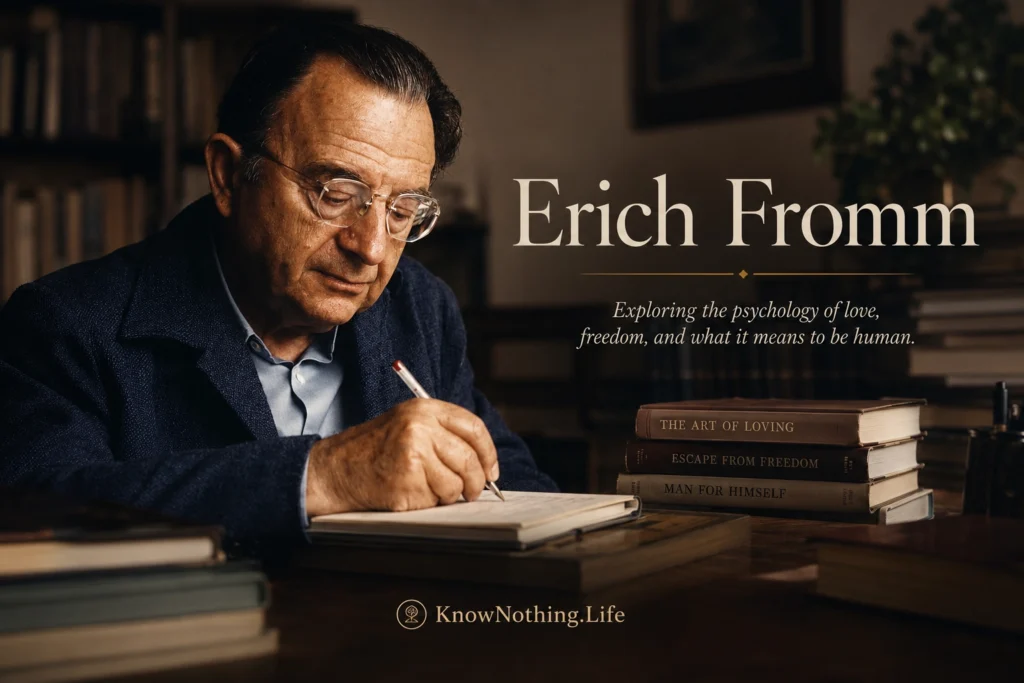
Erich Fromm was a German American social psychologist, psychoanalyst, philosopher, and public intellectual who sought to explain how society enters the human personality. He rejected the idea that individuals can be understood only through instincts, childhood conflicts, or private symptoms. Economic systems, family structures, religious traditions, and political ideologies also shape what people desire and fear. His humanistic psychoanalysis joined psychological insight with questions about freedom, responsibility, creativity, and human development.
His best-known books—Escape from Freedom, Man for Himself, The Sane Society, The Art of Loving, The Anatomy of Human Destructiveness, and To Have or to Be?—addressed a broad problem: why do people so often surrender their capacities for reason, love, and independence? Fromm believed that people are formed by society without being permanently trapped by it. They can recognize the forces shaping them and cultivate more productive ways of relating to themselves, other people, and the world.
Early Life and Intellectual Formation
Erich Seligmann Fromm was born in Frankfurt am Main on March 23, 1900, the only child of Orthodox Jewish parents Naphtali Fromm and Rosa Krause. Religious study, family tension, and the First World War shaped his early life. He was disturbed by ordinary Europeans’ embrace of nationalism and mass killing, an experience that helped create a question central to his career: why do people abandon independent judgment and submit to authorities or collective passions that diminish life?
Fromm briefly studied law at the University of Frankfurt before moving to Heidelberg, where he studied sociology under Alfred Weber and earned his doctorate in 1922. His dissertation examined Jewish law and diaspora life, and he later trained in psychoanalysis in Munich and Berlin. In 1929, he helped establish the South German Institute for Psychoanalysis in Frankfurt. The following year, he joined the Institute for Social Research, later associated with the Frankfurt School, to connect unconscious motivation with social structure.
Freud, Marx, and Exile
Fromm admired Sigmund Freud for revealing the importance of unconscious motives, but he rejected Freud’s tendency to explain human character primarily through biological drives. People, Fromm argued, adapt psychologically to the requirements of their societies. Capitalism, authoritarianism, and family life encourage characteristic forms of dependency, ambition, conformity, or possessiveness. He called this pattern social character: the emotional orientation that makes people want to act in ways their society requires. Fromm attempted to connect Marx’s theory of alienation with Freud’s account of unconscious conflict.
The rise of Nazism gave these questions immediate urgency. Fromm left Germany and arrived in the United States in 1934, continuing his work in New York after separating from the Institute for Social Research in 1939. He became an American citizen in 1940 and taught at the New School for Social Research and Bennington College. Disagreements with orthodox Freudians moved him toward a more relational and culturally grounded psychoanalysis. Rather than asking only how a patient could adjust to society, Fromm asked whether society itself was healthy enough to deserve adjustment.
Escape from Freedom and the Burden of Individuality
Fromm’s first major English-language book, Escape from Freedom, appeared in 1941. It examined a paradox of modern history: people had gained freedom from traditional authorities and inherited roles, yet many experienced individuality as isolation and powerlessness. Freedom from external control did not automatically create the inner strength needed for freedom to act, think, and love productively. When independence became unbearable, individuals could seek relief through submission, domination, destructiveness, or automatic conformity.
These mechanisms helped Fromm interpret fascism without treating it as an inexplicable eruption of madness. Authoritarian movements offered frightened individuals identity, certainty, and participation in something apparently stronger than themselves. Conformity provided another escape by encouraging people to adopt the personality expected by their culture while believing their preferences were entirely their own. Fromm’s conclusion was unsettling: “Destructiveness is the outcome of unlived life.” When society blocks human development, frustrated vitality may be redirected toward hatred, cruelty, or self-destruction.
Character, Ethics, and the Productive Life
In Man for Himself, published in 1947, Fromm developed a humanistic ethics grounded in the fulfillment of human capacities rather than obedience to external commands. He distinguished the productive character orientation from receptive, exploitative, hoarding, and marketing orientations. The productive person uses reason, works creatively, and relates to others without possessing them. Fromm did not mean productivity only in the economic sense. He meant the active realization of one’s powers through meaningful work, independence, reason, and care.
His statement that “Man’s main task in life is to give birth to himself” expressed this developmental ideal. A person is not born as a finished self but must gradually become capable of living deliberately. Market society, however, encourages individuals to experience personality as a commodity whose value depends on demand. People learn to package themselves, monitor approval, and become whatever appears employable or attractive. Fromm’s critique anticipated later concerns about personal branding, consumer identity, and the pressure to convert personality into market value.
The Art of Loving
Fromm reached his largest audience with The Art of Loving, published in 1956. He challenged the assumption that love is mainly a fortunate feeling produced by meeting the right person. People often concentrate on becoming lovable or securing affection while neglecting the capacity to love. For Fromm, love is an art requiring discipline, patience, concentration, humility, and practice. It is not merely emotional intensity and cannot be reduced to romantic attraction.
Mature love includes care, responsibility, respect, and knowledge. Fromm summarized its active nature by writing, “Love is the active concern for the life and the growth of that which we love.” Care without respect can become control, while responsibility without knowledge can become intrusive. Love permits closeness without erasing individuality and therefore differs from dependence, domination, or narcissistic attachment. Fromm extended this principle beyond couples to parental love, self-love, brotherly love, and love of humanity.
Society, Destructiveness, and the Having Mode
In The Sane Society, Fromm reversed the usual question of mental health. Instead of assuming that the majority must be normal because it functions successfully, he asked whether an entire society could encourage alienated ways of living. Industrial capitalism had produced material abundance, yet it often transformed workers and consumers into passive objects governed by bureaucracy and the market. A person could be socially successful while remaining inwardly powerless and unable to experience work or relationships as genuinely their own.
Later books deepened this critique. The Anatomy of Human Destructiveness distinguished defensive aggression from cruelty pursued for domination, while To Have or to Be? contrasted two fundamental orientations. The having mode bases identity on possession, control, consumption, and accumulation; the being mode emphasizes experience, creativity, sharing, and participation. Fromm captured the insecurity of possessive identity with the question, “If I am what I have and if what I have is lost, who then am I?” His argument was not that property is inherently immoral, but that possession becomes destructive when it defines the self.
Later Career and Lasting Influence
Fromm moved to Mexico in 1949, joined the National Autonomous University of Mexico, and helped establish psychoanalytic training there. He also taught at Michigan State University and New York University while maintaining a clinical practice. His interests expanded into religion, socialism, nuclear disarmament, technology, and community life. Works such as Psychoanalysis and Religion, The Forgotten Language, Marx’s Concept of Man, The Revolution of Hope, and You Shall Be as Gods reveal the unusual range of his humanistic project.
In 1974, Fromm moved to Muralto, Switzerland, where he died on March 18, 1980, five days before his eightieth birthday. His influence survives in humanistic psychology, critical theory, psychotherapy, political psychology, religious studies, and critiques of consumer culture. Fromm’s enduring contribution was his insistence that psychological health cannot be separated from social conditions or ethical purpose. He asked not merely how people avoid illness, but how they become more alive—capable of reason without coldness, individuality without isolation, and love without possession.