Sigmund Freud is one of the most influential and controversial figures in the history of psychology. His work fundamentally transformed how we understand the human mind, introducing the idea that much of our behavior is driven by unconscious processes beyond our immediate awareness. Through the development of psychoanalysis, Freud created a framework for exploring the hidden dimensions of thought, emotion, and desire.
Freud’s ideas extended far beyond clinical practice, shaping fields such as literature, philosophy, and cultural theory. Concepts like repression, the unconscious, and the interpretation of dreams have become embedded in everyday language, reflecting the enduring impact of his work. While many of his theories have been debated and revised, his role in opening up the inner world of the mind remains unparalleled.
Early Life and Intellectual Formation
Sigmund Freud was born on May 6, 1856, in Freiberg, Moravia (now part of the Czech Republic), into a Jewish family that later moved to Vienna. From an early age, Freud displayed exceptional intellectual ability, excelling in his studies and developing a keen interest in science. He pursued medicine at the University of Vienna, specializing in neurology, where he conducted research on the brain and nervous system.
Freud’s early career was rooted in the scientific traditions of his time, influenced by figures such as Jean-Martin Charcot, whose work on hysteria and hypnosis introduced Freud to the possibility that psychological factors could produce physical symptoms. This insight marked a turning point, leading Freud to shift his focus from purely physiological explanations to the exploration of the mind’s hidden processes.
Collaborating with Josef Breuer, Freud began to develop new methods for treating psychological disorders. Their work on hysteria, particularly the famous case of “Anna O.,” suggested that talking about repressed experiences could alleviate symptoms. This observation laid the groundwork for Freud’s later development of psychoanalysis.
The Birth of Psychoanalysis
Freud’s most significant contribution is the creation of psychoanalysis, a method of both investigation and treatment that seeks to uncover unconscious conflicts. Central to this approach is the idea that thoughts and behaviors are shaped by desires and memories that are not accessible to conscious awareness. Freud believed that bringing these unconscious elements into consciousness could lead to insight and healing.
One of the key techniques of psychoanalysis is free association, in which patients are encouraged to speak openly about whatever comes to mind. This process allows hidden thoughts and patterns to emerge, revealing the underlying dynamics of the psyche. Freud also emphasized the importance of dreams, viewing them as a window into the unconscious.
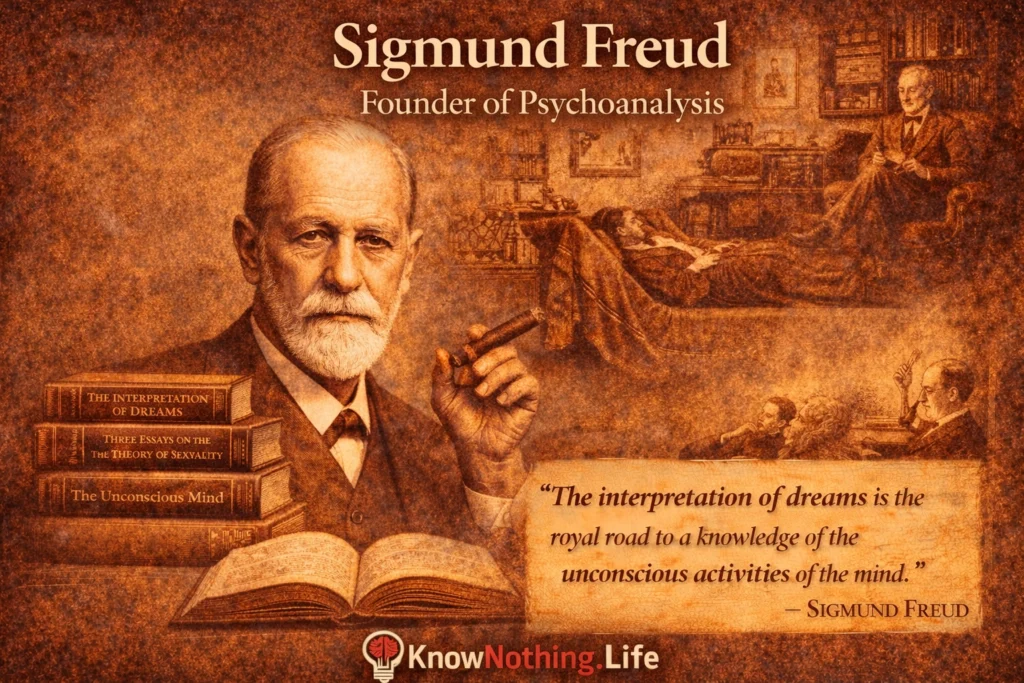
He famously wrote, “The interpretation of dreams is the royal road to a knowledge of the unconscious activities of the mind.” This statement encapsulates his belief that dreams provide access to deeper layers of meaning, offering clues about repressed desires and unresolved conflicts. Through psychoanalysis, Freud sought to map the complex terrain of the human psyche.
Major Works and Theoretical Framework
Freud’s ideas are articulated in a series of influential works that continue to shape psychological thought. Among the most important is The Interpretation of Dreams, in which he presents his theory of dreams as expressions of unconscious wish fulfillment. This work established many of the core concepts of psychoanalysis and remains one of his most widely read texts.
Another key contribution is Three Essays on the Theory of Sexuality, where Freud outlines his theory of psychosexual development. He proposed that personality is shaped by a series of developmental stages, each associated with different forms of pleasure and conflict. While controversial, this theory introduced the idea that early childhood experiences play a crucial role in shaping adult behavior.
Freud also developed a structural model of the psyche, consisting of the id, ego, and superego. The id represents instinctual drives, the ego mediates between these drives and reality, and the superego embodies internalized moral standards. This framework provides a way of understanding the internal conflicts that influence human behavior.
The Unconscious, Repression, and Human Behavior
At the heart of Freud’s theory is the concept of the unconscious, a realm of thoughts, memories, and desires that operate outside of conscious awareness. Freud argued that the unconscious exerts a powerful influence on behavior, shaping actions in ways that individuals may not fully understand. This idea challenged the prevailing view of humans as rational and self-aware beings.
Repression plays a central role in this framework. Freud believed that unacceptable thoughts and desires are pushed into the unconscious, where they continue to influence behavior indirectly. Symptoms such as anxiety, dreams, and slips of the tongue—often referred to as “Freudian slips”—are seen as expressions of these repressed elements.
Freud’s perspective on human nature is both complex and unsettling. He emphasized the role of conflict, suggesting that individuals are constantly negotiating between competing desires and social constraints. As he famously observed, “The ego is not master in its own house.” This insight underscores the limits of conscious control and the depth of unconscious influence.
Influence, Criticism, and Legacy
Sigmund Freud’s influence extends far beyond psychology, shaping disciplines such as literature, art, and philosophy. His ideas about the unconscious and symbolism have inspired countless interpretations of human behavior and culture. Psychoanalysis, as both a theory and a practice, has had a lasting impact on psychotherapy and mental health treatment.
However, Freud’s work has also been the subject of significant criticism. Some of his theories, particularly those related to sexuality and development, have been challenged for lacking empirical support. Others have argued that his methods are too subjective to meet scientific standards. Despite these critiques, many of his core ideas continue to be explored and refined.
Freud’s legacy is best understood as both foundational and provocative. He opened up new ways of thinking about the mind, even as later thinkers revised and expanded upon his ideas. Figures such as Carl Jung and Jacques Lacan built on his work, developing their own approaches to understanding the unconscious.
Conclusion
Sigmund Freud’s contributions to psychology represent a turning point in the study of the human mind. By introducing the concept of the unconscious and developing psychoanalysis, he transformed how we understand thought, emotion, and behavior. His work revealed the complexity of the psyche, challenging assumptions about rationality and self-awareness.
While his theories continue to be debated, their influence remains undeniable. Freud’s ideas have become part of the cultural and intellectual fabric, shaping how we think about ourselves and others. His exploration of the hidden dimensions of the mind continues to inspire inquiry and reflection.
In the end, Freud’s legacy lies in his willingness to confront the unknown. By venturing into the depths of the unconscious, he opened a new frontier in the understanding of human nature—one that continues to unfold to this day.