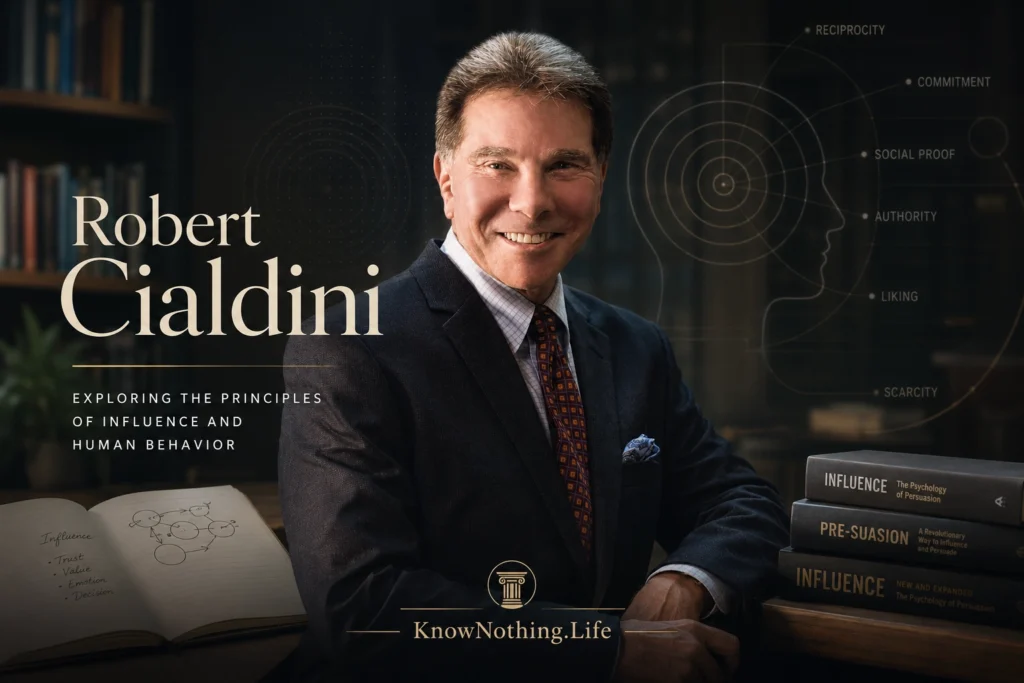
Robert B. Cialdini is an American social psychologist whose work changed how researchers, businesses, public institutions, and ordinary people understand persuasion. Rather than portraying influence as a mysterious talent possessed by charismatic individuals, he showed that agreement often follows recurring psychological principles. People respond to favors, commitments, experts, social evidence, personal affinity, limited opportunities, and shared identity in patterned ways. Cialdini organized these patterns into a practical framework while grounding them in experimental social psychology. His work also taught readers to recognize when the same principles are being used against them.
His most famous book, Influence: The Psychology of Persuasion, became a foundational text in behavioral science and business communication. Yet his career extends beyond that bestseller. His academic studies examined compliance, social identity, public image, environmental norms, and decision-making, while later books such as Pre-Suasion, Yes!: 50 Scientifically Proven Ways to Be Persuasive, and The Small BIG translated research into accessible strategies. Throughout this work, he emphasized that persuasion is not identical to coercion. Ethical influence helps people notice truthful and relevant information; manipulation conceals or fabricates it.
Early Life and Academic Formation
Cialdini was born on April 27, 1945, and grew up in Milwaukee, Wisconsin. As a teenager, he was a talented baseball player and briefly considered pursuing the sport professionally. A minor-league scout reportedly encouraged him to attend college instead. Cialdini studied psychology at the University of Wisconsin, earning his bachelor’s degree in 1967, and completed a doctorate in social psychology at the University of North Carolina at Chapel Hill in 1970. He then undertook postgraduate training at Columbia University.
He joined Arizona State University, where he built a career combining social psychology with questions relevant to marketing and organizational behavior. He eventually became Regents’ Professor of Psychology and Marketing and later Regents’ Professor Emeritus. Cialdini also held visiting appointments at Ohio State University, the University of California, the Annenberg School for Communication, and Stanford University’s Graduate School of Business. His election to the American Academy of Arts and Sciences in 2018 and the National Academy of Sciences in 2019 reflected the scholarly influence of research known far beyond universities.
Going Undercover to Study Influence
Cialdini became dissatisfied with studying persuasion only through laboratory situations. To understand how compliance professionals operated in everyday life, he spent nearly three years entering settings where eliciting agreement was central to the job. He trained and worked alongside automobile salespeople, fundraisers, advertisers, and other practitioners who depended upon getting customers or donors to say yes. This participant-observation research allowed him to compare marketplace techniques with findings from controlled experiments.
The approach gave Influence its distinctive character. Instead of presenting persuasion as a collection of tricks, Cialdini searched for the deeper rules that made different tactics effective. A free sample, a concession during negotiation, a celebrity endorsement, and a limited-time offer may look unrelated, but each activates a broader social or cognitive tendency. He treated the repeated successes of experienced practitioners as clues worth investigating, then asked whether the mechanisms could be demonstrated, limited, or reversed through research.
Influence and the Principles of Persuasion
First published in 1984, Influence organized compliance techniques around six principles: reciprocity, commitment and consistency, social proof, liking, authority, and scarcity. Reciprocity describes the pressure to return benefits or concessions; as Cialdini’s official summary puts it, “people are obliged to give back” after receiving something first. Commitment and consistency explain why people try to align later behavior with earlier choices. Social proof becomes especially powerful under uncertainty, when people look to similar others for evidence of correct behavior.
Liking increases agreement through similarity, familiarity, cooperation, and genuine praise, while authority directs attention toward credible expertise. Scarcity makes opportunities appear more valuable when availability is limited or threatened. The expanded edition of Influence added unity, concerning shared identity and the sense that another person belongs to the same “we.” Cialdini did not describe these shortcuts as inherently irrational. They often enable efficient decisions. Trouble begins when persuaders manufacture the evidence that normally makes the shortcut reliable.
Social Identity, Norms, and Public Behavior
Cialdini’s 1976 paper “Basking in Reflected Glory: Three (Football) Field Studies,” written with several colleagues, examined how students publicly connected themselves to successful university teams. They wore more school-identifying clothing after victories and used “we” more often when describing wins. The paper memorably noted that fans chant “We’re number one,” not “They’re number one.” The work demonstrated how affiliation with a successful group can enhance public identity even when the individual contributed nothing to the achievement.
Cialdini also helped develop the focus theory of normative conduct, distinguishing descriptive norms—what people commonly do—from injunctive norms—what people approve or disapprove. His field studies showed that norms guide behavior most strongly when attention is directed toward them. A warning that many visitors steal protected objects may unintentionally advertise theft as normal, even while condemning it. Better communication highlights the undesirable act while showing that most people refrain from it. This research influenced environmental campaigns, charitable appeals, tax compliance, and other public messages.
Pre-Suasion, Ethics, and Responsible Influence
In Pre-Suasion: A Revolutionary Way to Influence and Persuade, published in 2016, Cialdini shifted attention from the content of a request to the moment before it. Effective persuaders create conditions that make certain ideas mentally accessible. A question, image, setting, or opening topic can direct attention toward a concept that shapes what follows. The goal is not always to change beliefs directly, but to influence which beliefs are most prominent when a decision is made. Cialdini illustrated this with language, observing that asking for an “opinion” can invite criticism, while asking for “advice” encourages collaboration.
The same knowledge can support public health and charitable giving or enable false urgency and borrowed authority. Cialdini argues that ethical influence should rely on genuine features already present in a situation: relevant expertise, real popularity, authentic scarcity, or an existing shared identity. His books therefore discuss defense as well as application. Recognizing a free gift as an attempt to trigger obligation, or noticing that an endorsement comes from a paid spokesperson, can restore deliberation when automatic responses are being activated for another person’s benefit.
Major Works and Lasting Influence
Cialdini’s major books form a sustained project connecting behavioral research with practical communication. Influence remains the central work, while Influence: Science and Practice offered a more academic version of the framework. Pre-Suasion examined the preparation of attention before a message. With Noah Goldstein and Steve Martin, Cialdini coauthored Yes!: 50 Scientifically Proven Ways to Be Persuasive and The Small BIG: Small Changes That Spark Big Influence, emphasizing that modest contextual changes can produce substantial behavioral effects.
His influence appears in behavioral economics, public policy, fundraising, marketing, leadership, health communication, and digital design. The framework readily maps onto social media: popularity counts generate social proof, disappearing offers create scarcity, online personalities cultivate liking, and group identity activates unity. Yet Cialdini’s deepest contribution is methodological and moral. He made persuasion observable without reducing people to passive targets. By revealing the social cues that shape fast decisions, he made influence easier to use responsibly—and harder to hide.