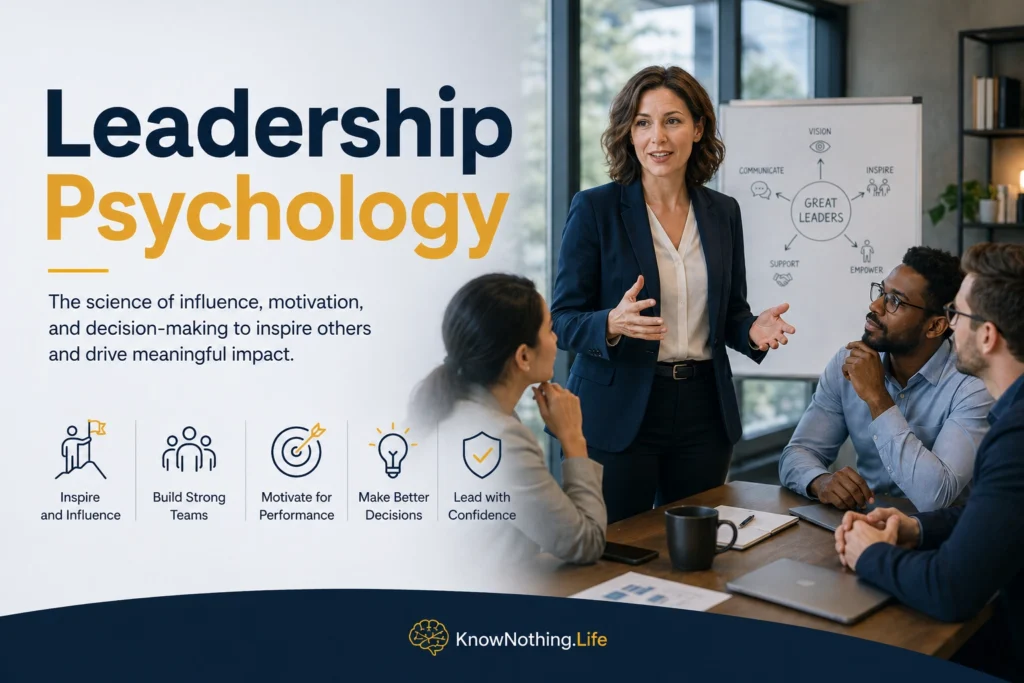
Leadership psychology is the scientific study of how psychological processes shape leadership behavior, effectiveness, and influence within groups and organizations. It examines how leaders think, feel, decide, and interact with others, as well as how followers perceive and respond to leadership. Rather than focusing solely on authority or position, leadership psychology emphasizes the dynamic relationship between leaders and followers, recognizing that influence emerges through social interaction, perception, and shared meaning.
The field has grown alongside industrial-organizational psychology, reflecting the increasing complexity of modern organizations. Early conceptions of leadership often emphasized innate traits, suggesting that leaders are born rather than made. However, contemporary research has shifted toward a more nuanced understanding that integrates personality, cognition, emotional intelligence, and situational factors. As social psychologist Kurt Lewin observed, “Leadership is not a position or a title, it is a process of social influence,” highlighting the relational nature of leadership.
Trait Theories and Leader Characteristics
Trait theories represent some of the earliest attempts to understand leadership, focusing on identifying the characteristics that distinguish effective leaders from others. Early research sought to isolate specific traits, such as intelligence, confidence, and decisiveness, that were believed to predict leadership success. While initial efforts produced inconsistent results, later studies refined this approach by examining broader personality dimensions.
The Five-Factor Model of personality has been particularly influential in this area, with traits such as extraversion and conscientiousness consistently associated with leadership effectiveness. Research by Timothy A. Judge and colleagues has shown that extraversion is one of the strongest predictors of leadership emergence. However, trait theories alone cannot fully explain leadership, as they do not account for situational variables or the dynamic nature of influence. This limitation led to the development of more comprehensive models that consider context and behavior.
Behavioral Theories of Leadership
Behavioral theories shifted the focus from who leaders are to what leaders do, emphasizing observable actions and styles of leadership. Early studies at Ohio State and the University of Michigan identified two key dimensions of leadership behavior: task-oriented and relationship-oriented. Task-oriented leaders focus on achieving goals and maintaining structure, while relationship-oriented leaders prioritize interpersonal connections and employee well-being.
These findings laid the groundwork for leadership development, suggesting that effective leadership behaviors can be learned and practiced. As management theorist Douglas McGregor noted in his Theory X and Theory Y framework, assumptions about human nature influence leadership style. Leaders who adopt a Theory Y perspective—believing that employees are self-motivated and capable—are more likely to foster engagement and creativity. Behavioral theories thus highlight the importance of leadership style in shaping organizational outcomes.
Contingency and Situational Leadership
Contingency theories emerged in response to the limitations of trait and behavioral approaches, emphasizing that the effectiveness of leadership depends on the context. These theories argue that there is no single best style of leadership; instead, effective leadership requires adapting to the demands of the situation, including the characteristics of followers, the nature of the task, and the organizational environment.
One of the most influential models is Fiedler’s contingency theory, developed by Fred Fiedler, which suggests that leadership effectiveness depends on the match between a leader’s style and the level of situational control. Similarly, situational leadership theory, proposed by Paul Hersey and Kenneth Blanchard, emphasizes adjusting leadership style based on the readiness and competence of followers. These approaches underscore the importance of flexibility and adaptability in leadership, recognizing that different situations require different responses.
Transformational and Transactional Leadership
Transformational and transactional leadership represent two of the most widely studied approaches in leadership psychology. Transactional leadership is based on exchanges between leaders and followers, using rewards and penalties to achieve compliance and performance. This approach is effective for maintaining structure and achieving short-term goals, but it may not inspire long-term commitment or innovation.
In contrast, transformational leadership focuses on inspiring and motivating followers to achieve higher levels of performance and personal development. Developed by Bernard Bass and building on the work of James MacGregor Burns, this model emphasizes vision, charisma, and individualized consideration. Bass argued that transformational leaders “raise followers to higher levels of motivation and morality,” fostering a sense of purpose and shared identity. Research has consistently shown that transformational leadership is associated with higher levels of satisfaction, engagement, and organizational performance.
Emotional Intelligence and Leadership
Emotional intelligence has become a central concept in leadership psychology, reflecting the importance of understanding and managing emotions in social interactions. Leaders with high emotional intelligence are better able to perceive and respond to the emotions of others, build strong relationships, and navigate complex social dynamics.
The concept was popularized by Daniel Goleman, who argued that “emotional intelligence is a key factor in leadership success.” Goleman identified components such as self-awareness, self-regulation, motivation, empathy, and social skills as essential for effective leadership. These abilities enable leaders to create positive work environments, resolve conflicts, and inspire trust. Emotional intelligence thus complements cognitive abilities, highlighting the importance of interpersonal skills in leadership effectiveness.
Leadership and Organizational Culture
Leaders play a crucial role in shaping organizational culture, influencing values, norms, and behaviors within the workplace. Culture is not only a reflection of organizational practices but also a product of leadership decisions and actions. Leaders set the tone for how employees interact, make decisions, and approach their work.
Research by Edgar Schein has emphasized that leaders are primary architects of culture, as they create and reinforce shared assumptions through their behavior. Schein defines culture as “a pattern of shared basic assumptions learned by a group,” highlighting its deep and often unconscious nature. Effective leaders align culture with organizational goals, fostering environments that support innovation, collaboration, and well-being. This alignment is critical for sustaining long-term success.
Ethical Leadership and Responsibility
Ethical leadership is an essential aspect of leadership psychology, focusing on the moral principles that guide decision-making and behavior. Leaders are often faced with complex ethical dilemmas, requiring them to balance competing interests and values. Ethical leadership involves not only making the right decisions but also creating a culture of integrity and accountability.
Philosopher Immanuel Kant argued that moral actions should be guided by universal principles, a perspective that has influenced modern ethical frameworks. In organizational contexts, ethical leadership is associated with trust, fairness, and transparency. Leaders who demonstrate ethical behavior set an example for others, promoting a culture of responsibility and respect. As business ethicist Linda Treviño has noted, “Ethical leaders influence employees’ behavior by modeling ethical conduct and reinforcing it through organizational systems,” highlighting the role of leadership in shaping ethical climates.
Leadership Development and Training
Leadership is not only an inherent trait but also a set of skills that can be developed through training and experience. Leadership development programs focus on enhancing competencies such as communication, decision-making, and emotional intelligence. These programs often include coaching, mentoring, and experiential learning opportunities.
Research has shown that effective leadership development requires both theoretical knowledge and practical application. As organizational psychologist David Day has argued, “Leadership development is a continuous process rather than a one-time event,” emphasizing the importance of ongoing learning. By investing in leadership development, organizations can build a pipeline of capable leaders who are prepared to navigate complex challenges.
Future Directions in Leadership Psychology
The future of leadership psychology is being shaped by changes in technology, globalization, and workforce dynamics. Remote work, digital communication, and diverse teams are creating new challenges for leaders, requiring them to adapt their approaches to different contexts. These changes highlight the importance of flexibility, cultural competence, and digital literacy in leadership.
There is also growing emphasis on inclusive leadership, which focuses on creating environments where diverse perspectives are valued and integrated. This approach recognizes that diversity can enhance creativity and decision-making, but only if it is effectively managed. As organizations continue to evolve, leadership psychology will play a critical role in understanding and guiding these changes, ensuring that leaders are equipped to meet the demands of the future.
Conclusion
Leadership psychology provides a comprehensive framework for understanding how leaders influence individuals and organizations. By integrating insights from trait, behavioral, and situational theories, it offers a nuanced perspective on what makes leadership effective. From emotional intelligence to ethical responsibility, the field highlights the complex interplay of factors that shape leadership behavior.
Ultimately, leadership is not simply about authority or control, but about influence, relationships, and shared purpose. By applying the principles of leadership psychology, organizations can develop leaders who inspire, support, and guide others toward collective success.