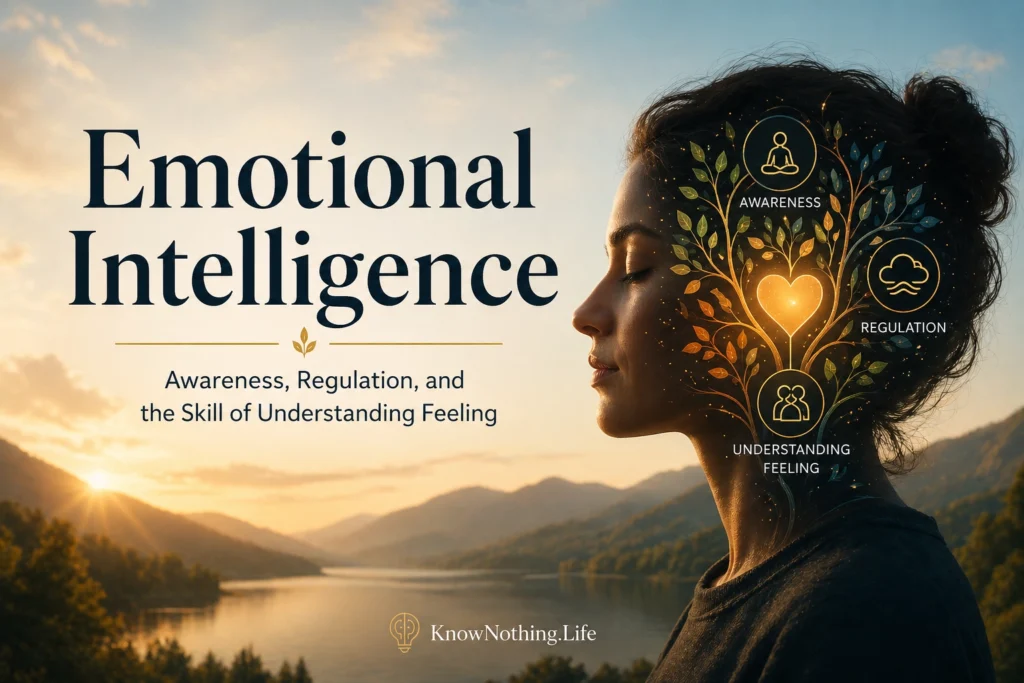
Emotional intelligence (EI) refers to the ability to perceive, understand, manage, and use emotions effectively in oneself and others. It represents a shift away from viewing intelligence solely as cognitive capacity and toward a broader understanding of human competence that includes emotional and social functioning. In everyday life, emotional intelligence influences how individuals navigate relationships, cope with stress, make decisions, and interpret the behavior of others.
The concept gained prominence through the work of Daniel Goleman, whose book Emotional Intelligence brought the idea into public consciousness. Goleman argued that “in a very real sense we have two minds, one that thinks and one that feels,” emphasizing that effective functioning depends on the integration of both. While earlier psychological theories often separated emotion from cognition, emotional intelligence highlights their interdependence, suggesting that emotional skills are as essential as intellectual ones.
Theoretical Foundations
The scientific foundation of emotional intelligence was established by Peter Salovey and John D. Mayer, who defined EI as a set of abilities related to processing emotional information. Their model conceptualizes emotional intelligence as a form of intelligence comparable to traditional cognitive abilities, involving skills that can be measured and developed.
Salovey and Mayer’s framework includes four key components: perceiving emotions, using emotions to facilitate thinking, understanding emotions, and managing emotions. These components form a hierarchy, with basic perceptual abilities supporting more complex forms of emotional reasoning and regulation. This model emphasizes that emotional intelligence is not a vague personality trait but a structured set of competencies.
The theoretical development of EI also draws on earlier work in social intelligence and multiple intelligences. Psychologist Howard Gardner proposed that intelligence is not a single entity but a collection of distinct abilities, including interpersonal and intrapersonal intelligence. Emotional intelligence can be seen as an extension of these ideas, focusing specifically on the role of emotion in cognition and behavior.
Components of Emotional Intelligence
Emotional intelligence is typically divided into several core components, each contributing to effective emotional functioning. Self-awareness involves recognizing one’s own emotions and understanding their impact on thoughts and behavior. This ability forms the foundation of EI, as it enables individuals to identify and reflect on their internal states.
Self-regulation refers to the ability to manage emotions, particularly in challenging situations. This includes controlling impulsive reactions, adapting to change, and maintaining emotional balance. Individuals with strong self-regulation are able to respond thoughtfully rather than react automatically, enhancing both personal and social outcomes.
Social awareness and relationship management extend emotional intelligence to interactions with others. Social awareness involves empathy—the ability to understand and share the feelings of others—while relationship management includes skills such as communication, conflict resolution, and collaboration. Together, these components enable individuals to navigate complex social environments effectively.
Emotional Intelligence and the Brain
The biological basis of emotional intelligence lies in the interaction between brain regions involved in emotion and cognition. The amygdala plays a key role in detecting emotional stimuli and generating responses, while the prefrontal cortex is involved in regulating these responses and integrating them with higher-order thinking.
Neuroscientist Joseph LeDoux has demonstrated that emotional processing can occur through both rapid, automatic pathways and slower, more deliberate ones. Emotional intelligence involves the ability to engage these systems effectively, allowing for both quick responses and thoughtful regulation.
Goleman introduced the concept of the “amygdala hijack” to describe situations in which emotional responses override rational thinking. Emotional intelligence, in this context, involves the capacity to prevent or manage such hijacks, maintaining control over behavior even in emotionally charged situations. This interplay between brain systems highlights the integration of emotion and cognition that underlies EI.
Development of Emotional Intelligence
Emotional intelligence develops over time, influenced by both biological factors and social experience. Early interactions with caregivers play a crucial role, as children learn to recognize and regulate emotions through processes of attachment and socialization. These early experiences shape the development of emotional awareness and coping strategies.
Psychologist John Bowlby emphasized the importance of secure attachment in emotional development, suggesting that supportive relationships provide a foundation for effective regulation. Children who experience consistent and responsive caregiving are more likely to develop strong emotional skills, while those with less stable environments may face challenges in managing emotions.
Education and social context also contribute to the development of EI. Programs that teach emotional skills, such as recognizing emotions and resolving conflicts, have been shown to improve both academic performance and social outcomes. This suggests that emotional intelligence is not fixed but can be cultivated through experience and practice.
Emotional Intelligence in Everyday Life
Emotional intelligence plays a significant role in everyday functioning, influencing how individuals handle stress, make decisions, and interact with others. In the workplace, EI is associated with leadership, teamwork, and effective communication. Leaders with high emotional intelligence are better able to motivate and support others, creating positive and productive environments.
In personal relationships, emotional intelligence contributes to empathy, understanding, and conflict resolution. Individuals who can recognize and respond to the emotions of others are more likely to build strong and meaningful connections. This capacity for emotional attunement is essential for maintaining healthy relationships.
Decision-making is another area where EI is important. Emotions provide valuable information about preferences and priorities, guiding choices in complex situations. As neuroscientist Antonio Damasio argued in Descartes’ Error, “emotion is integral to the processes of reasoning and decision-making.” Emotional intelligence enables individuals to use this information effectively, balancing emotional insight with rational analysis.
Critiques and Limitations
Despite its popularity, emotional intelligence has faced criticism. Some researchers argue that the concept overlaps with existing constructs, such as personality traits and social skills, raising questions about its distinctiveness. Others have questioned the validity of certain measures of EI, particularly those based on self-report.
There is also debate about the extent to which emotional intelligence can be considered a form of intelligence. Critics suggest that it may be better understood as a set of competencies or skills rather than a cognitive ability. This distinction has implications for how EI is measured and applied in research and practice.
Nevertheless, the concept has proven valuable in highlighting the importance of emotional processes in human functioning. Even if its boundaries are debated, the emphasis on emotional awareness and regulation has influenced a wide range of fields, from education to organizational psychology.
Conclusion
Emotional intelligence represents a comprehensive framework for understanding the role of emotion in human life. By integrating awareness, regulation, and social understanding, it provides a model for navigating the complexities of both internal experience and interpersonal relationships.
As research continues to refine the concept, emotional intelligence remains a powerful tool for enhancing well-being and effectiveness. It underscores that intelligence is not limited to abstract reasoning but includes the ability to understand and manage emotions. In doing so, it offers a more holistic view of human capability, recognizing that feeling and thinking are inseparable aspects of the mind.