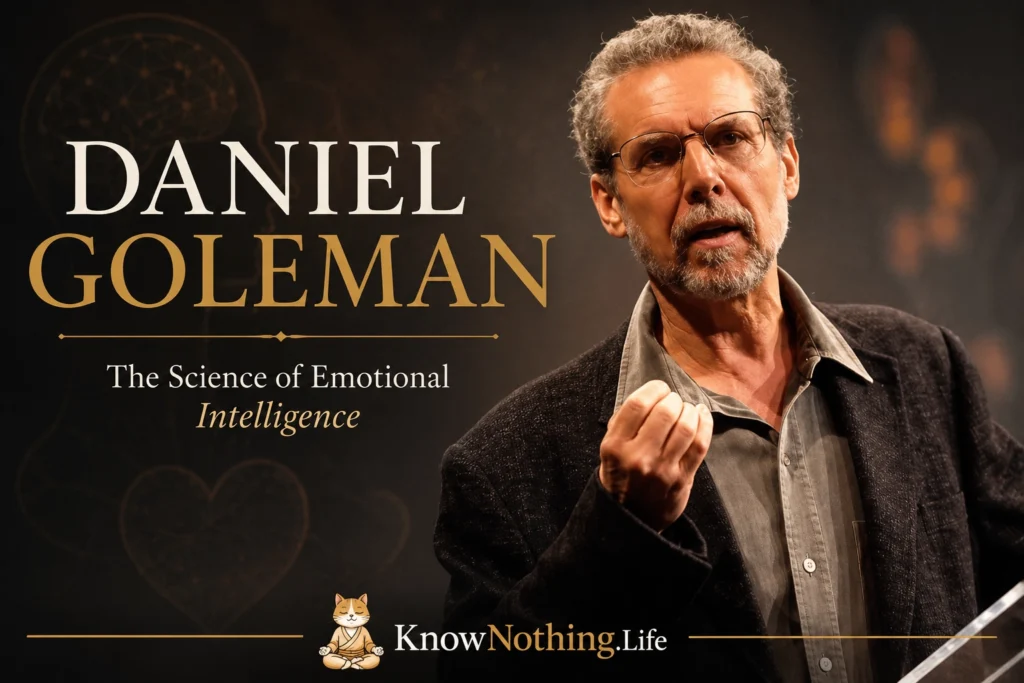
Daniel Goleman is an American psychologist, science journalist, and author whose work brought emotional intelligence into classrooms, workplaces, leadership programs, and everyday discussions of human ability. His 1995 bestseller Emotional Intelligence: Why It Can Matter More Than IQ challenged the assumption that academic intelligence alone determines success. Drawing together research from psychology, neuroscience, education, and behavioral science, Goleman argued that people also depend on the ability to recognize emotions, regulate impulses, understand others, sustain motivation, and manage relationships. His achievement was not the invention of emotional intelligence but its transformation from a specialized research concept into an internationally recognized framework for understanding personal and social effectiveness.
Goleman’s interests extend well beyond emotion. His books have explored meditation, self-deception, social connection, ecological awareness, attention, compassion, leadership, and the conditions that support optimal performance. Major works include The Meditative Mind, Vital Lies, Simple Truths, Working with Emotional Intelligence, Primal Leadership, Social Intelligence, Ecological Intelligence, Focus, Altered Traits, and Optimal. Across these subjects runs a consistent concern with how people can become more aware of the forces shaping their thoughts and behavior. Psychology, in Goleman’s hands, becomes a practical science of attention, responsibility, relationships, and human development.
Education, Meditation, and the Study of Consciousness
Born in Stockton, California, in 1946, Goleman grew up in an academic household and initially expected to become a university professor. He completed his undergraduate education through Amherst College and the University of California, Berkeley, before earning a doctorate from Harvard University’s Department of Social Relations in 1974. The interdisciplinary program combined psychology with sociology and anthropology, encouraging him to examine the mind within broader cultural and social settings. At Harvard, he studied with psychologist David McClelland, whose research on competencies later influenced Goleman’s approach to workplace performance and leadership.
A Harvard traveling fellowship took Goleman to India, where he studied traditional theories of the mind and meditation practices that had rarely appeared in Western psychology courses. A later postdoctoral grant allowed him to continue this work in India and Sri Lanka. These experiences informed his first book, originally published as The Varieties of the Meditative Experience and later revised as The Meditative Mind. After returning to Harvard, he taught a popular course on the psychology of consciousness. His early research established interests that would continue throughout his career: attention, emotional regulation, contemplative practice, and the possibility that mental habits can be deliberately trained.
From Academic Psychology to Science Journalism
Goleman’s career changed direction when McClelland recommended him for a position at Psychology Today. The magazine introduced him to science journalism and taught him how to translate complex findings without abandoning their intellectual substance. In 1984, he joined The New York Times, where he spent twelve years covering psychology, neuroscience, emotions, and human behavior. His reporting helped make scientific research understandable to readers who would never encounter the original academic literature. Harvard later honored this contribution by describing him as a major figure in bringing scientific psychology into mainstream public consciousness.
Journalism also allowed Goleman to recognize patterns across fields that researchers often studied separately. Reports on emotion, brain function, child development, impulse control, empathy, and interpersonal skill gradually suggested a larger story about intelligence. Newspaper articles could present isolated discoveries, but Goleman believed the evidence deserved a book-length synthesis. That project became Emotional Intelligence. Its success eventually led him to leave the newspaper and concentrate on writing, speaking, education, and organizational research. The book remained on The New York Times bestseller list for approximately eighteen months and was translated into dozens of languages.
Emotional Intelligence and a Broader Meaning of Ability
Psychologists Peter Salovey and John Mayer had introduced emotional intelligence as a scientific concept before Goleman’s book appeared. Their ability-based model emphasized perceiving, understanding, using, and regulating emotional information. Goleman popularized the term while broadening it to include competencies associated with motivation, empathy, self-control, and interpersonal effectiveness. This distinction matters because emotional intelligence is not a single uncontested theory or measurement system. Goleman’s model is best understood as an applied framework connecting emotional abilities with habits and competencies that influence behavior in schools, relationships, and organizations.
Goleman summarizes the idea by stating, “Emotional intelligence refers to a different way of being smart.” His model is commonly organized around four domains: self-awareness, self-management, social awareness, and relationship management. Self-awareness involves recognizing emotions and their influence on judgment. Self-management includes regulating disruptive reactions and adapting constructively. Social awareness centers on empathy and sensitivity to social environments, while relationship management includes communication, cooperation, inspiration, and conflict resolution. These abilities do not replace intellectual skill. They help determine how effectively people use their knowledge under emotional and interpersonal pressure.
Emotional Learning and the Development of Children
While writing Emotional Intelligence, Goleman became increasingly interested in bringing emotional skills into education. In 1993, he joined Eileen Growald, Tim Shriver, Roger Weissberg, and others in founding the Collaborative for Academic, Social, and Emotional Learning, commonly known as CASEL. The organization helped establish social and emotional learning as a structured educational movement. Its programs encourage students to identify feelings, regulate behavior, understand other perspectives, make responsible decisions, and maintain constructive relationships alongside conventional academic subjects.
This work reflected Goleman’s belief that emotional capacities can be strengthened rather than treated as fixed personality features. A child who struggles with frustration, attention, or social awareness is not necessarily condemned to retain the same patterns throughout life. Practice, feedback, supportive relationships, and appropriately designed environments can encourage new habits. The educational implications of this argument were considerable: schools should not concern themselves exclusively with information and examination scores while ignoring the skills that help students cope with conflict, stress, cooperation, and decision-making. Goleman’s public influence helped emotional literacy become part of wider conversations about what education is meant to accomplish.
Leadership and Emotional Competence at Work
Goleman extended his model into professional life with Working with Emotional Intelligence. He argued that technical knowledge and cognitive ability remain essential, especially when people are entering specialized fields, but they do not fully explain why some qualified employees become outstanding performers. Adaptability, initiative, emotional self-control, empathy, teamwork, and the ability to influence others often distinguish people whose formal qualifications appear similar. He also co-founded the Consortium for Research on Emotional Intelligence in Organizations to encourage more rigorous investigation of emotional and social competencies in workplace settings.
His Harvard Business Review essay “What Makes a Leader?” brought these arguments to executives and managers. Its central claim was direct: “IQ and technical skills are important,” but emotional intelligence is indispensable to leadership. In Primal Leadership, written with Richard Boyatzis and Annie McKee, Goleman explored how leaders influence the emotional climate of organizations. Effective leaders do more than issue instructions; their moods, attention, communication, and ability to respond to others can spread through a group. Leadership therefore requires emotional discipline as well as strategic intelligence, particularly during uncertainty, conflict, or rapid change.
Social Intelligence, Attention, and Human Connection
In Social Intelligence: The New Science of Human Relationships, Goleman shifted from managing individual emotions to examining what happens between people. Human interactions influence mood, stress, attention, and behavior through processes that frequently occur outside conscious awareness. Empathy is not merely recognizing that another person is distressed; social intelligence includes responding appropriately to that knowledge. Relationships can strengthen or destabilize people depending on whether they provide trust, attention, respect, and emotional safety. Goleman condensed the practical implication of this research into the advice, “Nourish your social connections.”
Focus: The Hidden Driver of Excellence placed attention at the center of performance and self-regulation. Goleman distinguished among inner focus, which supports self-awareness; focus on others, which enables empathy; and outer focus, which helps people understand systems and surrounding conditions. A leader or professional may fail by becoming excessively absorbed in any one area. Self-knowledge without social awareness can become self-preoccupation, while sensitivity to other people without broader systems thinking can produce short-sighted decisions. Excellence requires moving flexibly among these forms of attention and directing mental resources toward what a situation actually demands.
Meditation, Ecology, and Later Works
Goleman returned to his early interest in contemplative practice in Altered Traits, coauthored with neuroscientist Richard J. Davidson. The book examined scientific research on meditation while distinguishing temporary states experienced during practice from more durable changes in attention, emotion, and behavior. Rather than treating every claim made for meditation as established fact, the authors evaluated the strength and limitations of the available evidence. Goleman also participated in dialogues between scientists and the Dalai Lama, producing works including Healing Emotions, Destructive Emotions, and A Force for Good.
His later writing expanded emotional and social awareness into environmental life. Ecological Intelligence examined the hidden consequences of consumer choices and argued that individuals often lack the information required to understand a product’s full environmental and social effects. In Optimal, written with Cary Cherniss, Goleman returned to emotional intelligence as a resource for sustaining effective performance without treating constant intensity or burnout as signs of excellence. These books demonstrate the breadth of his project: awareness should extend inward toward one’s own emotions, outward toward other people, and further outward toward institutions and ecological systems.
Lasting Influence
Daniel Goleman’s most important contribution is his ability to synthesize specialized research into ideas that people can recognize and use. His work altered public language about intelligence by showing that competence includes how people respond to frustration, interpret social signals, direct attention, and build relationships. It also encouraged schools and organizations to treat emotional abilities as skills worthy of deliberate development. In 2023, Harvard awarded him its Centennial Medal for communicating psychology to broad audiences and for his foundational role in making emotional intelligence part of modern public thought.
His framework has also attracted legitimate debate. Researchers distinguish between emotional intelligence as a measurable ability, as a collection of personality characteristics, and as a set of workplace competencies. Popular programs marketed under the label “EQ” vary considerably in scientific quality, a problem Goleman himself has acknowledged. His lasting influence does not depend on the claim that emotional intelligence explains every form of achievement. It rests on a more defensible insight: intellectual ability is expressed through emotional and social life. Knowing what to do is rarely sufficient unless people can manage themselves, understand others, sustain attention, and act with awareness of their wider impact.