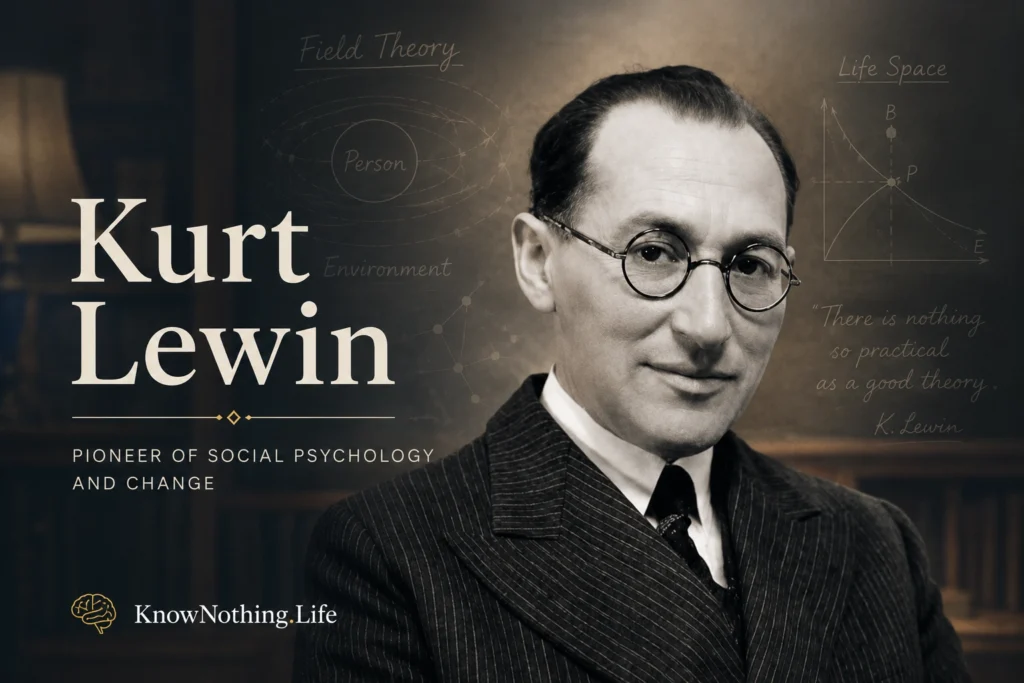
Kurt Lewin was a German American psychologist whose ideas helped establish modern social psychology, organizational psychology, group dynamics, and action research. At a time when much psychological research isolated individuals from their surroundings, Lewin argued that behavior could be understood only by examining the relationship between a person and the immediate environment. Thoughts, goals, social expectations, barriers, relationships, and group membership all formed part of a changing psychological field. His work replaced static descriptions of personality with a dynamic account of forces acting upon people within particular situations.
Lewin was equally committed to theory and practical social improvement. He studied children’s motivation, leadership styles, workplace relations, food habits, minority experiences, prejudice, and planned change. His major works include A Dynamic Theory of Personality, Principles of Topological Psychology, The Conceptual Representation and the Measurement of Psychological Forces, Resolving Social Conflicts, and Field Theory in Social Science. Although he died at fifty-six, his research supplied concepts and methods that continue to influence education, management, community psychology, public health, and institutional reform.
Early Life, War, and Psychological Education
Kurt Zadek Lewin was born on September 9, 1890, in Mogilno, then part of the Prussian province of Posen and now located in Poland. He was raised in a Jewish family and moved with his family to Berlin as a teenager. Lewin initially studied medicine and biology before turning increasingly toward philosophy and psychology. During the First World War, he served in the German army, was wounded, and continued working toward his doctorate while military service interrupted his academic life. He completed his Ph.D. at the University of Berlin in 1916.
After the war, Lewin became associated with Berlin’s influential community of Gestalt psychologists, including Max Wertheimer, Wolfgang Köhler, and Kurt Koffka. Gestalt psychology emphasized that organized wholes possess qualities that cannot be understood by examining isolated elements alone. Lewin applied this relational outlook to motivation, personality, and eventually social groups. He became a Privatdozent at the University of Berlin in 1921 and was promoted to an extraordinary professorship in 1927. His seminars attracted researchers who later became prominent psychologists, including Bluma Zeigarnik, whose experiments demonstrated the memorable effects of unfinished tasks.
Exile and an American Career
Lewin accepted a visiting appointment at Stanford University in 1932. When Adolf Hitler came to power the following year, anti-Jewish persecution made a secure return to German academic life impossible. Lewin emigrated permanently to the United States in 1933, first joining Cornell University and then becoming a professor at the University of Iowa in 1935. His mother remained in Europe and was later murdered during the Holocaust, giving his investigations of prejudice, dictatorship, minority status, and democratic culture an intensely personal historical setting.
At Iowa, Lewin worked within the Child Welfare Research Station and broadened his research from individual motivation to social influence and group life. He became an American citizen in 1940 and served as president of the Society for the Psychological Study of Social Issues in 1942. In 1944, he organized the Research Center for Group Dynamics at the Massachusetts Institute of Technology. He also helped establish the Commission on Community Interrelations through the American Jewish Congress, using research to address prejudice, discrimination, leadership, and relations among social groups.
Field Theory and the Life Space
Lewin’s field theory proposed that psychological events must be understood within the total situation existing at a particular time. He summarized this position through the formula B = f(P, E): behavior is a function of the person and the environment. The environment in this equation was not merely the objective physical setting. It included the environment as psychologically experienced, containing goals, fears, memories, relationships, expectations, opportunities, and obstacles that carried meaning for the individual. Person and environment formed an interdependent field rather than two separate causes that could be studied independently.
Lewin called the total psychological field the life space. He used diagrams, boundaries, regions, vectors, and forces to represent movement toward attractive goals or away from threatening situations. Principles of Topological Psychology, published in 1936, attempted to provide a formal language for these dynamic relationships. The diagrams could appear abstract, but they expressed an important practical insight: the same person may behave differently when the structure of the situation changes. Effective psychological explanation must therefore identify the forces operating now rather than rely exclusively on permanent traits or general labels.
Group Dynamics and Leadership
Lewin extended the logic of field theory from individuals to groups. A genuine group was not simply a collection of people who shared a visible characteristic; it was a dynamic whole whose members were interdependent. Changes affecting one member could alter relationships, expectations, and behavior across the group. This perspective encouraged psychologists to study communication, authority, norms, morale, cooperation, and conflict as properties of organized social systems. The Research Center for Group Dynamics became an institutional foundation for this new experimental study of collective behavior.
With Ronald Lippitt and Ralph White, Lewin conducted influential experiments comparing autocratic, democratic, and laissez-faire leadership climates in groups of children. The studies showed that leadership style could change aggression, cooperation, productivity, and the emotional atmosphere of a group. Democratic leadership generally encouraged participation and group involvement, while autocratic leadership could produce dependence and hostility. The experiments did not prove that one style is superior in every possible situation, but they demonstrated that social climates are experimentally observable and that leadership affects more than immediate task performance.
Action Research and Planned Change
Lewin rejected the separation of researchers from the communities and organizations they hoped to understand. He helped develop action research, an approach in which researchers and participants identify a problem, plan an intervention, act, evaluate the results, and revise their next steps. The process forms a continuing spiral of planning, action, and fact-finding rather than a single experiment followed by a detached publication. Lewin stated the practical standard directly: “Research that produces nothing but books will not suffice.” Knowledge should improve social practice while social action supplies new evidence for theory.
His wartime studies of food habits illustrated this principle. Lewin compared lectures and external requests with group discussions that allowed participants to make their own decisions. In one study involving foods that many households strongly resisted, substantially more participants acted after group decision than after hearing a conventional lecture. Lewin concluded that information alone often fails to change behavior because habits are supported by social norms, identities, routines, and channels of influence. Change becomes more likely when people participate in setting a goal and experience it as a meaningful group commitment.
Social Change, Theory, and Major Works
Lewin’s theory of planned change is frequently summarized as unfreezing, moving, and refreezing. In his original framework, established social behavior resembled a quasi-stationary equilibrium maintained by opposing forces. Change required weakening existing restraints or altering the balance of forces, moving toward a different level of conduct, and stabilizing the new pattern so that it would not immediately disappear. Modern management texts sometimes present this as a rigid three-step formula, but Lewin’s larger work emphasized continuing diagnosis, participation, feedback, and adjustment rather than mechanically imposing a permanent organizational state.
Lewin’s often-cited maxim, “There is nothing so practical as a good theory,” summarizes his refusal to choose between abstract science and useful intervention. A strong theory identifies relevant forces, suggests what evidence should be collected, and reveals where an intervention might succeed or fail. His posthumous collections Resolving Social Conflicts and Field Theory in Social Science brought together writings on minority problems, group decisions, cultural reconstruction, social equilibrium, conflict, and psychological fields. Together with his earlier books, they show a thinker attempting to construct a rigorous science capable of addressing real human problems.
Final Years and Lasting Influence
Lewin died unexpectedly of a heart attack in Massachusetts on February 12, 1947. His death came shortly after his work helped inspire the training laboratory movement that developed into the National Training Laboratories in Bethel, Maine. The experiential groups associated with this movement encouraged participants to examine communication, authority, feedback, and interpersonal behavior as those processes unfolded. Lewin did not live to direct the movement’s later development, but the institutions and researchers he brought together extended his influence through organizational development, leadership training, conflict resolution, and community intervention.
Lewin’s most enduring contribution was a way of thinking about human behavior as relational, contextual, and changeable. He showed that people cannot be understood apart from the groups and environments in which they act, yet those environments are not fixed realities beyond human influence. They can be investigated, redesigned, and transformed through democratic participation and disciplined research. His work made social psychology more experimental without making it socially indifferent, establishing a model of the psychologist as both theorist and participant in the difficult work of improving collective life.