Carl Jung stands as one of the most original and far-reaching thinkers in the history of psychology. While initially a close collaborator of Sigmund Freud, Jung eventually broke away to develop his own system—analytical psychology—expanding the understanding of the unconscious into realms that bridged psychology, mythology, religion, and symbolism. His work redefined the inner landscape of the human mind, emphasizing not only pathology but growth, meaning, and transformation.
Jung’s central insight was that the human psyche is not limited to personal experience. Beneath the individual unconscious lies a deeper layer shared by all humanity—a collective unconscious populated by universal patterns and symbols. This idea fundamentally altered the scope of psychology, opening it to the study of myths, dreams, and cultural expressions. Through his writings, Jung offered a vision of psychological development as a lifelong process of integration, culminating in what he called individuation.
Early Life and Intellectual Formation
Carl Gustav Jung was born on July 26, 1875, in Kesswil, Switzerland, into a family with strong religious roots. His father was a pastor, and his early life was shaped by theological discussions and spiritual questions. From a young age, Jung was deeply introspective, often reflecting on dreams, symbols, and inner experiences that would later become central to his work.
Jung studied medicine at the University of Basel, eventually specializing in psychiatry. His early professional work at the Burghölzli psychiatric hospital in Zurich exposed him to patients suffering from severe mental disorders, leading him to explore the relationship between language, emotion, and unconscious processes. His research into word association tests provided early evidence that hidden emotional complexes influence behavior.
Jung’s encounter with Freud marked a pivotal moment in his intellectual development. Freud saw Jung as a promising successor, and their collaboration was initially intense and productive. However, their differences—particularly regarding the role of sexuality and the nature of the unconscious—eventually led to a dramatic split. This break allowed Jung to pursue his own ideas, resulting in a distinct and influential body of work.
The Collective Unconscious and Archetypes
Jung’s most famous and transformative concept is the collective unconscious, a layer of the psyche that contains inherited patterns shared across humanity. Unlike the personal unconscious, which consists of repressed or forgotten experiences, the collective unconscious is universal and timeless, shaping human thought and behavior at a fundamental level.
Within this collective unconscious reside archetypes—recurring symbols and motifs that appear in myths, dreams, and cultural narratives. Examples include the Hero, the Shadow, the Anima and Animus, and the Self. These archetypes are not fixed images but dynamic patterns that manifest differently across cultures and individuals. Jung believed they serve as organizing principles for human experience, guiding both psychological development and cultural expression.
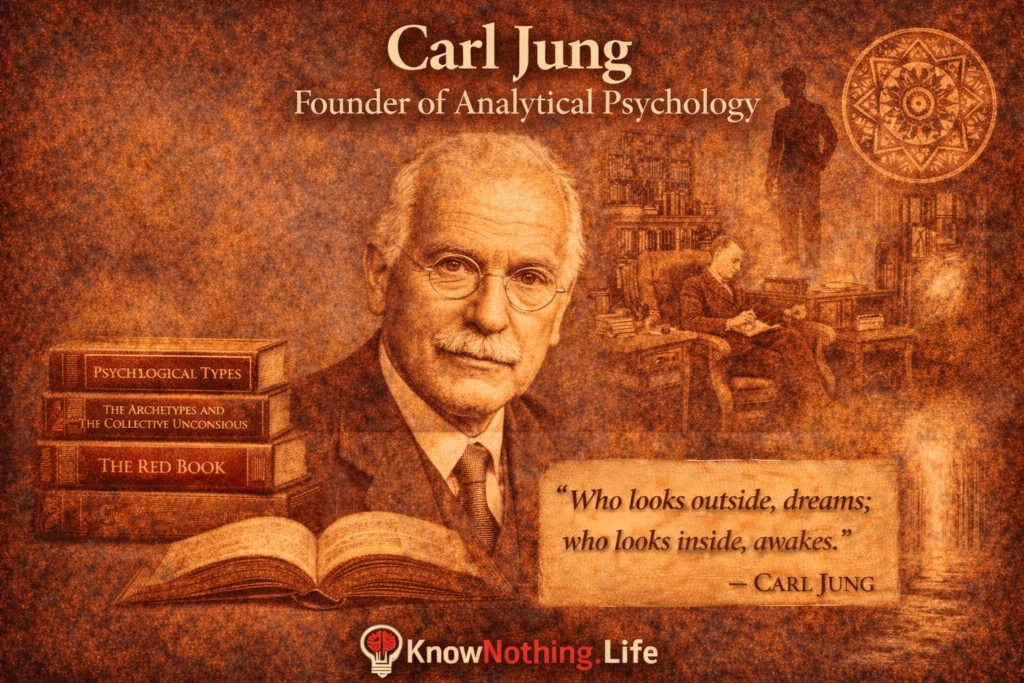
He wrote, “Who looks outside, dreams; who looks inside, awakes.” This statement reflects his emphasis on inner exploration as the path to understanding the deeper structures of the psyche. By engaging with archetypal symbols, individuals can gain insight into their own psychological processes and connect with universal aspects of human existence.
Major Works and Analytical Psychology
Jung’s ideas are articulated in a wide range of influential works that collectively define analytical psychology. Among the most important is Psychological Types, in which he introduces a theory of personality based on psychological functions and attitudes. This work laid the foundation for later personality frameworks, including the widely used Myers-Briggs Type Indicator.
Another key text is The Archetypes and the Collective Unconscious, where Jung explores the symbolic structures underlying human experience. Drawing on mythology, religion, and art, he demonstrates how archetypal patterns shape both individual and collective life. This work exemplifies his interdisciplinary approach, blending psychology with cultural and historical analysis.
Jung also produced deeply personal writings, such as The Red Book, a richly illustrated record of his inner experiences and imaginative explorations. Although not intended for publication during his lifetime, The Red Book offers a unique window into Jung’s own process of self-discovery, illustrating the principles of analytical psychology in action.
Individuation and the Structure of the Psyche
Central to Jung’s psychology is the concept of individuation, the process by which an individual becomes a unified and integrated self. This involves reconciling different aspects of the psyche, including conscious and unconscious elements, and developing a deeper understanding of one’s identity. Individuation is not a linear process but a lifelong journey of growth and transformation.
Jung’s model of the psyche includes several key components, such as the ego, the personal unconscious, and the collective unconscious. He also introduced the concept of the Self, which represents the totality of the psyche and serves as the guiding principle of individuation. The Self is often symbolized in dreams and myths as a mandala or a unifying figure, reflecting its role in bringing balance and harmony.
The Shadow, another important concept, represents the parts of the personality that are rejected or suppressed. Jung believed that confronting and integrating the Shadow is essential for psychological growth. “One does not become enlightened by imagining figures of light,” he wrote, “but by making the darkness conscious.” This insight underscores his emphasis on embracing the full complexity of the self.
Influence, Legacy, and Cultural Impact
Carl Jung’s influence extends far beyond psychology, shaping fields such as literature, art, religious studies, and cultural theory. His ideas about archetypes and symbolism have been widely applied in the analysis of myths, films, and narratives, providing a framework for understanding the deeper meanings embedded in cultural expressions.
In psychology, Jung’s work has inspired numerous approaches to therapy and self-development, particularly those that emphasize meaning, creativity, and personal growth. Analytical psychology continues to be practiced and studied, offering an alternative to more reductionist models of the mind. His emphasis on the integration of opposites and the search for wholeness resonates with contemporary interest in holistic approaches to mental health.
Despite his influence, Jung’s work has also been subject to criticism, particularly regarding the empirical basis of his theories. Some critics argue that concepts like the collective unconscious are difficult to test scientifically. Nevertheless, his ideas remain compelling, offering a rich and imaginative framework for exploring the depths of the human psyche.
Conclusion
Carl Jung’s legacy lies in his expansion of psychology into a study of meaning, symbolism, and transformation. By introducing concepts such as the collective unconscious, archetypes, and individuation, he opened new avenues for understanding the human mind and its connection to culture and history.
His work invites individuals to look inward, to explore the symbolic dimensions of their own experience, and to engage in the process of self-discovery. In doing so, Jung redefined psychology as not only a science of behavior but a path toward greater awareness and integration.
In an age increasingly focused on external achievement and surface-level understanding, Jung’s emphasis on depth and inner exploration remains profoundly relevant. His vision of the psyche as a dynamic and evolving system continues to inspire those who seek to understand themselves and the world in a more meaningful way.