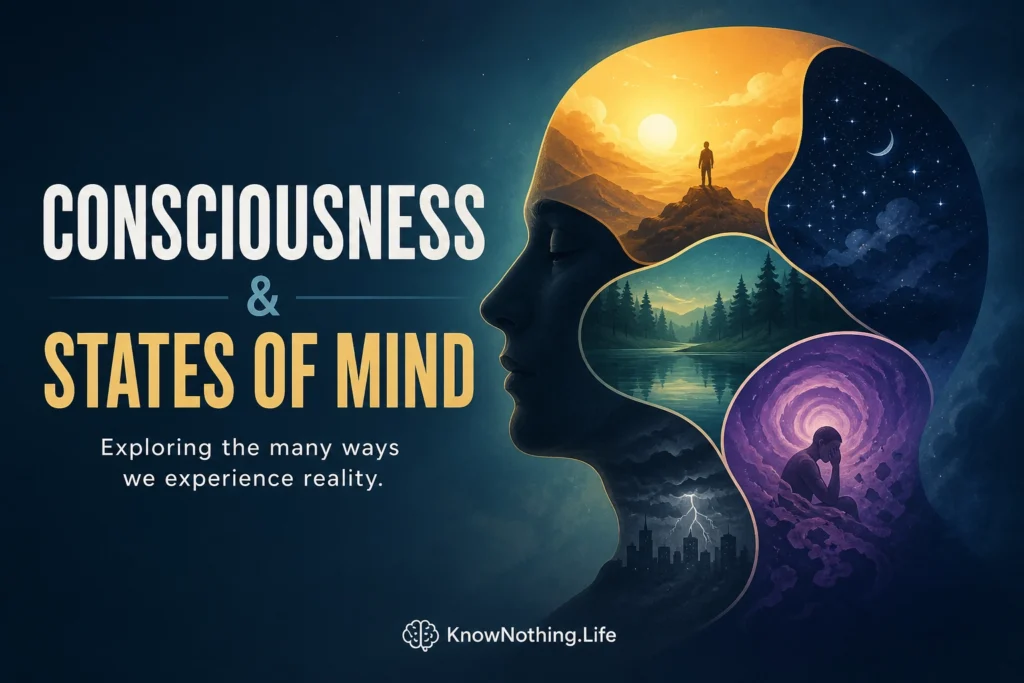
Consciousness remains one of the most profound and elusive subjects in both philosophy and science. It refers, at its most basic level, to subjective experience—the sense of “what it is like” to be aware, to perceive, to feel, and to think. Yet this seemingly simple definition conceals a vast complexity. Consciousness is not a single, static phenomenon; it is dynamic, layered, and deeply intertwined with the brain, the body, and the environment. From waking awareness to dreaming, from focused attention to altered states, human experience unfolds across a spectrum of mental conditions that collectively define our psychological reality.
The modern study of consciousness spans multiple disciplines, including neuroscience, psychology, and philosophy. Thinkers such as William James, in his classic work The Principles of Psychology, described consciousness as a “stream”—continuous, flowing, and ever-changing. This metaphor remains influential, emphasizing that conscious experience is not composed of discrete units but rather unfolds in a seamless progression. Later philosophers, such as Thomas Nagel, deepened the inquiry by asking what it means for a system to have subjective experience at all, famously posing the question in his essay What Is It Like to Be a Bat?
Understanding consciousness requires grappling with both its structure and its variability. States of mind—ranging from alert wakefulness to deep sleep, from meditation to intoxication—demonstrate that consciousness is not fixed but modifiable. These variations reveal important insights into how the brain constructs experience, how attention is directed, and how perception is shaped. The study of consciousness and its states is therefore not merely theoretical; it has profound implications for mental health, identity, and the nature of reality itself.
The Nature of Consciousness
At its core, consciousness involves awareness—of the external world, of internal mental states, and of oneself as a distinct entity. Philosophers have long debated whether consciousness can be fully explained in physical terms or whether it represents something fundamentally irreducible. René Descartes famously grounded knowledge in the certainty of conscious thought, declaring “Cogito, ergo sum” (“I think, therefore I am”). For Descartes, consciousness was the foundation of all knowledge, distinct from the physical body and accessible through introspection.
In contrast, contemporary neuroscience tends to approach consciousness as an emergent property of brain activity. Researchers such as Francis Crick, co-discoverer of the structure of DNA, later turned his attention to the brain, proposing in The Astonishing Hypothesis that consciousness arises from neural processes. According to this view, subjective experience is not separate from the brain but is produced by it, even if the precise mechanisms remain unclear. This perspective aligns with broader materialist approaches that seek to explain mental phenomena in terms of physical systems.
Despite these advances, consciousness presents what philosopher David Chalmers has termed the “hard problem.” While science can increasingly explain the functions of the brain—perception, memory, attention—it struggles to explain why these processes are accompanied by subjective experience. Why does neural activity feel like something from the inside? This question remains unresolved, highlighting the limits of current scientific understanding and the enduring mystery at the heart of consciousness.
Levels and Dimensions of Awareness
Consciousness is not an all-or-nothing phenomenon but exists along multiple dimensions. One key distinction is between levels of consciousness, which refer to the degree of wakefulness or alertness, and contents of consciousness, which refer to what one is aware of at any given moment. Medical frameworks often describe levels of consciousness in terms of states such as coma, vegetative state, and full wakefulness, each associated with different patterns of brain activity and responsiveness.
Within normal waking consciousness, awareness itself can vary significantly. Attention, for example, plays a central role in shaping conscious experience. As Michael Posner and other cognitive scientists have shown, attention acts as a filter, determining which stimuli enter conscious awareness and which remain outside it. This selective process allows individuals to focus on relevant information while ignoring distractions, but it also means that much of reality goes unnoticed.
Another important dimension is self-awareness—the capacity to reflect on one’s own thoughts and experiences. This metacognitive ability distinguishes humans from many other animals and enables complex behaviors such as planning, moral reasoning, and introspection. However, self-awareness is not constant; it fluctuates depending on context and mental state. In moments of deep concentration or “flow,” described by Mihaly Csikszentmihalyi, self-consciousness may fade, giving way to a more immersive and unified experience.
Altered States of Consciousness
Beyond ordinary waking awareness, humans experience a wide range of altered states of consciousness. These states can arise naturally, as in sleep and dreaming, or be induced through practices such as meditation, sensory deprivation, or the use of psychoactive substances. Each altered state offers a unique window into the mechanisms of consciousness, revealing how perception, cognition, and emotion can be transformed.
Sleep is perhaps the most universal altered state. During sleep, consciousness does not disappear entirely but shifts into different modes. Rapid eye movement (REM) sleep, in particular, is associated with vivid dreaming, during which the brain generates immersive experiences without external input. Research by scientists such as Allan Hobson has explored how neural activity during REM sleep produces the narrative and emotional qualities of dreams, suggesting that the brain remains highly active even when disconnected from the external world.
Meditative states provide another form of altered consciousness, often characterized by heightened awareness, reduced mental chatter, and a sense of unity or transcendence. Practices rooted in traditions such as Buddhism have been studied scientifically in recent decades, with researchers examining how meditation affects brain function and subjective experience. These states challenge conventional assumptions about consciousness, demonstrating that awareness can be both deeply focused and expansively open.
Psychoactive substances, including those studied by figures like Timothy Leary, can also profoundly alter consciousness. While such substances can produce insights and novel experiences, they also carry risks and raise complex ethical questions. The study of these states has contributed to a broader understanding of how brain chemistry influences perception and cognition, highlighting the delicate balance underlying conscious experience.
Consciousness and the Brain
The relationship between consciousness and the brain is one of the central questions in neuroscience. Advances in brain imaging technologies, such as functional MRI and EEG, have allowed researchers to identify neural correlates of consciousness—patterns of brain activity associated with specific conscious experiences. These findings suggest that consciousness arises from distributed networks rather than a single “center” in the brain.
One influential theory is the Global Workspace Theory, proposed by Bernard Baars. According to this model, consciousness functions as a kind of mental workspace in which information from different parts of the brain is integrated and made available for decision-making and action. When information enters this workspace, it becomes part of conscious awareness; when it does not, it remains unconscious.
Another prominent framework is Integrated Information Theory (IIT), developed by Giulio Tononi. IIT posits that consciousness corresponds to the degree of integrated information within a system. In this view, the more interconnected and unified the information processing within a system, the higher its level of consciousness. While still debated, this theory offers a quantitative approach to understanding consciousness and has implications for fields such as artificial intelligence.
Despite these advances, the precise relationship between neural activity and subjective experience remains elusive. While correlations can be identified, causation is more difficult to establish. This gap underscores the complexity of consciousness and the need for interdisciplinary approaches that combine empirical research with philosophical analysis.
Philosophical Perspectives and Debates
Philosophical inquiry into consciousness predates modern science and continues to shape contemporary debates. Dualist perspectives, associated with thinkers like René Descartes, posit that mind and body are fundamentally distinct. In contrast, physicalist theories argue that consciousness can be fully explained in terms of physical processes, even if the details are not yet understood.
Other perspectives challenge both dualism and strict physicalism. Phenomenology, developed by philosophers such as Edmund Husserl, emphasizes the direct study of conscious experience as it is lived. Rather than reducing consciousness to neural activity, phenomenologists seek to describe its structures—how perception, time, and selfhood are experienced from the first-person perspective.
More recent debates have explored the possibility of consciousness beyond humans. Questions about animal consciousness, artificial intelligence, and even panpsychism—the idea that consciousness is a fundamental feature of the universe—have expanded the scope of inquiry. As David Chalmers has argued, understanding consciousness may require rethinking some of our most basic assumptions about reality.
Conclusion
Consciousness and its many states of mind represent one of the most complex and fascinating areas of human inquiry. From the flowing stream described by William James to the unresolved “hard problem” articulated by David Chalmers, the study of consciousness reveals both the depth of human understanding and its limitations. It is a field that bridges disciplines, combining empirical research with philosophical reflection in an ongoing effort to grasp the nature of experience.
The variability of consciousness—its ability to shift across states such as wakefulness, dreaming, and meditation—demonstrates that our mental lives are far from fixed. These states not only shape how we perceive the world but also influence how we understand ourselves. By studying these variations, researchers gain insight into the mechanisms that underlie perception, attention, and identity.
Ultimately, the exploration of consciousness is also an exploration of what it means to be human. It invites us to consider not only how we think and perceive but also how we know that we think and perceive. In this sense, consciousness is both the subject and the medium of inquiry—a mystery that we investigate from within, even as it defines the very act of investigation itself.