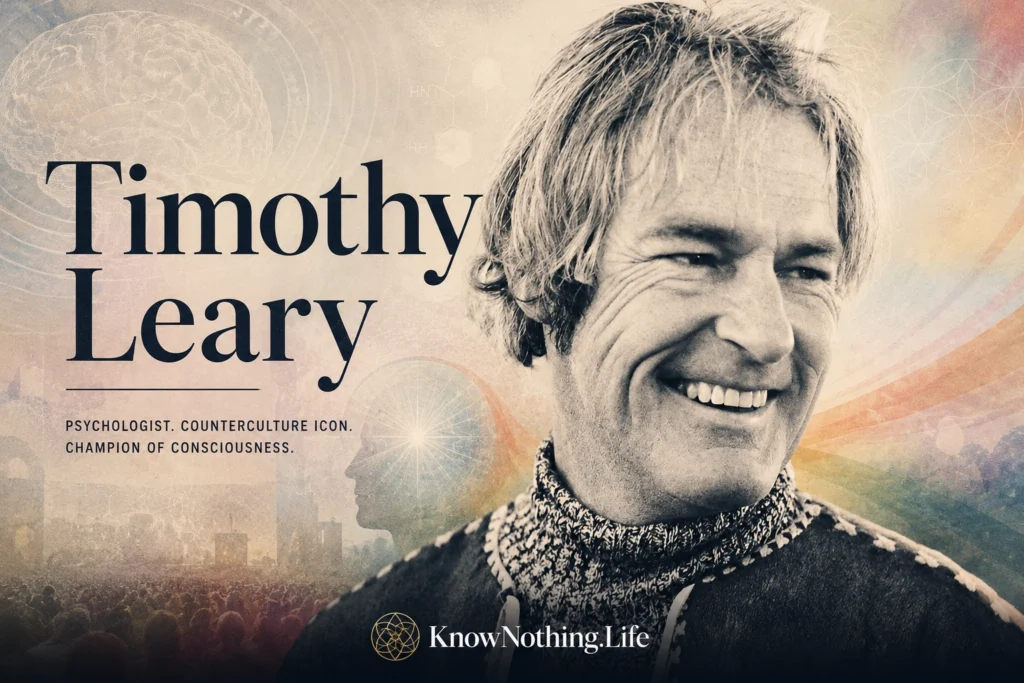
Timothy Leary was an American psychologist, writer, lecturer, and countercultural figure whose career moved from respected personality research to radical advocacy for psychedelic drugs. During the 1950s, he helped develop an influential system for mapping interpersonal behavior. By the middle of the following decade, however, he had become internationally associated with LSD, public rebellion, and the slogan “Turn on, tune in, drop out.” Few twentieth-century psychologists underwent such a dramatic transformation from academic researcher to cultural celebrity, political target, prisoner, fugitive, and technological futurist.
Leary’s legacy remains deeply divided. Admirers regard him as an early defender of consciousness research who recognized the therapeutic and spiritual possibilities of psychedelics before mainstream institutions were prepared to investigate them. Critics argue that his evangelism, weak experimental controls, ethical violations, and appetite for publicity damaged the credibility of psychedelic science and contributed to the political reaction that restricted research for decades. His major works—including Interpersonal Diagnosis of Personality, The Psychedelic Experience, High Priest, The Politics of Ecstasy, Exo-Psychology, Flashbacks, and Chaos & Cyber Culture—reflect the many intellectual identities he adopted across his life.
Early Life, Education, and Academic Psychology
Timothy Francis Leary was born on October 22, 1920, in Springfield, Massachusetts. His education followed an unusually turbulent path through the College of the Holy Cross, the United States Military Academy at West Point, the University of Alabama, military service, Washington State University, and the University of California, Berkeley. He earned a bachelor’s degree in psychology from Alabama, a master’s degree from Washington State, and a doctorate in psychology from Berkeley in 1950. His Army training included personnel psychology, which encouraged his interest in psychological measurement and the prediction of behavior.
During the 1950s, Leary worked as a university instructor, psychotherapist, consultant, and director of clinical research at Kaiser Hospital in Oakland. His most important academic publication was Interpersonal Diagnosis of Personality, issued in 1957. Drawing partly on the interpersonal psychiatry of Harry Stack Sullivan, the book organized behavior around recurring dimensions of status and affiliation. The resulting interpersonal circumplex became an important influence on later models of personality, clinical assessment, and relationships. This early work reveals that Leary was not initially a marginal mystic; he was a productive psychologist attempting to describe personality through systematic observation and measurement.
Harvard and the Psychedelic Project
Leary joined Harvard’s Center for Research in Personality as a lecturer in 1959. After consuming psilocybin mushrooms in Mexico in 1960, he became convinced that psychedelic experiences deserved systematic psychological study. With Richard Alpert and other collaborators, he established the Harvard Psilocybin Project. Their investigations included sessions with graduate students, artists, writers, religious professionals, and prisoners. The Concord Prison Experiment examined whether psilocybin-assisted experiences and continuing support might reduce recidivism, while the Good Friday Experiment, designed by Walter Pahnke, studied whether psilocybin could occasion experiences resembling religious mysticism.
Leary emphasized what became known as “set and setting”: the participant’s expectations, personality, mood, relationships, and physical surroundings could powerfully shape a psychedelic experience. The idea anticipated principles still considered important in contemporary psychedelic research, but his studies lacked many safeguards expected of modern clinical trials. Researchers sometimes took the substances alongside participants, subjects were not randomly selected, and the boundary between investigation and advocacy became increasingly unclear. Harvard faculty questioned both the scientific controls and the group’s attitude toward risk. Alpert and Leary left Harvard in 1963, bringing the university project to an abrupt end.
From Researcher to Countercultural Leader
After Harvard, Leary and his associates continued their activities through organizations including the International Federation for Internal Freedom, the Castalia Foundation, and the League for Spiritual Discovery. Much of this work centered on the Millbrook estate in New York, where residents and visitors experimented with meditation, communal living, performance, and psychedelic drugs. With Richard Alpert and Ralph Metzner, Leary wrote The Psychedelic Experience: A Manual Based on the Tibetan Book of the Dead. The book interpreted ego dissolution and altered consciousness through a Tibetan Buddhist framework, advising, “Whenever in doubt, turn off your mind, relax, float downstream.”
Leary’s transformation into a public evangelist reached its symbolic peak during the 1960s. “Turn on, tune in, drop out” became his most famous expression, repeated at the 1967 Human Be-In in San Francisco and throughout his lectures and recordings. Leary explained “turning on” as awakening new dimensions of consciousness, “tuning in” as reorganizing life around that awareness, and “dropping out” as disengaging from social routines that appeared meaningless. His recorded explanations sometimes went much further than harmless introspection, encouraging young listeners to leave schools, jobs, cities, and conventional relationships. The slogan made him a countercultural hero while confirming the fears of critics who believed he was promoting social abandonment rather than responsible research.
Consciousness, Politics, and Controversy
Leary increasingly portrayed access to altered states as a question of personal liberty. In a 1962 letter written with Alpert, he declared that “a major civil liberties issue” would be the control of consciousness and asked, “Who controls your cortex?” This rhetoric placed psychedelics within wider debates over authority, war, sexuality, religion, and generational conflict. Collections such as The Politics of Ecstasy and High Priest mixed session reports, interviews, cultural criticism, autobiography, and visionary speculation, presenting psychedelic experience as a challenge to conventional institutions rather than merely a potential clinical tool.
The strength of Leary’s message was also its scientific weakness. He frequently moved from reports of profound personal experiences to sweeping claims about human evolution, social transformation, genetics, and the nervous system. His charisma attracted cultural figures such as Allen Ginsberg, while his disregard for professional boundaries alienated researchers who might otherwise have supported psychedelic investigation. Leary did not single-handedly cause psychedelic prohibition, which arose from a much larger political and cultural struggle, but his theatrical advocacy gave opponents a highly visible symbol. His career illustrates how public enthusiasm can popularize an emerging field while simultaneously making careful research more difficult.
Arrest, Prison, Escape, and Exile
Leary’s advocacy became inseparable from his legal conflicts. A marijuana conviction arising from a 1965 border crossing reached the United States Supreme Court. In Leary v. United States, the Court reversed his conviction in 1969, holding that compliance with part of the Marihuana Tax Act would have created a substantial danger of self-incrimination and rejecting a statutory presumption concerning illegal importation. The decision was an important constitutional victory, but later possession charges in California produced a long prison sentence.
In 1970, Leary escaped from the California Men’s Colony with assistance from the Weather Underground and fled with his wife, Rosemary, first to Algeria and later through Europe. Authorities captured him in Afghanistan in 1973 and returned him to the United States, where he was held in several prisons. During his incarceration, he supplied federal investigators with information about associates, an action that damaged his reputation among former allies. He was released in 1976. These years inspired autobiographical and political writings, but they also exposed the contradiction between Leary’s public celebration of loyalty to personal freedom and the compromises he made to secure his own release.
Technology, Major Works, and Lasting Influence
After prison, Leary reinvented himself as a lecturer, performer, futurist, and advocate of personal computing. Books such as Exo-Psychology and Neuropolitique presented speculative models of consciousness and human evolution, while Flashbacks reconstructed his life according to his own shifting mythology. During the 1980s and 1990s, he became fascinated by software, interactive media, virtual reality, space migration, and online communication. His commercially released program Mind Mirror attempted to turn personality exploration into an interactive computer experience, and Chaos & Cyber Culture gathered his later reflections on digital identity and technological change.
Leary died from prostate cancer in Beverly Hills on May 31, 1996, at the age of seventy-five. His legacy cannot be reduced either to heroic liberation or irresponsible recklessness. His early personality research remains part of the history of interpersonal psychology, and his emphasis on psychological preparation and environment anticipated enduring concerns in psychedelic therapy. Yet his research practices and promotional excesses offer equally important warnings about scientific evidence, ethics, celebrity, and certainty. Timothy Leary made consciousness a public controversy, but the enduring task is to separate his valuable questions from the exaggerated answers he so confidently supplied.