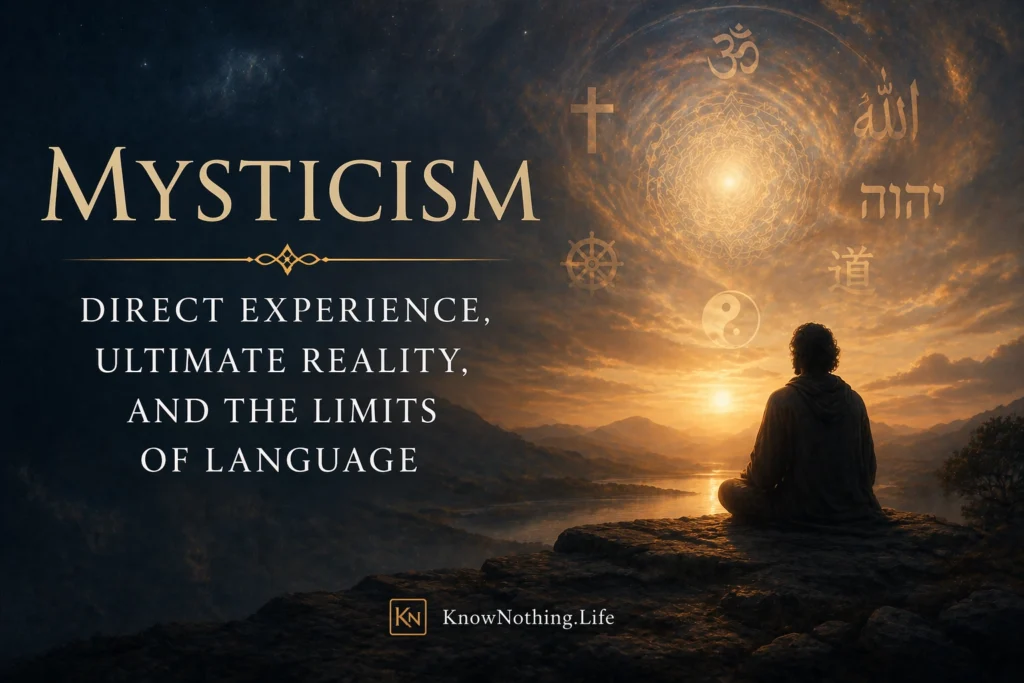
Mysticism is one of the most elusive yet persistent dimensions of human thought. Across cultures and centuries, individuals have claimed direct encounters with a reality that transcends ordinary perception—an experience often described as unity, divine presence, or pure consciousness. Unlike doctrinal religion or systematic philosophy, mysticism centers on experience rather than belief, emphasizing transformation over explanation. It is not confined to any single tradition; it appears in the contemplative practices of Christianity, the ecstatic poetry of Sufism, the meditative disciplines of Buddhism, and the metaphysical insights of Hindu Vedanta.
What makes mysticism philosophically compelling is its challenge to conventional categories of knowledge. Mystics frequently assert that what they encounter cannot be fully expressed in language or captured in concepts. This creates a tension: how can something be meaningful if it resists articulation? Yet despite this apparent paradox, mystical traditions have produced some of the most profound reflections on consciousness, reality, and the nature of the self. Mysticism, then, stands at the intersection of philosophy, religion, and psychology—pushing each to confront the limits of its own methods.
Defining Mysticism
At its core, mysticism refers to the pursuit or attainment of direct, unmediated experience of ultimate reality. This “ultimate reality” may be understood as God, the Absolute, the One, or even an impersonal ground of being. What unites diverse mystical traditions is not a shared doctrine but a shared structure of experience: a sense of immediacy, unity, and transformation that transcends ordinary subject-object distinctions.
Philosophers and scholars have long debated how to define mysticism without reducing its richness. Some emphasize its experiential aspect, describing it as a form of consciousness characterized by unity and insight. Others highlight its practical dimension, noting that mystical states are often cultivated through disciplined practices such as meditation, prayer, or asceticism. Still others focus on its interpretive framework, arguing that mystical experiences are shaped by the cultural and religious contexts in which they occur. These differing approaches reveal that mysticism is not a single phenomenon but a complex interplay between experience, interpretation, and tradition.
The Characteristics of Mystical Experience
Mystical experiences are often described using a set of recurring features. One of the most prominent is ineffability—the sense that the experience cannot be adequately expressed in words. Mystics frequently resort to metaphor, paradox, or poetic language to gesture toward what they have encountered. This limitation of language is not seen as a failure but as an indication of the depth and uniqueness of the experience itself.
Another key characteristic is the sense of unity or oneness. In many mystical accounts, the distinction between the self and the world dissolves, giving rise to a feeling of profound interconnectedness. This may take the form of union with a personal deity, as in Christian mysticism, or the realization of non-duality, as in certain Eastern traditions. Accompanying this unity is often a sense of noetic quality—the conviction that the experience conveys deep insight or knowledge, even if that knowledge cannot be fully articulated. Finally, mystical experiences are typically transformative, leaving a lasting impact on the individual’s worldview, values, and sense of identity.
Mysticism Across Traditions
Mysticism is not confined to any one religion or culture; it emerges wherever individuals seek direct contact with ultimate reality. In Christian mysticism, figures such as Meister Eckhart and Teresa of Ávila describe a union with God that transcends ordinary understanding. Their writings emphasize inner purification, detachment, and the gradual ascent toward divine intimacy.
In Islamic mysticism, or Sufism, poets like Rumi express mystical insight through lyrical language that celebrates love, longing, and the dissolution of the self in the divine. Meanwhile, in Hindu traditions, Advaita Vedanta teaches the realization that the individual self (Atman) is identical with the ultimate reality (Brahman), a non-dual insight that dissolves all distinctions. Buddhist mysticism, particularly in Zen, focuses on direct awareness and the realization of emptiness (śūnyatā), emphasizing that ultimate reality is beyond all conceptual categories.
Despite their differences, these traditions share a commitment to experiential knowledge and a recognition that ultimate reality cannot be fully grasped through rational analysis alone. This cross-cultural convergence suggests that mysticism addresses a fundamental dimension of human experience, even as it is expressed in diverse ways.
Mysticism and Knowledge
One of the central philosophical questions about mysticism concerns its epistemic status: can mystical experiences provide genuine knowledge? Mystics often claim that their experiences reveal truths about reality that are inaccessible through ordinary means. However, skeptics argue that such experiences are subjective and cannot be independently verified, raising doubts about their reliability.
Defenders of mysticism respond by pointing out that not all knowledge is propositional or easily articulated. Just as one can know what it is like to taste a fruit or feel an emotion without being able to fully describe it, mystical knowledge may be experiential rather than conceptual. Some philosophers argue that mystical experiences expand our understanding of consciousness and offer insights into the nature of reality that complement, rather than compete with, scientific or rational inquiry. Others maintain that the interpretive frameworks surrounding mystical experiences make it difficult to separate the experience itself from the beliefs that shape it.
The Role of Language and Symbolism
Language plays a paradoxical role in mysticism. On one hand, mystics insist that their experiences transcend linguistic expression. On the other hand, they rely on language to communicate, teach, and preserve their insights. This tension has led to the development of distinctive forms of expression, including metaphor, paradox, and symbolic imagery.
Mystical language often seeks to point beyond itself, using familiar terms in unfamiliar ways to evoke a sense of the ineffable. For example, the concept of “darkness” may be used to describe a state of divine presence that is beyond comprehension, as in the “dark night of the soul.” Similarly, paradoxical statements—such as “the self must be lost to be found”—challenge ordinary logic in order to convey deeper truths. These linguistic strategies are not merely decorative; they are integral to the mystical project, serving as tools for guiding others toward experiences that cannot be directly transmitted.
Mysticism and the Self
Mysticism frequently involves a reconfiguration of the self. In many traditions, the ego or individual identity is seen as a barrier to realizing ultimate reality. Through practices of meditation, contemplation, or devotion, the mystic seeks to transcend this limited sense of self and enter into a broader, more inclusive awareness.
This transformation can take different forms. In some cases, it is described as union with a higher reality, where the self is not destroyed but fulfilled in its connection to the divine. In others, it is characterized as the dissolution of the self altogether, revealing that the sense of individuality is an illusion. Philosophically, these perspectives raise important questions about identity, consciousness, and the nature of personal existence. They challenge the assumption that the self is a fixed, independent entity and suggest instead that it may be fluid, relational, or even ultimately unreal.
Critiques and Challenges
Mysticism has not gone unchallenged. Critics argue that mystical experiences are too subjective to serve as a reliable source of knowledge. Psychological explanations, for example, suggest that such experiences may be the result of altered brain states, emotional intensity, or cultural conditioning. From this perspective, mysticism tells us more about human cognition than about ultimate reality.
Another challenge comes from the diversity of mystical claims. If mystics from different traditions report experiences that lead to conflicting interpretations—such as personal versus impersonal ultimate reality—how can these claims be reconciled? Some scholars argue that the underlying experiences may be similar, with differences arising from interpretation. Others contend that the diversity reflects genuine differences in what is experienced, undermining the idea of a universal mystical core.
Mysticism in the Modern World
In the modern era, mysticism has taken on new forms and meanings. It is no longer confined to religious institutions but appears in secular contexts, including psychology, philosophy, and even neuroscience. Researchers study meditation and altered states of consciousness to understand their effects on the brain, while philosophers explore the implications of mystical experience for theories of mind and reality.
At the same time, mysticism continues to attract individuals seeking meaning beyond materialism and rationalism. In a world increasingly shaped by technology and scientific explanation, the appeal of direct, transformative experience remains strong. Mysticism offers a way of engaging with reality that emphasizes depth, connection, and transcendence—qualities that many feel are lacking in contemporary life.
Final Thoughts
Mysticism occupies a unique place in human thought, bridging the gap between experience and theory, the personal and the universal. It challenges us to reconsider what counts as knowledge, how language functions, and what it means to be a self. While it resists easy definition, its enduring presence across cultures suggests that it addresses something fundamental in the human condition.
Whether one views mystical experiences as glimpses of ultimate reality or as products of the human mind, their significance cannot be dismissed. They reveal the limits of rational analysis while pointing toward possibilities that lie beyond it. In this way, mysticism does not replace philosophy or science but complements them, offering a different perspective on the nature of reality and our place within it.