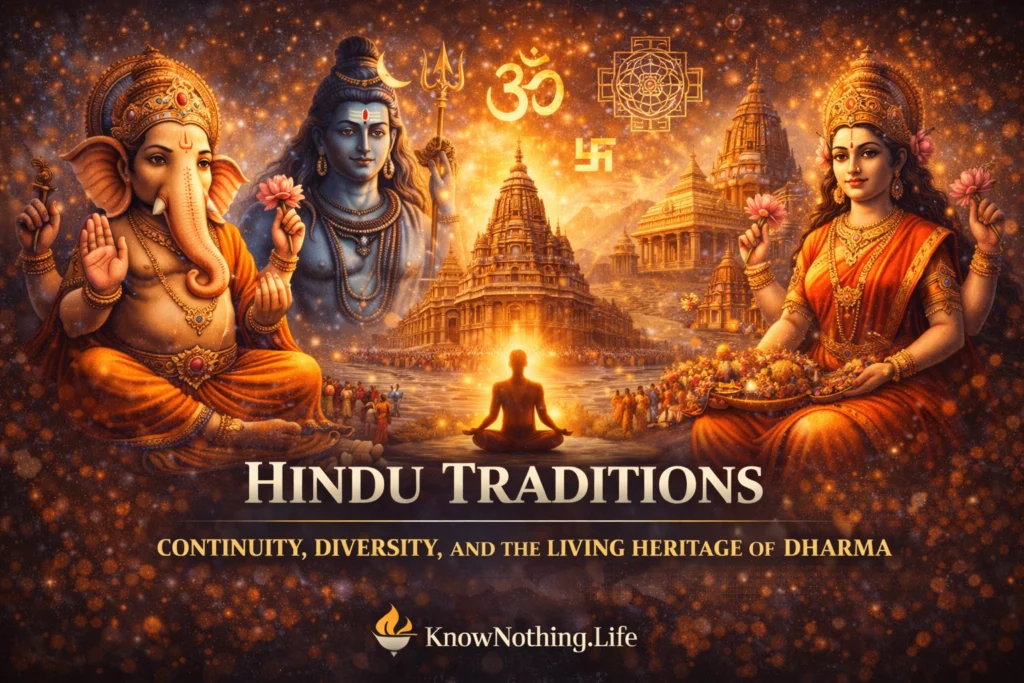
Hindu traditions represent one of the most ancient and continuously evolving cultural and philosophical frameworks in human history. Rather than a single unified religion or doctrine, Hinduism is a vast constellation of beliefs, practices, rituals, and philosophical systems that have developed over millennia in the Indian subcontinent. It is often described as a “family of traditions,” encompassing a wide range of perspectives on the nature of reality, the self, and the divine. This diversity allows Hindu traditions to accommodate both deeply personal spiritual paths and richly communal forms of worship, all grounded in a shared cultural and historical foundation.
At the heart of Hindu traditions lies the concept of dharma, a term that encompasses duty, moral order, and the sustaining principles of the universe. Dharma is not a fixed set of rules but a dynamic and context-dependent guide to living in harmony with oneself, society, and the cosmos. This emphasis on balance and responsibility reflects a broader worldview in which life is understood as an interconnected process shaped by karma (action and consequence) and guided by the pursuit of ultimate liberation (moksha). Hindu traditions thus offer not only theological insights but a comprehensive vision of life that integrates ethics, spirituality, and everyday practice.
Sacred Texts and Scriptural Foundations
The intellectual and spiritual foundations of Hindu traditions are preserved in a vast body of sacred literature, ranging from the ancient Vedas to later philosophical and devotional texts. The Vedas, composed over several centuries, are among the oldest known religious texts in the world. They consist of hymns, rituals, and philosophical reflections that explore the relationship between humans, the natural world, and the divine. Over time, the focus of these texts shifted from ritual performance to deeper metaphysical inquiry, particularly in the Upanishads, which examine the nature of the self (Atman) and ultimate reality (Brahman).
The Upanishads articulate some of the most profound ideas in Hindu thought, including the notion that the individual self is fundamentally identical with the universal principle. This insight is captured in the famous expression “Tat Tvam Asi” (“That Thou Art”), which suggests that the essence of the individual is not separate from the essence of the cosmos. Thinkers such as Yajnavalkya, who appears in the Brihadaranyaka Upanishad, explored these ideas through dialogues that probe the limits of language and perception in understanding ultimate reality.
Another central text is the Bhagavad Gita, a philosophical dialogue set within the epic Mahabharata. Attributed to the sage Vyasa, the Gita presents a synthesis of various paths to spiritual realization, including knowledge (jnana), action (karma), and devotion (bhakti). In one of its most famous passages, the divine figure Krishna instructs the warrior Arjuna: “You have a right to perform your prescribed duty, but you are not entitled to the fruits of action.” This teaching encapsulates the principle of selfless action, emphasizing the importance of duty without attachment to outcomes.
Philosophical Schools and Interpretations
Hindu traditions encompass a wide range of philosophical schools, each offering distinct interpretations of the nature of reality and the path to liberation. Among the most influential is Vedanta, particularly in its non-dualistic form as articulated by Adi Shankaracharya. In his commentaries on the Upanishads and the Brahma Sutras, Shankaracharya argued that the apparent multiplicity of the world is ultimately an illusion (maya), and that only Brahman is real. He famously stated, “Brahman is real, the world is illusory, the individual self is not different from Brahman,” summarizing the core insight of Advaita Vedanta.
Other Vedantic thinkers, such as Ramanuja and Madhva, offered alternative interpretations that emphasized the reality of the individual soul and its relationship with the divine. Ramanuja’s Vishishtadvaita (qualified non-dualism) posits that while all reality is grounded in Brahman, individual souls retain their distinct identities. Madhva’s Dvaita (dualism), on the other hand, asserts a fundamental distinction between the individual soul and God. These differing perspectives illustrate the richness and diversity of Hindu philosophical thought, which accommodates multiple paths and interpretations.
In addition to Vedanta, other classical schools such as Samkhya, Yoga, Nyaya, and Mimamsa contribute to the intellectual landscape of Hindu traditions. Each of these schools addresses key philosophical questions, from the nature of consciousness and matter to the methods of acquiring knowledge and the role of ritual. Together, they form a comprehensive framework for understanding the world and the human place within it.
Devotion, Ritual, and the Practice of Bhakti
While philosophical inquiry plays a central role in Hindu traditions, equally important is the practice of devotion, or bhakti. Bhakti emphasizes a personal relationship with the divine, often expressed through prayer, music, ritual, and storytelling. Devotional traditions are centered around various deities, including Vishnu, Shiva, and Devi, each representing different aspects of the divine. These traditions provide accessible and emotionally resonant pathways to spiritual fulfillment, complementing more abstract philosophical approaches.
The bhakti movement, which flourished in medieval India, brought a renewed emphasis on personal devotion and the accessibility of spiritual experience. Poet-saints such as Mirabai and Tulsidas expressed their devotion through songs and poetry that emphasized love, surrender, and the presence of the divine in everyday life. Mirabai, for example, wrote, “I am yours, O Lord, and you are mine,” capturing the intimate and personal nature of bhakti devotion.
Ritual practices, including temple worship, festivals, and rites of passage, also play a vital role in Hindu traditions. These practices are not merely symbolic but are understood as ways of participating in and sustaining the cosmic order. Through ritual, individuals and communities connect with the divine, reaffirm cultural values, and mark significant moments in life. The integration of ritual and devotion reflects the holistic nature of Hindu traditions, which encompass both inner and outer dimensions of spiritual life.
Key Concepts and Worldview
Hindu traditions are unified by several key concepts that shape their understanding of reality and human existence. One of the most central is karma, the principle that actions have consequences that extend beyond a single lifetime. Karma operates within the cycle of samsara, the continuous process of birth, death, and rebirth. Liberation (moksha) is achieved by transcending this cycle through knowledge, devotion, or disciplined action, depending on the path one follows.
Another important concept is the idea of the self (Atman) and its relationship to ultimate reality (Brahman). While interpretations vary across different schools, the general aim is to realize the true nature of the self, which is often obscured by ignorance and attachment. This realization is not merely intellectual but transformative, leading to a profound shift in one’s perception of reality and one’s place within it.
Hindu traditions also emphasize the importance of balance and harmony, both within the individual and in relation to the broader world. This perspective encourages a way of life that integrates ethical conduct, spiritual practice, and social responsibility. As the Mahabharata suggests, “Dharma protects those who protect it,” highlighting the reciprocal relationship between individuals and the moral order they uphold.
Contemporary Relevance and Global Influence
In the modern world, Hindu traditions continue to evolve and adapt, influencing a wide range of cultural and intellectual developments. Practices such as yoga and meditation, rooted in ancient Hindu philosophy, have gained global popularity as tools for physical health, mental well-being, and spiritual growth. These practices reflect the enduring relevance of Hindu insights into the nature of the mind and the importance of self-awareness.
Hindu traditions have also contributed to contemporary discussions on ethics, environmental sustainability, and the interconnectedness of life. The emphasis on nonviolence (ahimsa), respect for all living beings, and the recognition of the sacredness of nature resonate strongly with modern concerns about ecological balance and social harmony. These principles offer valuable perspectives for addressing the challenges of an increasingly interconnected world.
As Hindu traditions continue to engage with global cultures, they remain a dynamic and living heritage, capable of both preserving ancient wisdom and inspiring new forms of understanding. Their openness to multiple paths and interpretations makes them uniquely adaptable, allowing individuals from diverse backgrounds to find meaning and guidance within their framework.
Final Reflections on Hindu Traditions
Hindu traditions represent a remarkable synthesis of philosophy, spirituality, and cultural practice, offering a comprehensive vision of life that spans the material and the transcendent. Their emphasis on dharma, karma, and liberation provides a framework for understanding both the challenges and possibilities of human existence, while their diversity allows for a wide range of expressions and interpretations.
As Adi Shankaracharya observed, “The world is like a dream—real for the dreamer, but ultimately transient.” This insight captures the essence of Hindu thought, which seeks to uncover the deeper reality underlying the apparent multiplicity of the world. By encouraging reflection, devotion, and disciplined practice, Hindu traditions offer a path toward greater awareness, harmony, and freedom.
In the end, Hindu traditions endure not because they provide a single set of answers, but because they cultivate a way of engaging with life that is both profound and practical. They invite individuals to explore the depths of their own consciousness, to act with integrity and compassion, and to recognize the unity that underlies the diversity of existence.