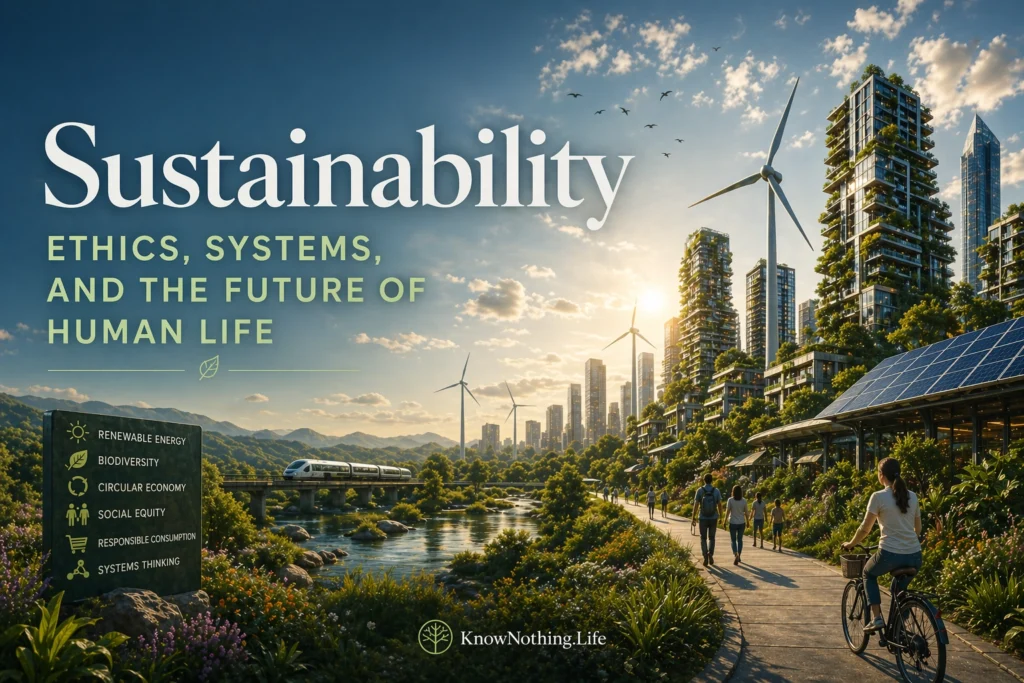
Sustainability has emerged as one of the most important and widely discussed concepts of the modern era. It refers, in its most familiar formulation, to the ability to meet present needs without compromising the ability of future generations to meet their own. Yet beneath this seemingly simple definition lies a complex network of philosophical, ethical, economic, and ecological questions. Sustainability is not merely a technical challenge; it is a problem of values, priorities, and the structure of human life.
Philosophically, sustainability forces a reconsideration of how humans relate to time, nature, and one another. It challenges short-term thinking, asking individuals and societies to account for long-term consequences that may not be immediately visible. It also raises questions about fairness and responsibility: who bears the costs of environmental damage, and who benefits from resource use? In this sense, sustainability is as much about justice as it is about preservation, requiring a reorientation of human goals toward balance, restraint, and continuity.
Historical Foundations of Sustainability Thinking
Although the term “sustainability” is relatively recent, the ideas underlying it have deeper historical roots. Early philosophical traditions often emphasized balance and harmony with nature. In ancient thought, Aristotle discussed moderation as a virtue, suggesting that excess leads to imbalance and instability. While not explicitly environmental, this emphasis on balance resonates with modern concerns about overconsumption and ecological limits.
In the early modern period, the rise of industrialization shifted attitudes toward nature. Francis Bacon promoted the idea that scientific knowledge could be used to control and exploit natural resources for human benefit. This perspective contributed to technological progress but also encouraged practices that disregarded long-term environmental consequences. The tension between exploitation and preservation became increasingly evident as industrial societies expanded.
By the 20th century, environmental degradation and resource depletion prompted a more explicit focus on sustainability. Philosophers and scientists began to recognize that unchecked growth could lead to ecological collapse. This realization marked a turning point, leading to the development of sustainability as a guiding principle for balancing human activity with environmental constraints.
The Ethical Foundations of Sustainability
Sustainability is fundamentally an ethical concept, grounded in questions about what individuals and societies ought to do. One of its central concerns is intergenerational justice—the idea that future generations have moral claims on the present. This principle challenges the tendency to prioritize immediate benefits, emphasizing the need to consider long-term consequences.
Philosophers such as John Rawls have explored how justice can be extended across time. Rawls argued that a just society must preserve resources and institutions for future generations, ensuring that they have the same opportunities as those living today. This perspective provides a moral framework for sustainability, linking it to broader theories of fairness and responsibility.
Sustainability also raises questions about the distribution of resources in the present. Environmental burdens and benefits are often unevenly distributed, with vulnerable populations bearing the greatest costs. Addressing these inequalities requires an ethical approach that considers both current and future needs, integrating environmental concerns with social justice.
Ecological Systems and Limits
A key aspect of sustainability is the recognition that human activity operates within ecological limits. The Earth’s ecosystems provide essential resources—such as air, water, and food—while also regulating climate and supporting biodiversity. However, these systems have finite capacities, and exceeding them can lead to degradation and collapse.
Philosophers and environmental thinkers emphasize the importance of understanding these limits. Aldo Leopold introduced the concept of a “land ethic,” which views humans as part of an ecological community rather than separate from it. This perspective highlights the need to preserve the integrity and stability of ecosystems, recognizing that human well-being is inseparable from environmental health.
The concept of limits challenges traditional notions of growth and progress. Economic systems often prioritize expansion and consumption, assuming that resources are abundant or replaceable. Sustainability, by contrast, emphasizes the need for restraint and balance, suggesting that long-term well-being depends on maintaining ecological equilibrium.
Economic Perspectives and Sustainable Development
Sustainability is closely linked to economic systems, as patterns of production and consumption play a central role in environmental impact. The concept of sustainable development seeks to integrate economic growth with environmental preservation, aiming to create systems that support both human prosperity and ecological health.
This integration raises complex philosophical questions about the nature of value and progress. Traditional economic models often focus on quantitative measures such as income and output, while sustainability requires consideration of qualitative factors such as environmental quality and social well-being. This shift challenges the assumption that economic growth is inherently beneficial, suggesting that it must be evaluated in terms of its broader impacts.
Philosophers and economists have explored alternative models that prioritize sustainability, such as circular economies and steady-state systems. These approaches emphasize resource efficiency, waste reduction, and long-term stability, offering new ways of thinking about economic organization. By reimagining economic systems, sustainability seeks to align human activity with ecological constraints.
Sustainability and Technology
Technology plays a dual role in the context of sustainability. On one hand, technological advancements have contributed to environmental challenges by enabling large-scale resource extraction and consumption. On the other hand, technology offers potential solutions, such as renewable energy, efficient production methods, and environmental monitoring systems.
Philosophers examine the implications of relying on technology to address sustainability issues. While technological innovation can mitigate environmental impact, it may also create new problems or reinforce existing patterns of consumption. This raises questions about whether sustainability can be achieved through technical solutions alone or whether it requires deeper changes in values and behavior.
The concept of appropriate technology emphasizes the need for solutions that are not only effective but also aligned with ecological and social contexts. This approach highlights the importance of considering the broader implications of technological choices, ensuring that they contribute to long-term sustainability rather than short-term gains.
Cultural and Social Dimensions of Sustainability
Sustainability is not only a technical or economic issue but also a cultural and social one. Values, beliefs, and practices shape how individuals and societies interact with the environment, influencing patterns of consumption and behavior. Achieving sustainability therefore requires changes at the level of culture and social norms.
Philosophers and social theorists emphasize the importance of education and awareness in promoting sustainable practices. By fostering a sense of responsibility and connection to the natural world, individuals can develop habits that support environmental preservation. This cultural shift involves rethinking priorities, moving away from consumption-driven lifestyles toward more balanced and mindful ways of living.
Social structures also play a critical role in shaping sustainability. Policies, institutions, and collective actions determine how resources are managed and distributed. Addressing environmental challenges requires cooperation and coordination, highlighting the importance of governance and community engagement in achieving sustainable outcomes.
Sustainability in Contemporary Context
In the modern world, sustainability has become a central concern across multiple domains, from policy and business to individual behavior. Climate change, resource depletion, and biodiversity loss have brought the concept to the forefront of global discourse, emphasizing the urgency of addressing environmental challenges.
Contemporary approaches to sustainability often involve interdisciplinary collaboration, integrating insights from science, economics, and philosophy. This holistic perspective reflects the complexity of the issues involved, recognizing that no single discipline can provide complete solutions. By combining different forms of knowledge, sustainability efforts aim to create more effective and comprehensive strategies.
At the same time, the implementation of sustainability faces significant obstacles, including political resistance, economic constraints, and social inertia. Overcoming these challenges requires not only technical innovation but also a commitment to ethical principles and long-term thinking. Philosophy plays a crucial role in this process, providing the conceptual tools needed to navigate competing priorities and values.
Conclusion
Sustainability represents a profound shift in how humans understand their relationship with the world. It challenges assumptions about growth, consumption, and progress, emphasizing the need for balance, responsibility, and foresight. By integrating ethical, ecological, and economic perspectives, sustainability offers a framework for addressing some of the most pressing challenges of our time.
Philosophical inquiry reveals that sustainability is not merely a set of practices but a way of thinking about the future. It involves recognizing the interconnectedness of human and natural systems, as well as the limits within which they operate. Achieving sustainability requires both individual and collective action, guided by principles of justice and respect for the environment.
Ultimately, sustainability is about the continuity of life and the preservation of possibility. It asks whether current choices will support or undermine the conditions necessary for future generations to thrive. In doing so, it provides a vision of a world in which human activity is aligned with the broader systems that sustain it, offering a path toward a more balanced and enduring form of existence.