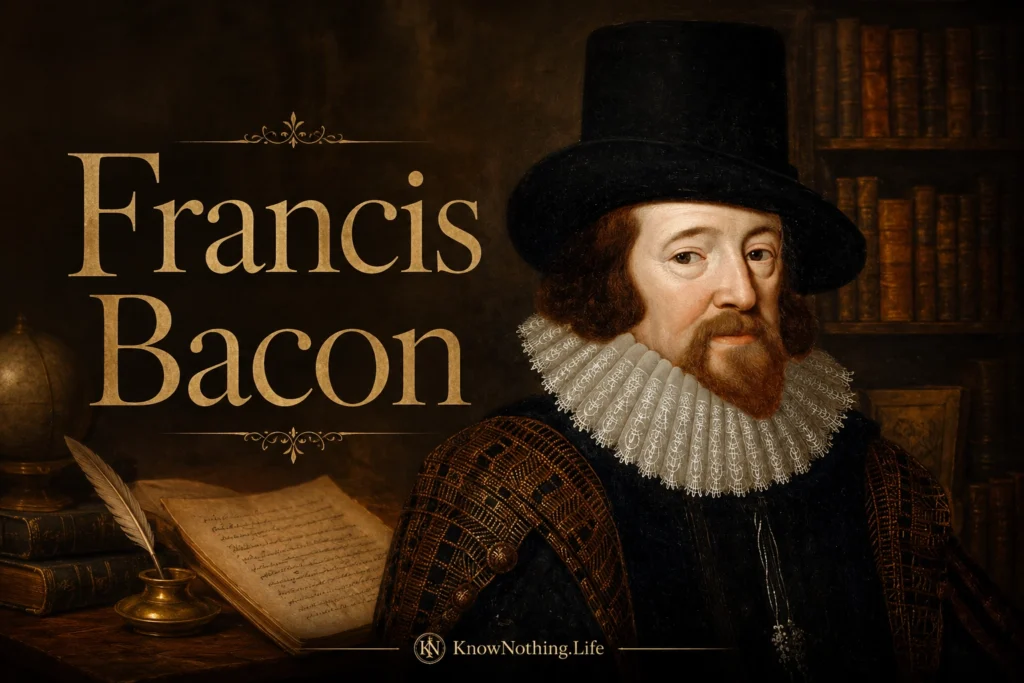
Francis Bacon was born on January 22, 1561, in London, into a family close to the center of Elizabethan power. His father, Sir Nicholas Bacon, served as Lord Keeper of the Great Seal under Queen Elizabeth I, and his mother, Anne Cooke Bacon, was a learned woman from a distinguished humanist family. Bacon grew up in an environment where politics, law, religion, classical learning, and public ambition were closely joined. From the beginning, his life was shaped by two worlds that would never fully separate: the court and the study.
Bacon entered Trinity College, Cambridge, as a boy and later studied law at Gray’s Inn. He came to believe that much of the learning inherited from the schools was sterile, overly dependent on authority, and too remote from practical discovery. This early dissatisfaction became one of the central forces in his philosophy. Bacon did not reject learning; he wanted to reform it. He believed knowledge should not merely decorate the mind or preserve old disputes. It should increase human power over nature and improve the conditions of life.
Law, Politics, and Ambition
Bacon’s public career unfolded through law and politics. He entered Parliament in the 1580s and spent decades pursuing advancement, often with frustration. He was intelligent, eloquent, and ambitious, but his rise was slower than he wished. He sought patronage from powerful figures, including the Earl of Essex, whose rebellion and execution later placed Bacon in a morally complicated position. Bacon served the crown, and his loyalty to state authority often outweighed personal attachment.
Under James I, Bacon’s fortunes improved. He became solicitor general in 1607, attorney general in 1613, Lord Keeper in 1617, and Lord Chancellor in 1618. He was also ennobled as Baron Verulam and later Viscount St Alban. These offices made him one of the most powerful legal and political figures in England. Yet Bacon was never only a court official. Even at the height of office, he saw himself as a reformer of knowledge. His career shows a mind divided between worldly advancement and intellectual transformation.
The Advancement of Learning
Bacon’s first major philosophical statement in English was The Advancement of Learning, published in 1605. The book argued that human knowledge had stagnated because scholars had become trapped by reverence for ancient authorities, verbal disputes, and premature systems. Bacon wanted a new program of inquiry based on observation, experiment, collection of facts, and gradual ascent from particulars to general principles. His goal was not curiosity for its own sake, but useful knowledge directed toward “the relief of man’s estate.”
This phrase expresses Bacon’s moral vision of science. Knowledge, for him, was not merely contemplation. It was a public good. In Meditationes Sacrae, he wrote in Latin that “knowledge itself is power,” a phrase later simplified into the famous “knowledge is power.” Bacon’s meaning was not that information should be hoarded by the powerful. He meant that true knowledge gives human beings the capacity to act, build, heal, cultivate, invent, and relieve suffering. Knowing and doing belonged together.
Novum Organum and the New Method
Bacon’s most famous philosophical work, Novum Organum, appeared in 1620 as part of his larger unfinished project, the Instauratio Magna, or Great Instauration. The title deliberately challenged Aristotle’s Organon, the traditional body of logical works that had shaped scholastic reasoning. Bacon believed syllogistic logic was useful for organizing what was already known but poor at discovering new truths. The mind needed a new instrument, a new organon, for investigating nature.
In Novum Organum, Bacon warned that the human mind is prone to error. His famous doctrine of the “idols” identified false images that distort understanding: idols of the tribe, cave, marketplace, and theater. These represented errors rooted in human nature, individual temperament, language, and inherited systems of thought. Bacon’s remedy was disciplined method. The investigator must not leap too quickly to grand theories. He must collect instances, compare cases, eliminate false explanations, and move gradually toward reliable knowledge.
Nature, Experiment, and Obedience
One of Bacon’s most famous lines is “Nature to be commanded must be obeyed.” The sentence captures his vision of scientific power. Human beings do not master nature by fantasy, wish, or verbal argument. They gain power by submitting to nature’s actual laws. Experiment is therefore not domination in the crude sense; it is disciplined listening. The scientist must learn how nature behaves before trying to use that knowledge.
Bacon’s method was not the modern scientific method in fully developed form, and later science moved far beyond his specific procedures. He underestimated the role of mathematics in some areas and did not himself produce major experimental discoveries. Yet his philosophical importance is enormous. He gave early modern Europe a new image of inquiry: organized, cooperative, empirical, progressive, and useful. He helped shift the ideal of knowledge away from commentary on inherited books and toward investigation of the world.
The Essays and Human Nature
Bacon was also one of the great masters of English prose. His Essays, first published in 1597 and expanded in later editions, are compact studies of human behavior, politics, friendship, ambition, truth, revenge, marriage, gardens, studies, and power. They are not sentimental works. Bacon writes with a cool, practical intelligence, often sounding like a man who has watched courts, lawsuits, flatterers, rivals, and rulers at close range. His essays teach prudence more than innocence.
Several of his best-known lines come from “Of Studies”: “Studies serve for delight, for ornament, and for ability,” and “Reading maketh a full man; conference a ready man; and writing an exact man.” These sentences show Bacon’s gift for aphorism. He could compress a philosophy of education into a single balanced line. In another famous passage, he writes that “some books are to be tasted, others to be swallowed, and some few to be chewed and digested.” Bacon’s prose remains alive because it combines rhythm, judgment, and worldly force.
History, Utopia, and the New Atlantis
Bacon’s range extended beyond philosophy and essays. His History of the Reign of King Henry VII, published in 1622, helped establish his reputation as a political historian. It examined kingship, policy, finance, diplomacy, and statecraft with the same practical intelligence found in his essays. Bacon understood politics as a field of motives, appearances, calculation, and institutional power. He was fascinated by how rulers preserve authority and how states are built after disorder.
His unfinished utopian work New Atlantis, published after his death, gave literary form to his dream of organized scientific inquiry. The island society of Bensalem contains Salomon’s House, an institution devoted to experiment, invention, observation, and the collection of knowledge for public benefit. Later readers often saw in Salomon’s House a prophetic image of the modern research institute or scientific academy. Bacon imagined science not as the solitary work of isolated geniuses, but as a coordinated social enterprise.
Fall From Power
Bacon’s political career ended in disgrace in 1621, when he was charged with corruption for accepting gifts from litigants while serving as Lord Chancellor. He admitted wrongdoing, though he insisted that his judgments had not been influenced by bribes. Parliament sentenced him to a heavy fine, imprisonment in the Tower of London, and exclusion from future office. The imprisonment was brief and the fine was remitted, but his public career was over.
This fall remains central to Bacon’s biography because it complicates his legacy. The philosopher of disciplined inquiry and public usefulness was also a court politician who accepted the compromised habits of power. His disgrace does not erase his intellectual achievement, but it prevents a simple heroic portrait. Bacon understood human weakness partly because he participated in the world he analyzed. His life illustrates both the promise of reason and the dangers of ambition.
Final Years and Lasting Legacy
After his fall, Bacon devoted himself more fully to writing and intellectual projects. He died on April 9, 1626, after becoming ill, according to a famous account, while experimenting with the preservation of meat by packing a chicken with snow. Whether or not every detail of the story is exact, it has endured because it seems symbolically fitting: Bacon dying in the pursuit of experimental knowledge. He was buried at St Michael’s Church in St Albans.
Francis Bacon’s lasting importance lies in the way he reimagined knowledge as active, experimental, collective, and useful. He was not the single inventor of modern science, but he became one of its greatest prophets. His call to overcome idols, observe nature, test claims, and use knowledge for human benefit helped shape the intellectual spirit of the Scientific Revolution. Bacon remains essential because he gave modern inquiry one of its defining ambitions: not merely to argue about the world, but to investigate it, transform it, and relieve human suffering through disciplined knowledge.