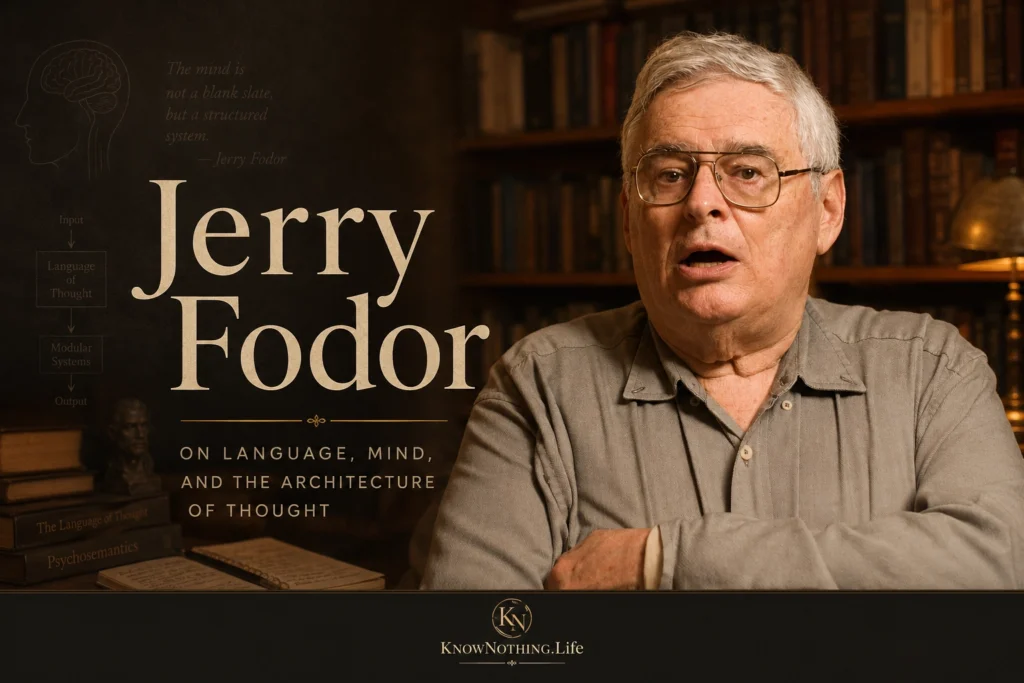
Jerry Alan Fodor was born on April 22, 1935, in New York City. He came of age during a period when American philosophy was strongly shaped by analytic method, behaviorism, linguistics, and the rise of computer science. These were exactly the intellectual forces that would define his career. Fodor was not a philosopher who treated the mind as a vague mystery or a poetic metaphor. He wanted to explain thought with the seriousness of science while preserving what he believed behaviorism had erased: the reality of beliefs, desires, meanings, and mental representation.
Fodor studied philosophy at Columbia University, graduating in 1956, and earned his Ph.D. from Princeton University in 1960. His early formation placed him near some of the most important philosophical debates of the twentieth century: the nature of language, the relation between mind and body, the limits of behaviorism, and the possibility of a scientific psychology. He was intellectually close to the rationalist and computational traditions associated with Noam Chomsky, Hilary Putnam, and early cognitive science. From the beginning, Fodor’s work had a combative clarity. He wrote as if philosophy mattered because bad theories of mind could make whole sciences go wrong.
MIT and the Rise of Cognitive Science
Fodor taught at the Massachusetts Institute of Technology from 1959 to 1986, a period when MIT became one of the major centers for linguistics, psychology, artificial intelligence, and cognitive science. This environment was crucial. Fodor’s philosophy developed alongside the cognitive revolution, which challenged the behaviorist idea that psychology should explain behavior without appealing to inner mental states. Behaviorism had tried to keep science respectable by avoiding beliefs, desires, intentions, and meanings. Fodor thought this was a mistake.
His early work helped make intentional psychology philosophically respectable again. He argued that a serious science of the mind must treat mental states as real causes of behavior. People do things because they believe certain things, want certain things, and represent the world in certain ways. These states are not ghostly substances; they are functional and computational states realized in the brain. Fodor helped create a middle path between Cartesian dualism and behaviorist reduction: the mind is physical, but psychological explanation has its own structure.
The Language of Thought
Fodor’s most famous early book, The Language of Thought, was published in 1975. In it, he defended the idea that thinking occurs in an internal system of representation often called “Mentalese.” The claim was not that people silently speak English, French, or any ordinary language inside their heads. It was that thought has a language-like structure: it contains symbols, syntax, and compositional meaning. Just as words combine into sentences whose meanings depend on their parts and arrangement, mental representations combine into structured thoughts.
This became one of the defining hypotheses of cognitive science. Fodor argued that the productivity and systematicity of thought make sense if the mind operates over structured internal representations. If a person can think that John loves Mary, that person can also understand the related thought that Mary loves John because the mind can recombine representational parts. One of Fodor’s sharpest slogans was “no computation without representation.” The phrase captures his view that computational psychology requires internal symbols with content. To explain thinking, one must explain what the mind computes over.
Representational Theory of Mind
Fodor’s representational theory of mind treated beliefs and desires as relations to mental representations. To believe that snow is white, on this view, is to stand in a certain functional relation to an internal representation whose content is that snow is white. This theory preserved the ordinary explanatory power of folk psychology while trying to make it scientifically respectable. Fodor did not think everyday talk of belief and desire was a disposable superstition. He thought it pointed toward real structures a cognitive science must explain.
This position made him one of the strongest opponents of eliminative and reductionist programs that tried to replace intentional psychology with neuroscience alone. Fodor accepted that mental states are physically realized, but he denied that psychology could simply disappear into physics or neurology. His famous defense of the “special sciences” argued that higher-level sciences such as psychology, economics, and biology have their own lawful generalizations. As he later put it, “The world, it seems, runs in parallel, at many levels of description.” The line summarizes his resistance to the idea that one basic science could swallow all the rest.
The Modularity of Mind
In 1983, Fodor published The Modularity of Mind, another major work that influenced philosophy, psychology, linguistics, and cognitive science. The book argued that certain parts of the mind, especially perceptual and language-input systems, are modular. A module, for Fodor, is a specialized, fast, automatic, domain-specific system whose operations are largely “informationally encapsulated.” In other words, some mental systems process information without full access to everything else the person knows.
The idea is easy to see in perception. Even when people know that two lines in an optical illusion are the same length, they may continue to see one as longer than the other. Knowledge does not simply penetrate early visual processing. Fodor used this kind of fact to argue that the mind is not a single undifferentiated general-purpose reasoner. It includes specialized systems with their own internal operations. His remark that if vision could “deliver news about protons,” its encapsulation would be doubtful shows both his wit and his philosophical point: perceptual systems deliver limited, usable outputs, not the whole truth of science.
Central Systems and the Limits of Psychology
Fodor’s modularity thesis is often misunderstood. He did not claim that everything in the mind is modular. In fact, he sharply distinguished modular input systems from central systems responsible for belief fixation, planning, reasoning, and decision-making. These central systems, he argued, are not modular. They are global, flexible, slow, and sensitive to background knowledge. The very features that make human reasoning powerful also make it difficult to explain scientifically.
This led Fodor to a more skeptical view of cognitive science than some of his admirers expected. He believed that perceptual and linguistic input systems might be tractable because they are encapsulated, but central cognition may resist neat computational explanation. In The Mind Doesn’t Work That Way, published in 2000, he criticized overly optimistic theories that treated the whole mind as a set of modules or simple computational routines. Fodor was a founder of computational cognitive science, but he was also one of its sharpest internal critics.
Concepts, Content, and Meaning
Fodor spent much of his later career arguing about concepts and mental content. In Psychosemantics and A Theory of Content and Other Essays, he tried to explain how mental symbols get their meanings. If thought involves internal representations, then a central question follows: what makes a symbol mean dog, tree, danger, justice, or tomorrow? Fodor explored causal theories of content, asymmetric dependence, and the relation between minds and the world. These debates were technical, but they were not trivial. They concerned how thought can be about anything at all.
His later book Concepts: Where Cognitive Science Went Wrong attacked many standard theories of concepts, especially those that treated concepts as definitions, prototypes, or bodies of knowledge. Fodor defended a radical form of concept atomism, arguing that many lexical concepts are not internally structured in the ways philosophers and psychologists often suppose. His position was controversial, but characteristically forceful. He preferred a strange, difficult theory to one he thought explained too much by cheating.
Critic of Darwinian and Intellectual Fashion
Fodor’s later career also made him famous as a critic of fashionable explanations. He attacked connectionism when he thought neural-network models could not account for the systematic and compositional structure of thought. With Zenon Pylyshyn, he argued that human cognition has features best explained by classical symbolic architecture. He also became sharply critical of some forms of evolutionary psychology, especially claims that the mind is massively modular and that cognitive traits can be neatly reverse-engineered from adaptive functions.
In 2010, with Massimo Piattelli-Palmarini, Fodor published What Darwin Got Wrong, a highly controversial critique of natural selection as an explanatory framework. Many biologists and philosophers rejected the argument, but the book reflected a consistent Fodorian habit: he distrusted sweeping stories that seemed too easy. Whether writing about the mind, concepts, neuroscience, or evolution, Fodor asked whether the explanation actually explained the thing in question. He enjoyed being difficult, but the difficulty had a philosophical purpose.
Rutgers, Final Years, and Legacy
In 1988, Fodor moved to Rutgers University, where he became State of New Jersey Professor of Philosophy and Cognitive Science. His arrival helped make Rutgers one of the leading departments in philosophy of mind and cognitive science. He founded the Rutgers Center for Cognitive Science and continued to write, lecture, argue, and provoke. His wife, Janet Dean Fodor, was an important linguist and psycholinguist, and the intellectual atmosphere around Fodor’s work remained closely tied to language, cognition, and the sciences of mind.
Jerry Fodor died in New York City on November 29, 2017. His legacy is enormous. He helped revive philosophical realism about mental states, gave cognitive science one of its central models, defended the language of thought, reshaped debates about modularity, and insisted that psychology has its own explanatory dignity. He was often wrong in ways that mattered more than other philosophers being safely right, because his arguments forced opponents to become clearer. Fodor remains essential because he asked a question that still drives philosophy and cognitive science: if the mind is physical, how can thought still have meaning?