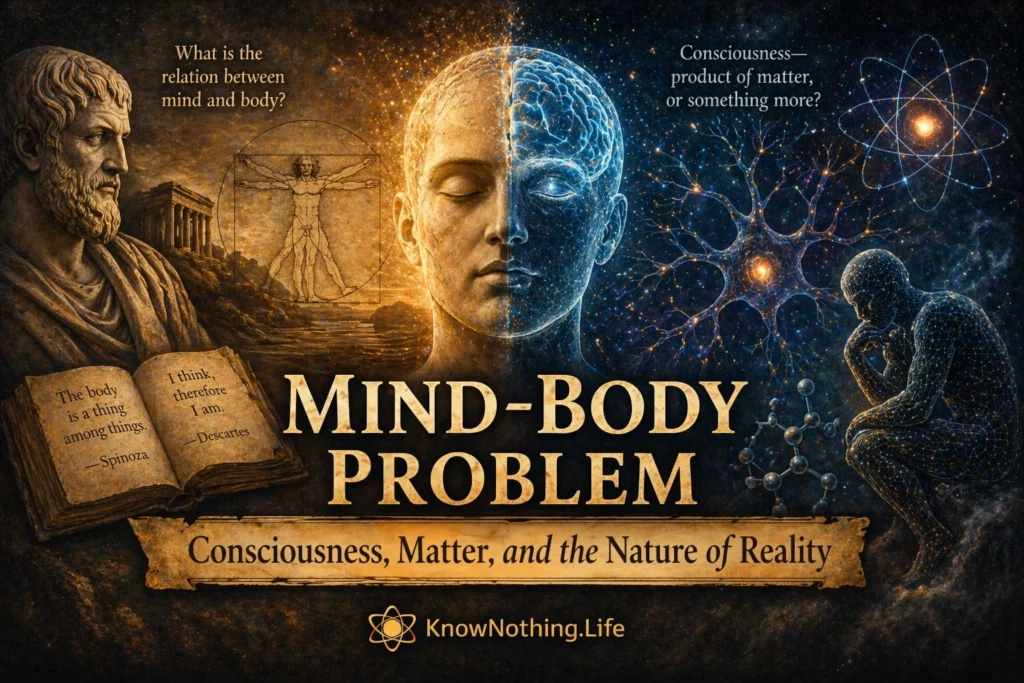
The mind-body problem is one of the oldest and most persistent questions in philosophy. It concerns the relationship between mental phenomena—such as thoughts, feelings, and consciousness—and the physical body, particularly the brain. At its core lies a fundamental puzzle: how can subjective experience arise from physical processes? Or, conversely, how can non-physical mental states interact with the material world?
This problem sits at the intersection of metaphysics, philosophy of mind, and science. It challenges our assumptions about what exists and how different kinds of entities relate to one another. While advances in neuroscience have deepened our understanding of the brain, they have not resolved the philosophical question of how mental experience fits into a physical framework. As a result, the mind-body problem continues to be a central issue in both philosophy and cognitive science.
Dualism: The Separation of Mind and Body
One of the most influential approaches to the mind-body problem is dualism, the view that the mind and body are fundamentally distinct. René Descartes famously argued that the mind is a non-physical substance characterized by thinking, while the body is a physical substance governed by mechanical laws. This distinction allowed Descartes to preserve the uniqueness of consciousness, separating it from the material world.
However, dualism raises a significant challenge: if mind and body are distinct substances, how do they interact? Descartes suggested that interaction occurs in the pineal gland, but this explanation has been widely criticized as insufficient. The problem of interaction remains one of the central objections to dualism, as it is difficult to explain how something non-physical could influence physical processes without violating the laws of physics.
Despite these challenges, dualism continues to have intuitive appeal. Many people find it difficult to reduce subjective experience to physical processes, and the idea of a distinct mental realm aligns with common intuitions about consciousness and identity. Variations of dualism, including property dualism, attempt to reconcile these intuitions with scientific findings, suggesting that mental properties are distinct from but dependent on physical systems.
Physicalism: Mind as Matter
In contrast to dualism, physicalism holds that everything that exists is ultimately physical, including the mind. According to this view, mental states are either identical to brain states or can be fully explained in terms of physical processes. Advances in neuroscience have provided strong support for this perspective, revealing detailed correlations between brain activity and mental phenomena.
One influential version of physicalism is identity theory, which proposes that specific mental states correspond directly to specific brain states. For example, the experience of pain might be identified with a particular pattern of neural activity. While this approach offers a straightforward account of the mind-body relationship, it has been criticized for oversimplifying the complexity of mental life.
Another approach, functionalism, shifts the focus from physical composition to functional roles. Instead of identifying mental states with specific brain states, functionalism defines them in terms of their causal relationships—how they interact with other mental states, sensory inputs, and behavioral outputs. This perspective allows for the possibility that different physical systems, including machines, could have minds if they perform the appropriate functions.
The Problem of Consciousness
Even within a physicalist framework, consciousness presents a unique challenge. While it is possible to explain many cognitive processes in terms of neural mechanisms, the subjective quality of experience—what philosophers call qualia—remains difficult to account for. Why does brain activity give rise to the feeling of pain, the perception of color, or the experience of emotion?
David Chalmers famously described this as the “hard problem” of consciousness. Unlike the “easy problems,” which involve explaining behavior and information processing, the hard problem concerns the existence of subjective experience itself. Even a complete scientific account of brain function may leave unanswered the question of why those functions are accompanied by conscious awareness.
Thought experiments have been used to illustrate this difficulty. For instance, Frank Jackson proposed the “knowledge argument,” which imagines a scientist who knows everything about color perception but has never experienced color. When she finally sees red, she seems to learn something new—what it is like to experience red—suggesting that physical knowledge alone may be insufficient to capture all aspects of consciousness.
Alternative Approaches
In response to the challenges faced by both dualism and physicalism, philosophers have developed alternative approaches to the mind-body problem. One such approach is property dualism, which maintains that while there is only one kind of substance (the physical), it can have both physical and mental properties. This view attempts to preserve the reality of subjective experience without positing a separate mental substance.
Another approach is panpsychism, the idea that consciousness is a fundamental feature of the universe, present in some form even at the most basic levels of matter. While this view may seem counterintuitive, it offers a way to bridge the gap between physical processes and subjective experience by suggesting that consciousness does not emerge from matter but is intrinsic to it.
Emergentism provides yet another perspective, proposing that consciousness arises from complex physical systems but cannot be reduced to their components. According to this view, mental properties “emerge” when physical systems reach a certain level of complexity, much like liquidity emerges from the interactions of individual water molecules. While this approach avoids some of the problems of reductionism, it raises questions about how and why such emergence occurs.
Mind, Brain, and Identity
The mind-body problem also has implications for personal identity and the nature of the self. If the mind is identical to the brain, then changes in brain structure should directly affect identity. Indeed, neurological studies have shown that injuries or diseases affecting the brain can alter personality, memory, and behavior, suggesting a close connection between mind and brain.
However, questions remain about what constitutes the continuity of the self. Is identity tied to physical continuity, psychological continuity, or some combination of both? Philosophers have proposed various criteria, including memory, consciousness, and narrative coherence, to account for personal identity. These debates highlight the complexity of the relationship between mind and body, extending beyond metaphysical questions to issues of ethics and human experience.
The possibility of transferring or replicating minds, often discussed in the context of artificial intelligence and future technologies, further complicates these questions. If a person’s mental states could be duplicated in another medium, would that duplicate be the same person? Such scenarios challenge traditional notions of identity and underscore the importance of the mind-body problem in contemporary thought.
Science and the Future of the Debate
Advances in neuroscience, psychology, and artificial intelligence continue to shape the discussion of the mind-body problem. Brain imaging technologies have provided unprecedented insight into the neural correlates of mental states, while computational models offer new ways of understanding cognition. These developments have strengthened the case for physicalist approaches, but they have not eliminated philosophical questions about consciousness and subjectivity.
At the same time, interdisciplinary research is opening new avenues for exploration. Philosophers, scientists, and engineers are increasingly collaborating to address questions about the nature of mind and its relation to the body. This collaboration reflects a broader recognition that the mind-body problem cannot be fully resolved within a single discipline.
As our understanding of the brain and cognition evolves, the mind-body problem remains a central and enduring challenge. It forces us to confront the limits of scientific explanation and the nature of subjective experience, ensuring its continued relevance in both philosophy and science.
Conclusion
The mind-body problem explores the relationship between mental phenomena and the physical world, raising fundamental questions about consciousness, identity, and reality. From the dualism of René Descartes to contemporary debates about physicalism and emergence, it has generated a wide range of perspectives and ongoing controversies.
Despite centuries of inquiry, the problem remains unresolved, reflecting the complexity of the issues it addresses. By examining the nature of mind and its connection to the body, philosophy continues to deepen our understanding of what it means to think, feel, and exist.