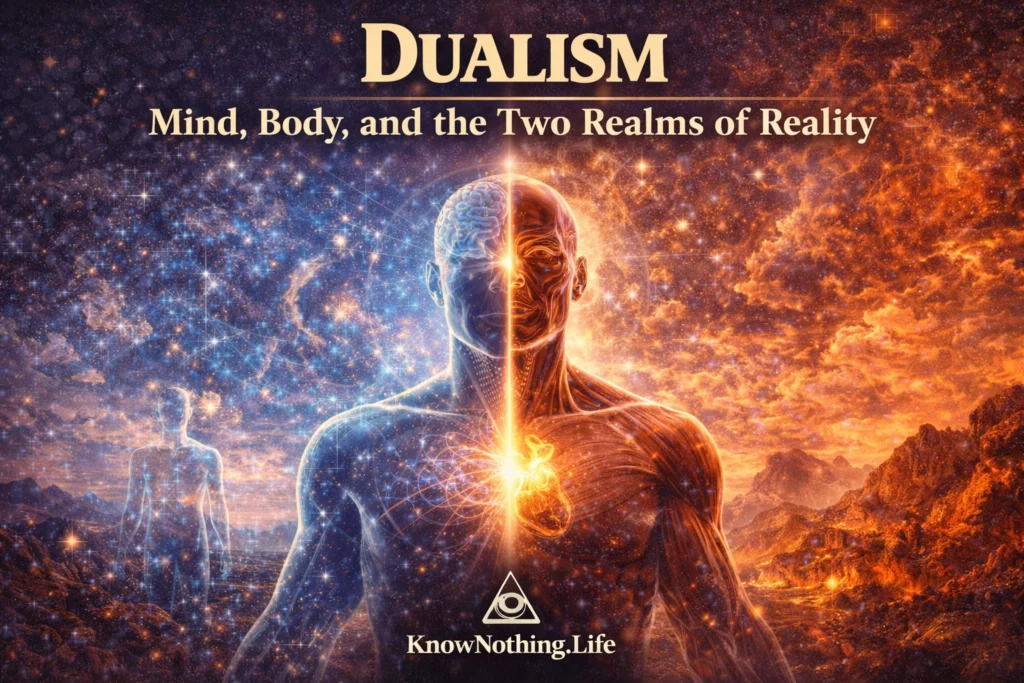
Dualism is one of the most influential and enduring theories in the philosophy of mind, proposing that reality consists of two fundamentally different kinds of substance or properties: the mental and the physical. At its core, dualism asserts that the mind is not reducible to the body, and that conscious experience cannot be fully explained in purely physical terms. This position stands in contrast to physicalism, which seeks to explain all phenomena—including mental states—through physical processes.
The appeal of dualism lies in its attempt to account for the qualitative, subjective nature of consciousness. Human beings do not merely process information; they experience sensations, emotions, and thoughts from a first-person perspective. This inner life seems distinct from the physical processes of the brain, raising the question of whether the mind belongs to a different ontological category. Dualism seeks to preserve this distinction, offering a framework in which mental and physical realities coexist.
Descartes and Substance Dualism
The most famous formulation of dualism is found in the work of René Descartes. In Meditations on First Philosophy, Descartes argued that the mind and body are distinct substances with different essential properties. The mind is characterized by thinking and is non-extended, while the body is characterized by extension in space and is non-thinking.
Descartes’ argument is grounded in his method of doubt. By questioning everything that could possibly be doubted, he arrived at the conclusion that the existence of the thinking self is certain. He famously declared, “Cogito, ergo sum” (“I think, therefore I am”). From this, he inferred that the mind exists independently of the body, as it can be known with certainty even if the body’s existence is uncertain.
Substance dualism provides a clear distinction between mental and physical reality, but it also introduces a significant problem: how do these two substances interact? Descartes suggested that the interaction occurs in the pineal gland, but this explanation has been widely criticized as insufficient. The interaction problem remains one of the most persistent challenges for dualism.
Property Dualism and the Nature of Consciousness
In response to the difficulties of substance dualism, some philosophers have proposed property dualism, which maintains that while there is only one kind of substance (the physical), it possesses both physical and mental properties. According to this view, mental states are not separate substances but distinct aspects of physical systems.
David Chalmers has been a prominent defender of property dualism, particularly in relation to the problem of consciousness. In The Conscious Mind, Chalmers argues that physical explanations cannot fully account for subjective experience. He introduces the concept of the “hard problem of consciousness,” emphasizing the difficulty of explaining why physical processes give rise to experience.
Chalmers writes that consciousness is “the most familiar thing in the world and the most mysterious.” This highlights the gap between objective descriptions of the brain and the subjective experience of awareness. Property dualism attempts to bridge this gap by recognizing consciousness as a fundamental feature of reality, rather than reducing it to physical processes.
Arguments for Dualism
Dualism is supported by several philosophical arguments, many of which focus on the unique characteristics of mental phenomena. One of the most influential is the argument from introspection, which emphasizes the direct awareness individuals have of their own thoughts and experiences. This awareness seems fundamentally different from the observation of physical objects, suggesting that the mind operates in a distinct domain.
Another argument is based on the conceivability of disembodied existence. If it is possible to conceive of a mind existing without a body, then the two must be distinct. Descartes used this reasoning to support substance dualism, arguing that the ability to doubt the existence of the body while affirming the existence of the mind demonstrates their separability.
Additionally, the argument from qualia—the subjective qualities of experience—supports dualism. Sensations such as the redness of a rose or the taste of sweetness cannot be fully captured by physical descriptions. These qualitative aspects of experience suggest that there is more to the mind than can be explained by physical processes alone.
Criticisms of Dualism
Despite its intuitive appeal, dualism faces significant criticisms. One of the most serious is the interaction problem: if the mind and body are fundamentally different, how can they influence each other? This issue challenges the coherence of substance dualism, as it requires a mechanism for interaction between incompatible entities.
Another criticism comes from the success of physical science in explaining natural phenomena. As neuroscience advances, many aspects of mental life—such as perception, memory, and emotion—are increasingly understood in terms of brain activity. This has led some to argue that dualism is unnecessary, as physical explanations can account for mental phenomena.
Philosophers such as Gilbert Ryle have criticized dualism as a conceptual error. In The Concept of Mind, Ryle described it as the “ghost in the machine,” arguing that treating the mind as a separate entity is a misunderstanding of how language and concepts function. These critiques have led many to favor alternative approaches, such as physicalism or functionalism.
Dualism in Contemporary Philosophy
Despite these criticisms, dualism remains a significant position in contemporary philosophy. It continues to attract support, particularly in discussions of consciousness and subjective experience. Some philosophers argue that the explanatory gap between physical processes and conscious experience is too large to be bridged by physicalism alone.
In addition, dualist ideas have found resonance in debates about artificial intelligence and the nature of the self. If consciousness cannot be reduced to physical processes, then creating genuinely conscious machines may be impossible. This perspective challenges assumptions about the limits of technology and the uniqueness of human experience.
Contemporary dualism often takes more nuanced forms, integrating insights from science while maintaining the distinctiveness of mental phenomena. These developments reflect the ongoing relevance of dualist ideas in addressing unresolved questions about the mind.
The Significance of Dualism
Dualism plays a crucial role in shaping how individuals understand consciousness, identity, and reality. By emphasizing the distinction between mind and body, it highlights the uniqueness of subjective experience and the limitations of purely physical explanations.
Philosophically, dualism raises fundamental questions about the nature of existence. It challenges the assumption that reality is entirely physical, opening the possibility of multiple dimensions of being. This perspective has implications for ethics, religion, and the understanding of human nature.
At the same time, dualism invites critical examination of its own assumptions. The challenges it faces—particularly the interaction problem—encourage ongoing inquiry into the nature of the mind and its relationship to the body. This dynamic interplay between theory and critique ensures that dualism remains a central topic in philosophy.
Conclusion
Dualism offers a powerful and enduring framework for understanding the relationship between mind and body. From the substance dualism of René Descartes to the property dualism of David Chalmers, it has evolved to address new challenges while preserving its core insight: that mental and physical realities are fundamentally distinct.
While dualism faces significant criticisms, it continues to provide a compelling account of consciousness and subjective experience. It highlights the limitations of reductionist approaches and underscores the complexity of the mind.
Ultimately, the debate over dualism reflects a deeper question about the nature of reality itself. Is the world entirely physical, or does it include dimensions that cannot be captured by scientific explanation? In exploring this question, dualism remains a vital and thought-provoking perspective in the philosophy of mind.