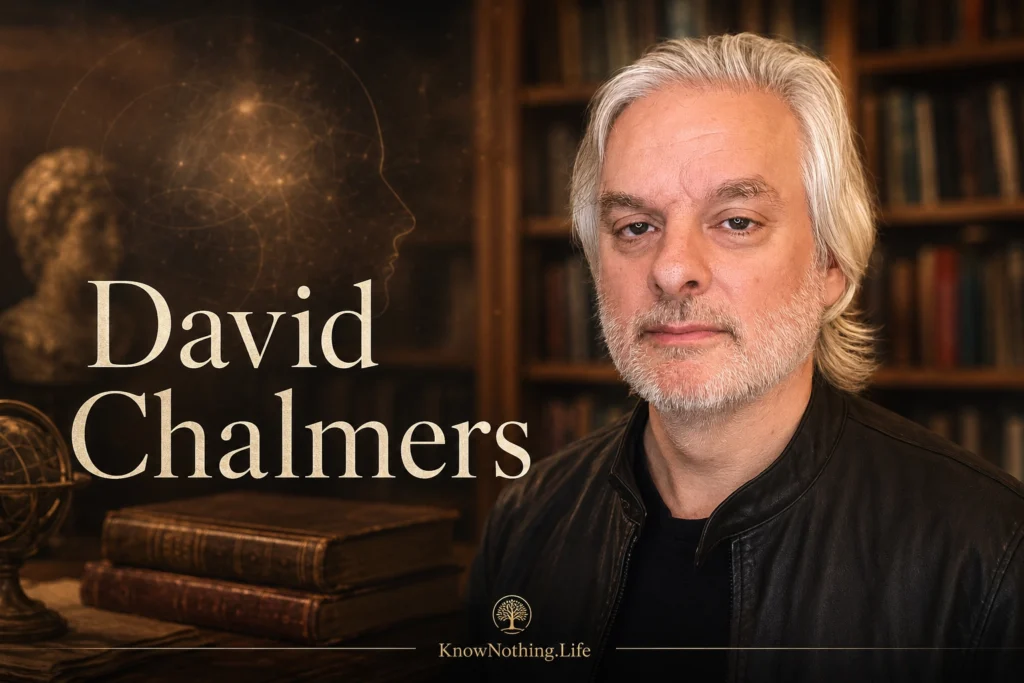
David John Chalmers was born on April 20, 1966, in Sydney, Australia, and grew up in Sydney and Adelaide. Before he became one of the most famous philosophers of mind in the world, he was drawn to mathematics, puzzles, systems, and abstract structure. He studied pure mathematics at the University of Adelaide from 1983 to 1986, a background that later gave his philosophical work its distinctive combination of imagination and precision. Chalmers did not enter philosophy as someone content with vague mystery. He entered it as someone trained to ask whether a problem had been properly formulated.
After his undergraduate years, Chalmers went to Oxford as a graduate student in mathematics in 1987. During that period, his interest shifted toward consciousness, a subject that would define his career. In his own autobiographical description, his “little obsession with the problem of consciousness spun out of control.” That phrase captures the unusual mixture of seriousness and playfulness in his intellectual personality. Chalmers would become known for treating the most elusive questions in philosophy with technical rigor, but also with openness to strange possibilities.
Indiana, Hofstadter, and Cognitive Science
Chalmers moved to Indiana University in 1989, where he completed a Ph.D. in philosophy and cognitive science in 1993. He worked in Douglas Hofstadter’s Center for Research on Concepts and Cognition, an environment shaped by artificial intelligence, analogy, computation, mind, and the study of meaning. Hofstadter’s influence helped place Chalmers at the intersection of philosophy, cognitive science, and computer models of intelligence. His early work engaged with connectionism, computation, representation, and the possibility of artificial minds.
This background matters because Chalmers was never simply a defender of old-fashioned metaphysical mystery. He understood the power of cognitive science and artificial intelligence from the inside. His later arguments against reductive physicalism did not come from hostility to science. They came from the conviction that science explains many things brilliantly while still leaving something central unexplained: subjective experience. He accepted the importance of function, information processing, and neural mechanisms, but argued that they do not automatically explain why experience exists at all.
The Hard Problem of Consciousness
Chalmers became internationally famous after his 1995 paper “Facing Up to the Problem of Consciousness” and his 1996 book The Conscious Mind: In Search of a Fundamental Theory. In the paper, he distinguished between the “easy problems” of consciousness and the “hard problem.” The easy problems are not easy in practice; they include explaining perception, attention, reportability, memory, behavioral control, and cognitive access. They are easy in Chalmers’s technical sense because they appear explainable by specifying mechanisms and functions.
The hard problem is different. Chalmers wrote, “The really hard problem of consciousness is the problem of experience.” When we see red, feel pain, hear music, or taste coffee, there is something it is like to undergo those states. A complete story about brain function may tell us how information is processed, but Chalmers argues that it still leaves open the question of why such processing is accompanied by inner life. This formulation reshaped modern philosophy of mind. It gave scientists and philosophers a clear label for the gap between objective explanation and subjective experience.
The Conscious Mind and Naturalistic Dualism
The Conscious Mind presented Chalmers’s most influential early position. He argued that consciousness cannot be reductively explained in purely physical terms. The book developed arguments involving conceivability, zombies, supervenience, and explanatory gaps. The philosophical zombie is a being physically and behaviorally identical to a human being but lacking conscious experience. Chalmers did not claim zombies actually exist. He used the thought experiment to argue that if such beings are coherently conceivable, then consciousness is not logically entailed by the physical facts alone.
His positive view is often called naturalistic dualism. Unlike traditional substance dualism, it does not claim that the mind is a ghostly substance separate from nature. Instead, it suggests that experience may be a fundamental feature of reality, requiring basic psychophysical principles that connect physical processes with conscious experience. Chalmers’s position was controversial, but it had the advantage of clarity. He forced the debate to confront a direct question: can physical explanation alone account for why experience exists?
Consciousness, Science, and Debate
Chalmers’s work helped energize the contemporary science of consciousness. He has been closely associated with interdisciplinary conferences, centers, and debates bringing together philosophers, neuroscientists, psychologists, physicists, and artificial intelligence researchers. He co-founded the Association for the Scientific Study of Consciousness and has helped create or lead consciousness centers in Australia and the United States. His career has been marked by the conviction that consciousness requires both philosophical analysis and scientific research.
At the same time, Chalmers’s arguments have drawn strong criticism. Philosophers such as Daniel Dennett, Patricia Churchland, and others have challenged the hard problem framework, arguing that it overstates mystery or misdescribes the relation between experience and function. Chalmers’s influence can be measured partly by the intensity of these objections. Few contemporary philosophical ideas have generated as much debate across disciplines. Even critics often use his terminology when explaining what they reject.
Language, Metaphysics, and Constructing the World
Although Chalmers is best known for consciousness, his work extends far beyond philosophy of mind. He has written extensively on meaning, modality, two-dimensional semantics, epistemology, metaphysics, computation, and philosophical methodology. His 2012 book Constructing the World grew out of his John Locke Lectures at Oxford and was inspired in part by Rudolf Carnap’s The Logical Structure of the World. The book argues for a version of scrutability: the idea that truths about the world can, in principle, be derived from a limited base of truths under ideal reasoning.
This project shows Chalmers’s systematic side. He is not only interested in isolated puzzles. He wants to understand how language, thought, possibility, knowledge, and reality fit together. His technical work on two-dimensional semantics influenced debates about meaning, reference, necessity, and the mind-body problem. In this sense, Chalmers belongs to the analytic tradition at its most ambitious: rigorous, formally careful, and willing to ask very large questions with precise tools.
Reality+, Virtual Worlds, and Technology
In 2022, Chalmers published Reality+: Virtual Worlds and the Problems of Philosophy, bringing his philosophical method to virtual reality, simulation, skepticism, technology, and the future of human life. The book argues that virtual worlds should not be dismissed as mere illusions or escapist fantasies. Chalmers writes that “virtual worlds are real” and that people can, in principle, lead meaningful lives in them. This position extends old philosophical questions about reality, perception, and skepticism into the age of the metaverse.
The importance of Reality+ lies in its refusal to treat technology as philosophically shallow. Chalmers uses virtual reality to revisit Descartes, Plato, the external world, God, value, justice, and identity. He argues that digital objects can be real objects when they play the right roles in digital environments. The claim is provocative, but it follows a pattern found throughout his work: where many see a puzzle as science fiction, Chalmers sees a serious test case for metaphysics.
Artificial Intelligence and Machine Consciousness
Chalmers has also become an important voice in debates about artificial intelligence and machine consciousness. His early background in cognitive science and computation made him unusually well prepared for the rise of large language models, virtual agents, and increasingly sophisticated AI systems. He has argued that current systems may face serious obstacles to consciousness, but he also takes seriously the possibility that future systems could become conscious under the right conditions.
This openness does not mean careless speculation. Chalmers’s approach to AI consciousness follows the same pattern as his approach to human consciousness: identify the hard question, separate it from easier behavioral and functional questions, and ask what would count as evidence. If consciousness is tied to certain forms of information processing, organization, integration, or global availability, then artificial systems may eventually force philosophers to decide whether experience is restricted to biology or can arise in nonbiological systems. Chalmers has helped make that question respectable rather than merely futuristic.
Academic Roles and Lasting Importance
Chalmers has held major academic positions at Washington University in St. Louis, the University of California, Santa Cruz, the University of Arizona, the Australian National University, and New York University. He is currently University Professor of Philosophy and Neural Science at NYU and co-director of the Center for Mind, Brain, and Consciousness. He is also associated with the Australian National University and the PhilPapers Foundation. His major books include The Conscious Mind, The Character of Consciousness, Constructing the World, and Reality+.
David Chalmers remains essential because he gave contemporary philosophy one of its clearest and most enduring problems. The hard problem of consciousness did not solve the mystery of mind, but it sharpened the question so forcefully that the debate could not remain the same. His work shows that consciousness, technology, AI, language, and reality are not separate puzzles. They converge on a single philosophical demand: explain how a world described from the outside can also contain experience from the inside. Few living philosophers have done more to make that demand impossible to ignore.