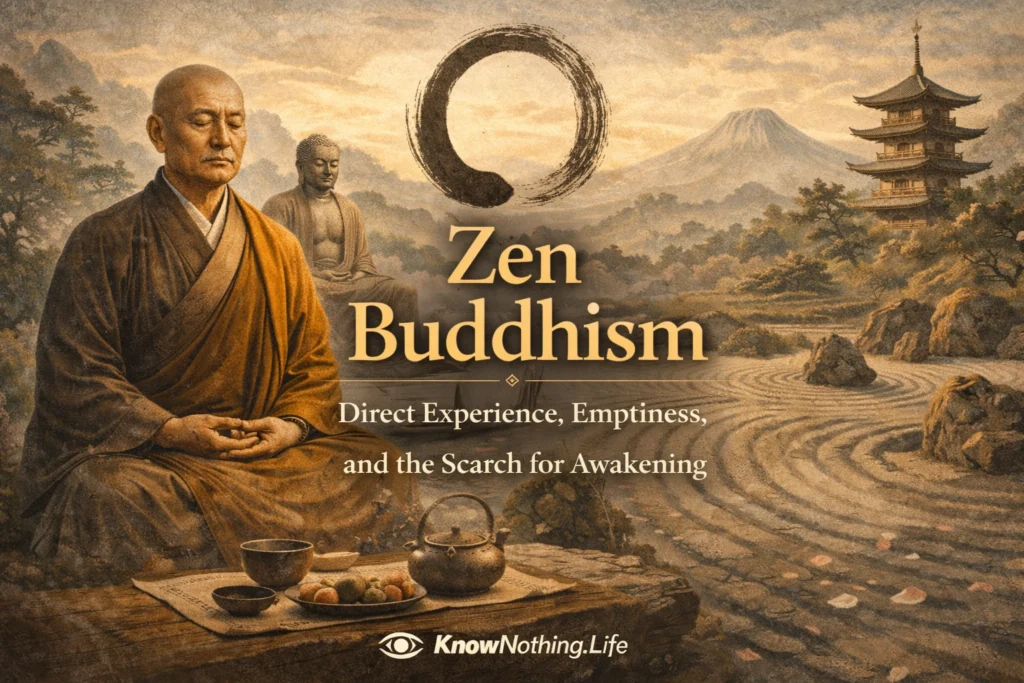
Zen Buddhism is a distinctive school of Mahāyāna Buddhism that emphasizes direct experience, meditation, and the realization of one’s true nature beyond conceptual thought. Emerging in China as Chan Buddhism and later developing in Japan as Zen, it represents a radical simplification of Buddhist teaching, stripping away elaborate doctrines in favor of immediate insight. Zen traces its origins to the legendary monk Bodhidharma, who is said to have transmitted a “special teaching outside the scriptures,” pointing directly to the human mind. This spirit is encapsulated in a famous Zen phrase: “A special transmission outside the scriptures; no dependence on words and letters; directly pointing to the human mind; seeing one’s nature and becoming Buddha.”
At its core, Zen challenges the assumption that truth can be grasped through intellectual understanding alone. While it does not reject Buddhist teachings, it insists that ultimate realization must be experienced directly. This emphasis on immediacy and presence distinguishes Zen from more scholastic traditions, inviting practitioners to move beyond abstraction and encounter reality as it is. Through meditation, discipline, and paradoxical insight, Zen offers a path toward awakening that is both austere and profoundly transformative.
Foundations of Zen Thought and Practice
Zen philosophy is grounded in key Buddhist concepts such as emptiness (śūnyatā), non-self, and impermanence, but it approaches them in a uniquely experiential way. Rather than analyzing these ideas through philosophical argument, Zen encourages practitioners to realize them directly through meditation and awareness. The practice of zazen, or seated meditation, is central to this process. In zazen, one sits in stillness, observing thoughts without attachment and allowing the mind to settle into clarity. This practice is not aimed at achieving a particular state but at uncovering the nature of mind itself.
The concept of emptiness is particularly important in Zen. It does not mean nothingness but the absence of fixed, independent existence. All things arise in interdependence, constantly changing and lacking a permanent essence. This insight dissolves the boundaries between self and world, revealing a deeper unity. As expressed in the Heart Sutra, “Form is emptiness, emptiness is form,” a statement that captures the paradoxical nature of reality in Zen thought.
Zen also emphasizes mindfulness in everyday life. Enlightenment is not confined to the meditation hall but is present in every moment—walking, eating, working. The ordinary becomes extraordinary when approached with full awareness. This integration of practice and daily life reflects Zen’s commitment to simplicity and directness, where the path to awakening is found not in distant goals but in the immediacy of experience.
The Role of Koans and Paradox
One of the most distinctive features of Zen is the use of koans—paradoxical questions or statements designed to disrupt conventional thinking and provoke insight. Koans are not riddles to be solved intellectually but tools for breaking through the limitations of rational thought. By confronting the mind with contradictions, they create a space in which deeper understanding can emerge. A famous example is the question, “What is the sound of one hand clapping?” which cannot be answered through logic alone.
Koans are often recorded in collections such as the Gateless Gate and the Blue Cliff Record, where they are accompanied by commentaries and dialogues between masters and students. These texts illustrate the dynamic and often surprising nature of Zen teaching, where insight can arise from unexpected moments. The goal is not to arrive at a correct answer but to experience a shift in perception, a sudden awakening known as satori.
This use of paradox reflects a broader Zen critique of language and conceptual thought. Words, while useful, can obscure the reality they seek to describe. Zen masters often employ silence, gestures, or seemingly nonsensical responses to point beyond language. As one saying goes, “The finger pointing at the moon is not the moon,” reminding practitioners that teachings are guides, not the truth itself.
Dōgen and the Philosophy of Practice
Among the most influential figures in Japanese Zen is Dōgen, founder of the Sōtō school. His writings, particularly the Shōbōgenzō, offer a profound exploration of Zen philosophy and practice. Dōgen’s thought is characterized by its depth and subtlety, emphasizing the unity of practice and enlightenment. For Dōgen, meditation is not a means to an end but the expression of awakening itself.
Dōgen challenges the idea that enlightenment is something to be attained in the future. Instead, he teaches that each moment of sincere practice is already an expression of enlightenment. “Practice and realization are one,” he writes, dissolving the distinction between path and goal. This perspective transforms the nature of spiritual practice, shifting it from a pursuit of attainment to a realization of what is already present.
His philosophy also explores the nature of time and existence in ways that anticipate modern philosophical concerns. In his essay “Uji” (“Being-Time”), Dōgen argues that existence is inseparable from time, and that each moment is complete in itself. This view challenges linear conceptions of time and invites a deeper appreciation of the present moment. Through his work, Dōgen articulates a vision of Zen that is both rigorous and expansive, bridging the gap between practice and philosophy.
Zen in Art, Culture, and Daily Life
Zen Buddhism has had a profound influence on Japanese culture, shaping not only religious practice but also art, aesthetics, and everyday life. Its emphasis on simplicity, mindfulness, and direct experience is reflected in practices such as the tea ceremony, calligraphy, and garden design. These activities are not merely artistic expressions but forms of meditation, embodying the principles of Zen in tangible ways.
The aesthetic concepts associated with Zen, such as wabi-sabi and yūgen, reflect a sensitivity to imperfection, transience, and subtle beauty. A weathered teacup, a sparse ink painting, or a quiet garden can all evoke a sense of depth and presence that transcends ordinary perception. These forms of art invite contemplation and awareness, encouraging individuals to engage with the world in a more attentive and appreciative manner.
Zen’s influence extends beyond traditional practices into modern life, where its principles are applied in fields such as psychology, leadership, and creativity. Its emphasis on presence and clarity resonates in a world often characterized by distraction and complexity. By returning to the simplicity of the present moment, Zen offers a path toward greater focus, balance, and insight.
Zen in Historical and Global Context
Historically, Zen developed through the interaction of Indian Buddhism and Chinese Taoism, creating a unique synthesis that emphasized naturalness and spontaneity. As it spread to Japan, it evolved into distinct schools, including Rinzai and Sōtō, each with its own approach to practice. The Rinzai school emphasizes koan study and sudden awakening, while the Sōtō school focuses on zazen and gradual realization.
In the modern era, Zen has gained global recognition, influencing thinkers, artists, and practitioners around the world. Figures such as D.T. Suzuki played a key role in introducing Zen to Western audiences, highlighting its philosophical depth and practical relevance. Suzuki’s writings emphasized the experiential nature of Zen, making it accessible to those outside traditional Buddhist contexts.
Zen’s global influence reflects its universal appeal. Its teachings do not depend on cultural or religious boundaries but speak to fundamental aspects of human experience. By emphasizing direct insight and the simplicity of being, Zen continues to inspire individuals seeking clarity and meaning in an increasingly complex world.
Final Reflections on Zen Buddhism
Zen Buddhism offers a path that is both simple and profound, rooted in the direct experience of reality. It challenges the reliance on concepts and encourages a return to the immediacy of the present moment. Through meditation, paradox, and disciplined practice, it reveals a way of seeing that transcends ordinary distinctions and opens the possibility of awakening.
The enduring power of Zen lies in its ability to transform perception. It does not provide answers in the conventional sense but invites a shift in awareness that changes how one relates to the world. As Zen teachings remind us, enlightenment is not something to be acquired but something to be realized—here and now, in the unfolding of each moment. In this simplicity, Zen reveals a depth that continues to resonate across cultures and generations, offering a timeless approach to understanding the nature of mind and existence.