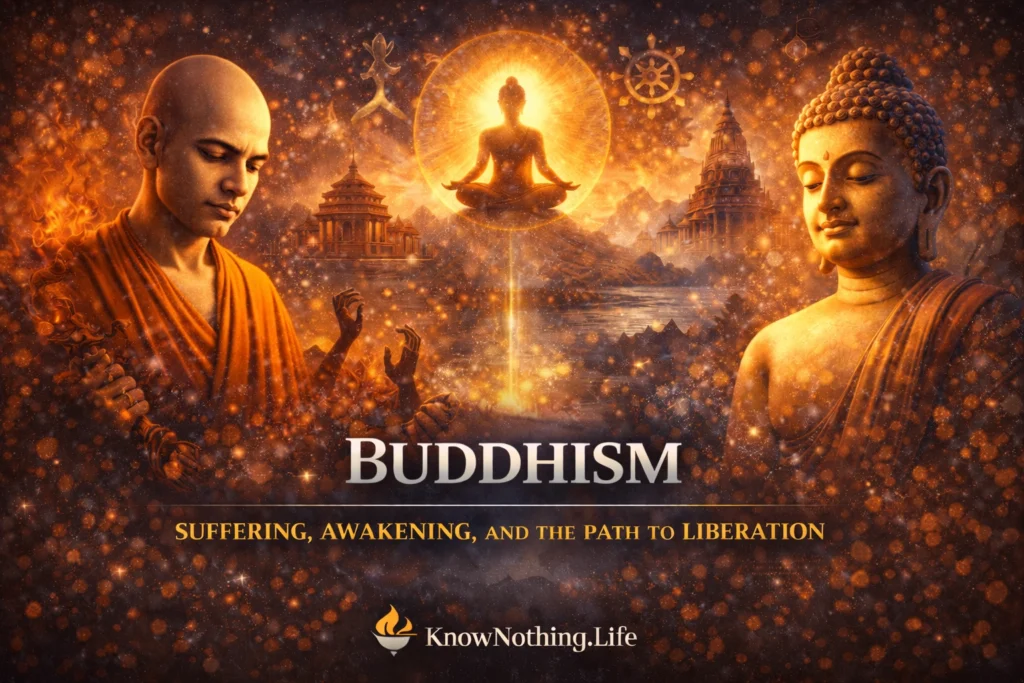
Buddhism is one of the world’s most profound philosophical and spiritual traditions, originating in ancient India and spreading across Asia and beyond. At its heart lies a deep investigation into the nature of suffering, the impermanence of existence, and the possibility of liberation through insight and disciplined practice. Unlike many traditions that center on divine authority, Buddhism focuses on human experience—what it means to suffer, to desire, and ultimately to awaken. Its teachings offer both a diagnosis of the human condition and a practical path toward freedom.
Founded by Siddhartha Gautama in the 6th century BCE, Buddhism emerged in a cultural context rich with philosophical and religious inquiry. Rejecting both extreme asceticism and indulgence, the Buddha proposed a “Middle Way” that avoids extremes and cultivates balance. His teachings, preserved in texts such as the Dhammapada and various sutras, emphasize ethical conduct, mental discipline, and wisdom as the means to transcend suffering. As the Buddha famously stated, “I teach only suffering and the cessation of suffering,” highlighting the practical focus of his philosophy.
The Four Noble Truths and the Nature of Suffering
The foundation of Buddhist thought is the Four Noble Truths, which articulate a clear and systematic understanding of human suffering. The first truth acknowledges that life, as ordinarily experienced, is marked by dukkha—a term often translated as suffering, dissatisfaction, or unease. This does not mean that life is entirely painful, but that it is inherently unstable and incapable of providing lasting fulfillment. Birth, aging, illness, and death, as well as attachment to transient pleasures, all contribute to this pervasive condition.
The second Noble Truth identifies the cause of suffering as craving (tanha), which arises from ignorance about the true nature of reality. Humans tend to cling to desires, identities, and experiences as though they were permanent, leading to frustration and disappointment when they inevitably change. The third Noble Truth offers hope by asserting that the cessation of suffering (nirvana) is possible when craving is extinguished. This state represents not annihilation, but liberation from the cycle of attachment and rebirth.
The fourth Noble Truth outlines the path to this liberation: the Noble Eightfold Path, a comprehensive guide to ethical and mental development. As expressed in the Dhammapada, “From craving springs grief, from craving springs fear; for one who is wholly free from craving there is no grief, whence fear?” This insight underscores the central Buddhist claim that suffering is not an unavoidable fate but a condition that can be understood and overcome through insight and practice.
The Noble Eightfold Path and Ethical Practice
The Noble Eightfold Path provides a practical framework for transforming one’s life and cultivating the conditions necessary for awakening. It is traditionally divided into three categories: wisdom (right view and right intention), ethical conduct (right speech, right action, right livelihood), and mental discipline (right effort, right mindfulness, right concentration). Each element of the path reinforces the others, creating a holistic approach to personal development.
Ethical conduct forms the foundation of Buddhist practice, emphasizing non-harm, honesty, and compassion. By cultivating right speech and action, individuals create the conditions for a peaceful and harmonious life, both internally and externally. This ethical dimension is not imposed as a set of commandments but arises naturally from an understanding of interconnectedness and the consequences of actions. In this sense, morality in Buddhism is closely linked to wisdom, as ethical behavior reflects a deeper awareness of reality.
Mental discipline, particularly through meditation, plays a crucial role in the Buddhist path. Practices such as mindfulness and concentration enable individuals to observe their thoughts and emotions without attachment, leading to greater clarity and insight. As the Buddha taught, “The mind is everything. What you think you become,” highlighting the transformative power of mental cultivation. Through sustained practice, individuals can develop a deeper understanding of impermanence, suffering, and non-self, ultimately leading to liberation.
Impermanence, Non-Self, and the Nature of Reality
Three fundamental characteristics of existence—impermanence (anicca), suffering (dukkha), and non-self (anatta)—form the philosophical core of Buddhism. Impermanence refers to the constant change that defines all phenomena, from physical objects to mental states. Nothing remains fixed or permanent, and recognizing this truth is essential to overcoming attachment and suffering. The Buddha emphasized this point repeatedly, stating, “All conditioned things are impermanent—when one sees this with wisdom, one turns away from suffering.”
The concept of non-self challenges the idea of a stable, independent identity. According to Buddhist thought, what we consider the “self” is actually a collection of changing processes—physical, emotional, and cognitive—without a fixed essence. This insight undermines the tendency to cling to identities and possessions, opening the possibility for greater freedom and flexibility in how one experiences life. Rather than denying the existence of the individual, Buddhism reframes it as a dynamic and interdependent process.
These teachings are further developed in later Buddhist philosophy, particularly in the work of Nagarjuna, founder of the Madhyamaka school. In texts such as the Mulamadhyamakakarika, Nagarjuna introduces the concept of emptiness (shunyata), arguing that all phenomena lack inherent existence and arise only through dependent origination. He writes, “Whatever is dependently arisen, that is explained to be emptiness,” offering a profound reinterpretation of reality as relational and contingent rather than fixed and independent.
Buddhist Traditions and Global Development
Over time, Buddhism developed into several major traditions, each with its own interpretations and practices. Theravāda Buddhism, often considered the closest to the earliest teachings, emphasizes monastic discipline and individual liberation through insight. Mahāyāna Buddhism expands the focus to include the ideal of the bodhisattva, a being who seeks enlightenment not only for themselves but for all sentient beings. This tradition includes influential texts such as the Lotus Sutra and the Heart Sutra, which explore themes of compassion and emptiness.
Another significant development is Vajrayāna Buddhism, which incorporates ritual, symbolism, and esoteric practices to accelerate the path to enlightenment. Found primarily in Tibet and parts of the Himalayas, Vajrayāna emphasizes the transformative power of visualization, mantra, and the guidance of a spiritual teacher. Despite their differences, all Buddhist traditions share a commitment to the core teachings of the Buddha and the goal of liberation from suffering.
Buddhism has also adapted to diverse cultural contexts, influencing art, literature, and social structures across Asia. In China, it interacted with Daoism and Confucianism; in Japan, it gave rise to Zen, with its emphasis on direct experience and simplicity. These adaptations demonstrate the flexibility and universality of Buddhist teachings, which continue to resonate across different societies and historical periods.
Contemporary Relevance and Influence
In the modern world, Buddhism has gained widespread attention for its insights into mindfulness, mental health, and the nature of consciousness. Practices derived from Buddhist meditation have been integrated into psychological therapies, particularly in approaches such as mindfulness-based stress reduction (MBSR). These applications highlight the practical value of Buddhist teachings in addressing contemporary challenges, from stress and anxiety to the search for meaning in a rapidly changing world.
Buddhist philosophy has also contributed to global discussions on ethics, environmental sustainability, and social responsibility. Its emphasis on compassion, nonviolence, and interconnectedness offers a powerful framework for addressing issues such as climate change and social inequality. By encouraging individuals to recognize their interdependence with others and the natural world, Buddhism promotes a sense of responsibility that extends beyond individual concerns.
As globalization continues to bring different cultures into closer contact, Buddhism remains a dynamic and evolving tradition. Its ability to adapt while preserving its core principles ensures its continued relevance in a world that is increasingly complex and interconnected. Whether approached as a philosophy, a religion, or a practical guide to living, Buddhism offers enduring insights into the nature of human experience.
Final Reflections on Buddhism
Buddhism stands as a profound exploration of the human condition, offering a path from suffering to awakening grounded in insight, discipline, and compassion. Its teachings challenge deeply held assumptions about identity, permanence, and fulfillment, inviting individuals to reconsider the foundations of their experience. By emphasizing the impermanent and interdependent nature of reality, Buddhism provides a framework for understanding both the causes of suffering and the possibility of liberation.
As Siddhartha Gautama taught, “Peace comes from within. Do not seek it without.” This simple yet profound statement encapsulates the essence of Buddhist philosophy, which directs attention inward as the key to transformation. Rather than relying on external circumstances, individuals are encouraged to cultivate awareness, compassion, and wisdom as the basis for a meaningful life.
In the end, Buddhism endures because it addresses universal human concerns with clarity and depth. It offers not only a philosophical system but a lived path—one that invites continuous reflection, practice, and growth. Through its teachings, individuals are empowered to move beyond suffering and toward a deeper understanding of themselves and the world.