Few individuals in human history have shaped spiritual and philosophical thought as profoundly as Siddhartha Gautama, known to the world as the Buddha, or “the Awakened One.” His life represents a turning point in humanity’s search for meaning, offering a systematic path to understanding suffering and transcending it. Unlike figures whose teachings were rooted in divine revelation or political authority, Gautama’s insights emerged from direct personal experience—an exploration of the mind, existence, and the nature of reality itself.
What makes Siddhartha Gautama unique is the universality of his message. His teachings do not rely on belief in a creator deity or adherence to rigid dogma, but instead emphasize observation, discipline, and personal transformation. Through what would later become known as Buddhism, he provided a framework that continues to guide millions in their pursuit of clarity, compassion, and liberation from suffering.
Early Life and Royal Upbringing
Siddhartha Gautama was born around the 5th or 6th century BCE in Lumbini, in present-day Nepal, into a royal family of the Shakya clan. His father, King Suddhodana, ensured that his son was raised in an environment of comfort and luxury, shielding him from the harsh realities of life. From an early age, Siddhartha was surrounded by wealth, pleasure, and protection, with the intention that he would eventually assume leadership of the kingdom.
Despite these privileges, there were early indications that Siddhartha possessed a contemplative and introspective nature. According to traditional accounts, sages predicted that he would either become a great king or a spiritual teacher. Determined to steer him toward worldly success, his father sought to prevent him from encountering suffering or anything that might inspire renunciation.
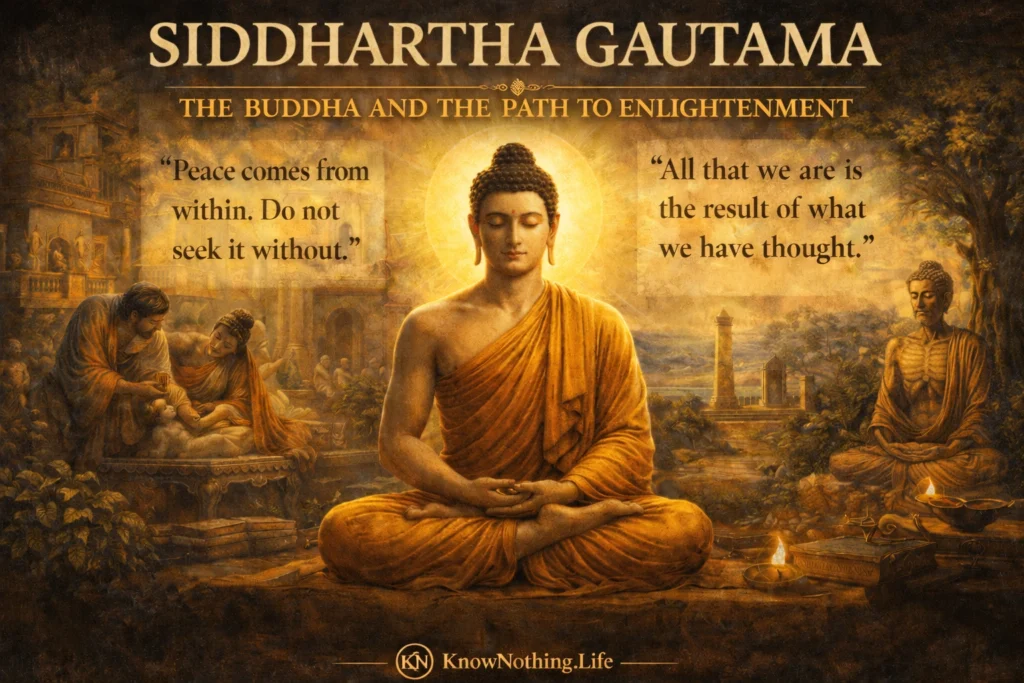
However, this carefully constructed environment could not contain his curiosity indefinitely. As he grew older, Siddhartha ventured beyond the palace walls and encountered what are now known as the “Four Sights”: an old man, a sick person, a corpse, and an ascetic. These experiences shattered his perception of reality, revealing the inevitability of aging, illness, and death. Confronted with these truths, he began to question the meaning of life and the possibility of escaping suffering.
The Great Renunciation and Quest for Truth
At the age of 29, Siddhartha made a decisive and transformative choice. Leaving behind his royal life, his wife, and his newborn son, he embarked on a spiritual journey in search of answers. This moment, often referred to as the Great Renunciation, marked the beginning of his quest to understand the nature of suffering and how it might be overcome.
Initially, he sought guidance from established teachers and practiced rigorous forms of asceticism. For several years, Siddhartha engaged in extreme self-denial, believing that liberation could be achieved through the rejection of all physical needs. He pushed his body to the brink of death, reducing himself to a state of severe emaciation. However, despite his dedication, he found that such practices did not lead to the clarity he sought.
Recognizing the limitations of both indulgence and extreme austerity, Siddhartha adopted what he would later call the “Middle Way”—a balanced approach that avoids both extremes. This realization was pivotal, as it shifted his focus from external practices to internal understanding. He began to cultivate meditation and deep concentration, preparing himself for the insight that would ultimately transform him.
Enlightenment and Awakening
Siddhartha’s journey culminated in his meditation beneath the Bodhi tree in Bodh Gaya. Determined not to rise until he had attained true understanding, he entered a state of profound concentration. During this period, he is said to have confronted Mara, a symbolic representation of temptation, fear, and illusion. By overcoming these forces, Siddhartha demonstrated mastery over the mental obstacles that bind individuals to suffering.
Through deep meditation, he attained enlightenment, gaining insight into the nature of existence. He understood the cycle of birth, death, and rebirth, as well as the underlying causes of suffering. This awakening transformed him into the Buddha—the “Awakened One”—a teacher who had discovered a path to liberation accessible to all.
Central to his realization were the Four Noble Truths: the truth of suffering, the cause of suffering, the cessation of suffering, and the path leading to its cessation. These principles form the foundation of his teachings, offering both a diagnosis of the human condition and a practical solution.
Core Teachings and Philosophy
The philosophy of Siddhartha Gautama is grounded in clarity, discipline, and direct experience. At its core lies the understanding that suffering arises from attachment and desire. Humans cling to impermanent things—pleasure, identity, possessions—mistakenly believing they can provide lasting satisfaction. When these inevitably change or disappear, suffering follows.
To address this, the Buddha taught the Noble Eightfold Path, a comprehensive guide to ethical living, mental discipline, and wisdom. This path includes right understanding, intention, speech, action, livelihood, effort, mindfulness, and concentration. Rather than prescribing rigid rules, it offers a framework for cultivating awareness and aligning one’s life with deeper truths.
Another essential concept in his teaching is impermanence (anicca). Everything in existence is in a constant state of change, and recognizing this reality is key to reducing attachment. Closely related is the idea of non-self (anatta), which challenges the notion of a fixed, unchanging identity. According to the Buddha, what we perceive as the self is a collection of ever-changing processes rather than a permanent essence.
Key Teachings and Quotes
The teachings of Siddhartha Gautama are often conveyed through concise and powerful statements that capture the essence of his philosophy. One of his most well-known sayings is: “Peace comes from within. Do not seek it without.” This reflects his emphasis on internal transformation rather than external solutions.
Another frequently cited teaching is: “All that we are is the result of what we have thought.” This highlights the role of the mind in shaping experience, suggesting that our perceptions and intentions determine the quality of our lives. By cultivating awareness and discipline, individuals can transform their relationship with the world.
He also offered guidance on dealing with suffering and attachment: “You only lose what you cling to.” This statement encapsulates the idea that attachment is the root of suffering. By letting go of rigid desires and expectations, individuals can achieve a state of greater freedom and equanimity.
These teachings, preserved in texts such as the Dhammapada, continue to serve as practical tools for those seeking clarity and balance. Their simplicity belies a depth that invites ongoing reflection and application.
The Spread of Buddhism and Influence
After attaining enlightenment, the Buddha spent the remainder of his life teaching and guiding others. He traveled extensively across northern India, sharing his insights with individuals from all walks of life. His teachings were not limited to elites or scholars; they were accessible to anyone willing to listen and practice.
He established a community of followers known as the Sangha, which played a crucial role in preserving and transmitting his teachings. This community included monks, nuns, and lay practitioners, creating a structure that allowed Buddhism to endure beyond his lifetime. Through oral tradition and later written texts, his teachings spread across regions and cultures.
Over time, Buddhism expanded beyond India, influencing civilizations throughout Asia and eventually the world. Its philosophical insights have shaped art, ethics, psychology, and meditation practices. In modern times, Buddhist principles have been integrated into fields such as mindfulness-based therapy, demonstrating their continued relevance.
Legacy and Modern Relevance
The legacy of Siddhartha Gautama is not confined to religious practice; it extends into philosophy, psychology, and everyday life. His emphasis on mindfulness and awareness has become particularly significant in contemporary society, where individuals often struggle with distraction, stress, and emotional turbulence.
Modern interpretations of his teachings focus on practical application. Mindfulness meditation, rooted in Buddhist practice, is now widely used to improve mental health and well-being. The idea of observing thoughts without attachment aligns closely with contemporary approaches to emotional regulation and cognitive awareness.
Beyond individual practice, the Buddha’s teachings also offer insights into broader human concerns. His emphasis on compassion, ethical conduct, and interconnectedness provides a framework for addressing social and environmental challenges. By recognizing the interdependence of all beings, individuals are encouraged to act with greater responsibility and care.
Conclusion
The life of Siddhartha Gautama represents a profound journey from privilege to enlightenment, from ignorance to understanding. Through his insights, he offered a path that transcends cultural and historical boundaries, addressing the fundamental questions of existence and suffering.
His teachings continue to resonate because they are grounded in direct experience and practical wisdom. Rather than offering abstract theories, he provided tools for transformation—methods that individuals can apply in their own lives. In doing so, he demonstrated that liberation is not reserved for a select few, but is accessible to anyone willing to engage in the process of self-discovery.
Ultimately, Siddhartha Gautama reminds us that the answers we seek are not found in external circumstances, but within our own awareness. Through discipline, insight, and compassion, it is possible to move beyond suffering and toward a deeper understanding of life itself.