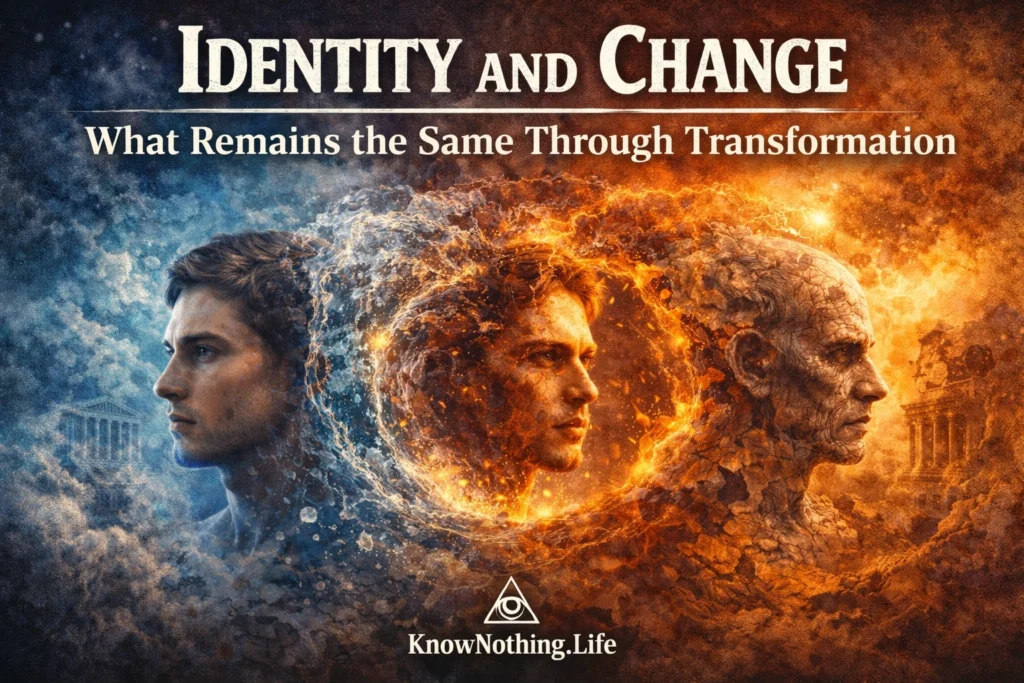
The problem of identity and change sits at the center of metaphysics, asking a deceptively simple question: how can something remain the same while undergoing change? Everyday experience suggests that objects, people, and even ideas persist over time despite alterations. A tree grows, sheds leaves, and ages, yet we still call it the same tree. A person develops, forgets, learns, and transforms, yet retains a sense of self. But what justifies this continuity?
Philosophers have long struggled with this tension between permanence and flux. If something changes, it is no longer exactly as it was—so in what sense can it still be the same? Conversely, if it remains identical in every respect, then it has not truly changed. The challenge lies in reconciling these two intuitions. The debate over identity and change has shaped philosophical thought from ancient Greece to contemporary discussions, influencing how we understand objects, persons, and reality itself.
Heraclitus and the Philosophy of Flux
The earliest articulation of the problem can be traced to Heraclitus, who emphasized the constant flux of reality. He famously declared, “No man ever steps in the same river twice,” highlighting the idea that everything is in a state of continuous change. For Heraclitus, stability is an illusion; the world is defined by transformation, and permanence is a conceptual convenience rather than a metaphysical truth.
This perspective challenges the notion of identity by suggesting that nothing truly remains the same. If the river’s waters are constantly flowing, and the person stepping into it is also changing, then both the subject and the object are different at every moment. Identity, in this view, is not a fixed property but a dynamic process.
Heraclitus’ philosophy forces a reconsideration of how identity is understood. Rather than being tied to unchanging essence, identity may emerge from patterns of continuity within change. This idea resonates with modern perspectives that emphasize processes over static entities, suggesting that what persists is not substance but structure.
Parmenides and the Denial of Change
In stark contrast to Heraclitus, Parmenides argued that change is impossible and that reality is fundamentally unchanging. In his work On Nature, Parmenides claimed, “What is, is; and what is not, is not.” From this premise, he concluded that change, which would require something to come from non-being or pass into it, is logically incoherent.
For Parmenides, true reality is singular, eternal, and unchanging. The appearance of change is an illusion created by human perception. This radical view eliminates the problem of identity and change by denying change altogether. If nothing changes, then identity is preserved absolutely.
Although few philosophers fully accept Parmenides’ conclusion, his arguments highlight the logical difficulties involved in explaining change. His challenge forced later thinkers to develop more sophisticated accounts that could accommodate both change and identity without contradiction.
Aristotle: Substance and Persistence
Aristotle offered one of the most influential solutions to the problem of identity and change. In Metaphysics, he introduced the concept of substance as the underlying reality that persists through change. While properties such as color, size, or location may vary, the substance remains the same.
Aristotle distinguished between essential and accidental properties. Essential properties define what a thing is and cannot be changed without altering its identity, while accidental properties can change without affecting the core nature of the object. For example, a person can change their appearance or location while remaining the same individual.
This framework allows for both continuity and transformation. A substance persists as long as its essential nature remains intact, even as its accidental features change. Aristotle’s account provides a balanced approach, preserving the reality of change while maintaining a stable basis for identity.
The Ship of Theseus and the Problem of Replacement
The problem of identity becomes particularly vivid in thought experiments such as the Ship of Theseus. If a ship has all its parts gradually replaced over time, is it still the same ship? And if the original parts are reassembled into another ship, which one is the true Ship of Theseus?
This paradox illustrates the difficulty of defining identity in terms of physical continuity. If identity depends on material composition, then the ship ceases to be the same as its parts are replaced. If it depends on form or function, then the ship may remain the same despite complete material change.
Philosophers have proposed various solutions. Some emphasize continuity of structure or organization, while others focus on historical continuity—the idea that an object’s identity is tied to its history. These approaches highlight that identity is not a simple property but a complex relationship involving time, change, and context.
Personal Identity: Memory and Consciousness
The question of identity becomes even more complex when applied to persons. What makes someone the same individual over time? John Locke offered a psychological account in An Essay Concerning Human Understanding, arguing that personal identity is based on continuity of consciousness. According to Locke, a person is the same as long as they can remember past experiences.
This view shifts the focus from physical or metaphysical substance to mental continuity. It suggests that identity is tied to memory and self-awareness rather than to the body or soul. However, it also raises questions: what happens if memories are lost or altered? Can identity persist without continuous recollection?
David Hume challenged the idea of a stable self altogether. In A Treatise of Human Nature, he argued that the self is merely a bundle of perceptions, constantly changing and lacking a fixed core. Hume wrote, “I never can catch myself at any time without a perception.” This view undermines the notion of enduring identity, suggesting that it is a construct of the mind.
Modern Perspectives: Identity in Science and Philosophy
In contemporary philosophy, the problem of identity and change intersects with developments in science and logic. Questions about identity arise in fields such as biology, physics, and cognitive science. For example, if the human body replaces most of its cells over time, what accounts for personal continuity?
Philosophers have developed various theories to address these issues. Some adopt a reductionist approach, analyzing identity in terms of physical or psychological continuity. Others propose non-reductionist views, arguing that identity cannot be fully explained by underlying processes.
In analytic philosophy, discussions often focus on criteria of identity—conditions under which two things are considered the same. These criteria vary depending on the context, reflecting the complexity of the concept. Identity may not be a single, uniform relation but a set of overlapping conditions that differ across domains.
The Philosophical Significance of Identity and Change
The problem of identity and change has far-reaching implications beyond metaphysics. It influences how we understand responsibility, continuity, and meaning in human life. If identity is stable, then individuals can be held accountable for past actions. If it is fluid, then responsibility becomes more complex.
This issue also shapes how people think about growth and transformation. The idea that one can change while remaining the same person underlies concepts of personal development and self-improvement. At the same time, it raises questions about authenticity and the limits of change.
Philosophically, the tension between identity and change reflects a deeper concern with permanence and impermanence. It challenges us to reconcile the desire for stability with the reality of transformation, a tension that lies at the heart of human experience.
Conclusion
The problem of identity and change remains one of the most profound and enduring questions in philosophy. From the opposing views of Heraclitus and Parmenides to the nuanced accounts of Aristotle and modern thinkers, it has inspired a wide range of perspectives. By examining how things persist through transformation, this debate reveals the complexity of reality and the limits of human understanding.
It shows that identity is not a simple, fixed property but a dynamic relationship shaped by change. Ultimately, the question of identity and change invites ongoing reflection. It challenges us to consider what it means to remain the same in a world that is constantly evolving—a question that is as personal as it is philosophical.