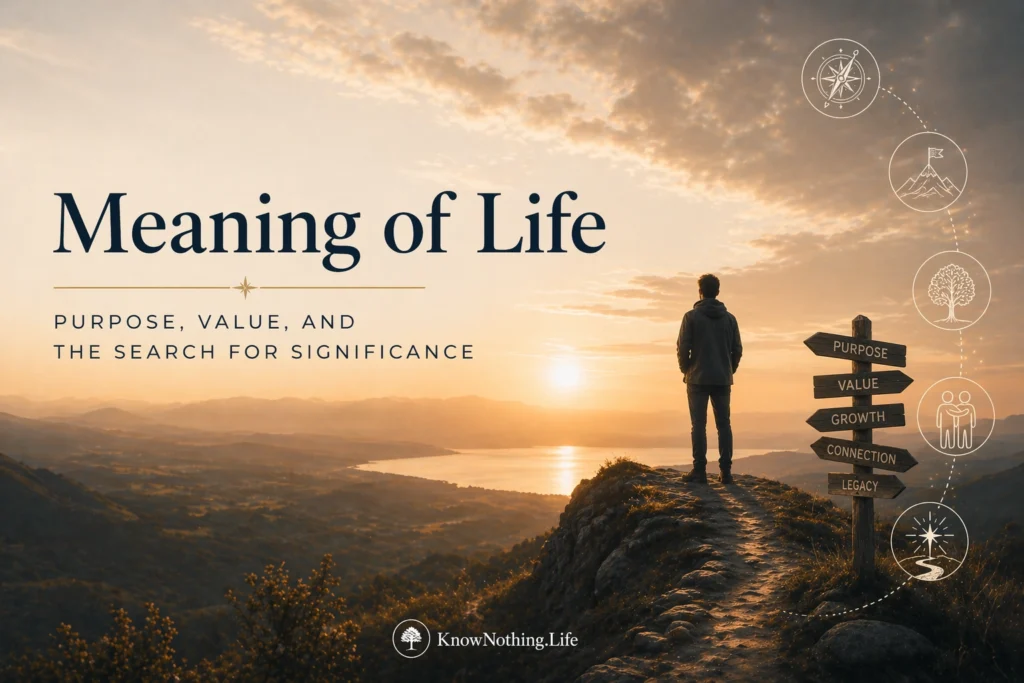
The question of the meaning of life is among the most enduring and profound in human thought. It asks not only why we exist, but what makes existence worthwhile. Unlike questions that can be resolved through empirical investigation, the meaning of life resists simple answers, inviting reflection across philosophy, religion, psychology, and personal experience. It is a question that each individual must confront, often in moments of uncertainty, transition, or introspection.
Throughout history, thinkers have offered diverse perspectives on this question. Some, like Aristotle, grounded meaning in human flourishing and the cultivation of virtue. Others, such as Jean-Paul Sartre, argued that meaning is not given but created through individual choice and action. These differing views reflect the complexity of the question itself, suggesting that meaning may not be a single, universal answer but a multifaceted and evolving pursuit.
Philosophical Approaches to Meaning
Philosophers have approached the meaning of life from a variety of angles, often shaped by their broader metaphysical and ethical commitments. Classical thinkers tended to link meaning with the realization of human potential, emphasizing harmony, reason, and the pursuit of excellence. For Aristotle, the highest good was eudaimonia, often translated as flourishing or well-being, achieved through the cultivation of virtue and the exercise of reason.
In contrast, existential philosophers challenged the idea that life has an inherent or predetermined meaning. Jean-Paul Sartre famously argued that existence precedes essence, meaning that individuals must create their own purpose through their choices. This perspective places responsibility on the individual, emphasizing freedom and authenticity as central to meaningful living.
Between these poles, other philosophical traditions have sought to reconcile objective and subjective elements of meaning. Some argue that meaning arises from engagement with values that transcend the individual, such as truth, beauty, or justice. Others emphasize the role of personal commitment and interpretation, suggesting that meaning is both discovered and created. These approaches highlight the richness and diversity of philosophical inquiry into life’s significance.
The Role of Happiness and Fulfillment
Happiness is often associated with the meaning of life, but the relationship between the two is complex. While happiness can contribute to a sense of meaning, it is not necessarily identical to it. A life filled with pleasure may lack deeper significance, while a life marked by struggle and sacrifice may still be profoundly meaningful.
Philosophers and psychologists have explored different conceptions of happiness, distinguishing between fleeting pleasure and more enduring forms of fulfillment. The Aristotelian idea of eudaimonia emphasizes a holistic form of well-being that includes intellectual, moral, and social dimensions. This perspective suggests that meaning arises from living in accordance with one’s values and realizing one’s potential.
Modern psychological research also supports the idea that meaning and happiness are related but distinct. Individuals who pursue meaningful goals, engage in purposeful activities, and cultivate strong relationships often report higher levels of well-being. This suggests that meaning may be a deeper and more sustainable source of fulfillment, providing a sense of direction and coherence in life.
Relationships, Community, and Connection
Human beings are inherently social, and relationships play a central role in the experience of meaning. Connections with family, friends, and broader communities provide a sense of belonging and purpose, shaping how individuals understand themselves and their place in the world.
Philosophers have long recognized the importance of social bonds. Aristotle described humans as “political animals,” emphasizing the role of community in achieving a good life. Relationships offer opportunities for mutual support, shared experiences, and the development of virtues such as empathy and compassion.
In contemporary thought, the significance of relationships is often linked to concepts of care and interdependence. Meaning is not solely an individual achievement but emerges through interaction with others. Acts of kindness, cooperation, and solidarity contribute to a sense of purpose that extends beyond the self, highlighting the relational nature of meaningful existence.
Work, Creativity, and Contribution
Work and creative activity are also important sources of meaning. Through work, individuals can contribute to society, develop skills, and express their abilities. Whether through professional achievements, artistic expression, or everyday tasks, these activities provide a sense of accomplishment and purpose.
Philosophers and psychologists have noted that meaningful work often involves a sense of engagement and alignment with personal values. When individuals feel that their efforts matter and have a positive impact, they are more likely to experience their lives as meaningful. This connection between effort and value underscores the importance of contribution in shaping life’s significance.
Creativity, in particular, offers a unique avenue for meaning. By producing something new—whether a work of art, a scientific discovery, or a personal project—individuals participate in the ongoing creation of culture and knowledge. This process not only enriches the world but also provides a sense of fulfillment and identity.
Suffering, Struggle, and Meaning
The presence of suffering in human life raises challenging questions about meaning. If life includes pain, loss, and hardship, how can it still be meaningful? This question has been central to philosophical and religious inquiry, leading to a range of responses.
Some perspectives, such as those influenced by Friedrich Nietzsche, suggest that suffering can contribute to meaning by fostering growth, resilience, and self-overcoming. Nietzsche’s idea that one can find value even in adversity emphasizes the transformative potential of struggle.
Similarly, existential thinkers like Albert Camus argued that meaning can emerge through the confrontation with suffering. Camus’ concept of the absurd highlights the tension between the human desire for meaning and the reality of an indifferent universe. Rather than succumbing to despair, he advocated for a defiant engagement with life, finding meaning in the act of living itself.
These perspectives suggest that suffering does not necessarily negate meaning but can, under certain conditions, deepen it. By responding to challenges with courage and reflection, individuals can transform adversity into a source of insight and purpose.
Religion, Spirituality, and Transcendence
For many individuals, the meaning of life is closely tied to religious or spiritual beliefs. These perspectives often provide comprehensive frameworks for understanding existence, offering explanations for life’s purpose and guidance for ethical living.
Religious traditions typically ground meaning in a relationship with a higher power or in participation in a larger cosmic order. This can provide a sense of direction and assurance, connecting individual lives to a broader narrative. Spiritual practices, such as meditation or prayer, may also contribute to a sense of meaning by fostering inner awareness and connection.
Even outside formal religious contexts, many people seek forms of transcendence that go beyond ordinary experience. This may involve engagement with nature, art, or philosophical reflection, providing a sense of connection to something larger than oneself. These experiences can enrich life and contribute to a deeper sense of purpose.
The Modern Search for Meaning
In contemporary society, the search for meaning takes place in a context of diversity and rapid change. Traditional sources of meaning, such as religion and community, may be less dominant, leading individuals to explore new ways of understanding their lives. This can create both opportunities and challenges, as individuals navigate a wide range of possibilities.
The rise of individualism has emphasized personal choice and self-definition, aligning with existential ideas about creating meaning. At the same time, it can lead to feelings of isolation or uncertainty, as individuals lack shared frameworks for understanding their experiences. This tension highlights the complexity of the modern search for meaning.
Technological and cultural developments also influence how meaning is experienced. Access to information, global connectivity, and changing social norms shape the ways in which individuals pursue purpose and fulfillment. In this evolving landscape, the question of the meaning of life remains as relevant as ever, inviting ongoing reflection and exploration.
Final Thoughts
The meaning of life is not a question with a single, definitive answer. It encompasses a wide range of perspectives, from philosophical theories to personal experiences, each offering insights into what makes life significant. Whether grounded in virtue, freedom, relationships, or transcendence, meaning emerges through engagement with the world and reflection on one’s place within it.
What unites these perspectives is the recognition that meaning involves both understanding and action. It is not something that can be passively received but must be actively pursued and shaped. This process requires openness, reflection, and a willingness to confront both the possibilities and challenges of existence.
Ultimately, the meaning of life is as much a journey as it is a destination. By engaging with its philosophical dimensions and reflecting on our own experiences, we can develop a deeper appreciation of what it means to live a meaningful life—one that is guided by purpose, enriched by connection, and responsive to the complexities of the human condition.