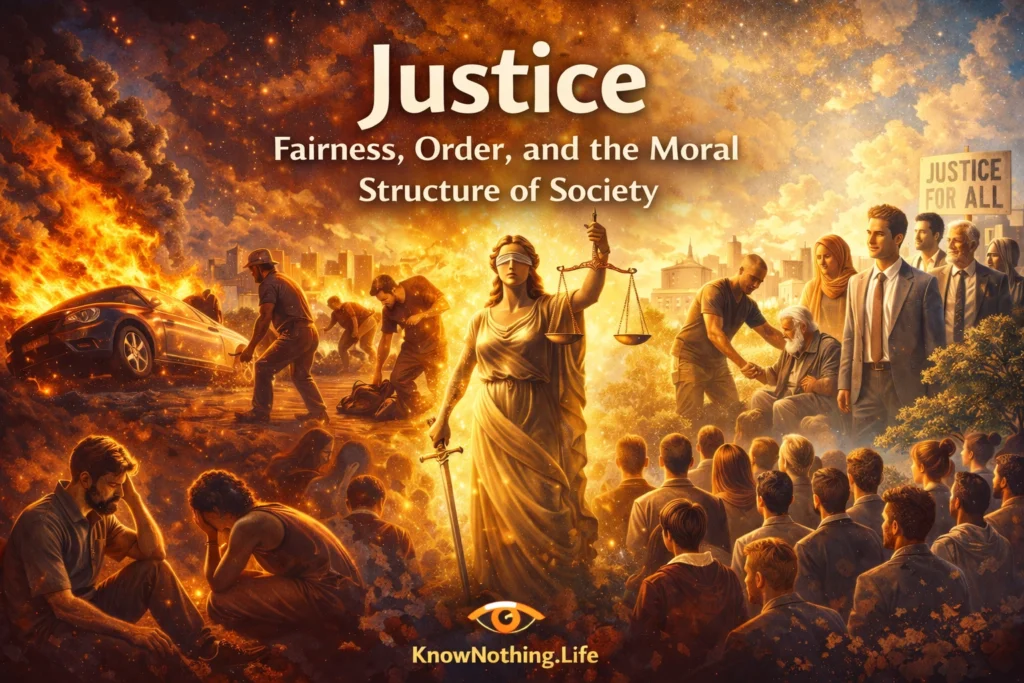
Justice is one of the oldest and most enduring concepts in human thought, shaping laws, institutions, and moral reasoning across civilizations. It concerns the fair distribution of goods, rights, and responsibilities, as well as the proper response to wrongdoing. From ancient philosophy to modern political theory, justice has been understood not merely as a legal principle but as a foundational ideal that defines how individuals relate to one another within a society. Whether expressed through laws, customs, or ethical systems, justice reflects a deeper aspiration toward balance, order, and moral legitimacy.
At its core, justice asks what people are owed and why. It raises difficult questions about equality, merit, punishment, and power. These questions have produced competing answers across time, each shaped by cultural, historical, and philosophical contexts. What remains constant is the recognition that justice is essential to social cohesion. Without some shared sense of fairness, trust erodes, conflict intensifies, and institutions lose their authority. The pursuit of justice, therefore, is not only a philosophical endeavor but a practical necessity for sustaining human communities.
Justice in Ancient Philosophy
The earliest systematic explorations of justice emerge in ancient Greek philosophy, particularly in Plato’s The Republic. In this work, Plato presents justice as harmony—both within the individual and within the state. He argues that a just society mirrors a well-ordered soul, where reason governs spirit and appetite. Justice, in this sense, is not merely about external actions but about internal balance. A just person acts rightly because their inner structure is aligned with truth and reason, not because they fear punishment or seek reward.
Plato’s student, Aristotle, offers a more practical and nuanced account in Nicomachean Ethics. He distinguishes between distributive justice, which concerns the fair allocation of resources, and corrective justice, which addresses wrongs and restores balance. Aristotle emphasizes proportionality: justice requires giving each person what they deserve based on relevant criteria such as merit or contribution. As he writes, “Justice is the virtue that consists in the distribution of what is due.”
These classical frameworks establish two enduring dimensions of justice: one focused on harmony and moral order, the other on fairness and proportionality. Together, they form the foundation for much of Western thinking about law and ethics, influencing later traditions in both philosophy and political theory.
Justice and Social Contract Theory
In the early modern period, the concept of justice becomes closely tied to political authority and the legitimacy of the state. Thinkers like Thomas Hobbes, John Locke, and Jean-Jacques Rousseau develop social contract theories to explain how justice arises from agreements among individuals. For Hobbes, writing in Leviathan, justice is defined by the rules established under a sovereign authority. In a state of nature, where no such authority exists, there is no justice—only conflict. Justice emerges when individuals agree to surrender certain freedoms in exchange for security and order.
Locke offers a more optimistic view in his Two Treatises of Government. He argues that individuals possess natural rights to life, liberty, and property, and that justice consists in protecting these rights. Governments are legitimate only insofar as they uphold this moral framework. When they fail, citizens have the right to resist. Rousseau, in The Social Contract, takes this further by emphasizing the “general will”—the collective interest of the people. Justice, for Rousseau, is not merely about protecting individual rights but about aligning laws with the common good.
These theories shift the focus of justice from cosmic or moral order to political legitimacy and collective agreement. They highlight the role of institutions in defining and enforcing justice, while also raising enduring questions about authority, consent, and equality.
Modern Theories of Justice
In the twentieth century, debates about justice take on new urgency in response to social inequality, economic disparity, and political conflict. One of the most influential modern accounts is offered by John Rawls in A Theory of Justice. Rawls introduces the idea of the “original position,” a hypothetical scenario in which individuals choose principles of justice behind a “veil of ignorance,” unaware of their own social status or personal advantages. This thought experiment is designed to ensure fairness by eliminating bias.
Rawls argues that a just society would adopt two main principles: equal basic liberties for all, and social and economic inequalities arranged to benefit the least advantaged. As he famously states, “Justice is the first virtue of social institutions.” His framework emphasizes fairness, equality of opportunity, and the moral importance of protecting vulnerable members of society.
Critics of Rawls, such as Robert Nozick, challenge this redistributive approach. In Anarchy, State, and Utopia, Nozick argues that justice lies in respecting individual rights and voluntary exchanges, not in achieving patterned distributions of wealth. For him, any forced redistribution violates personal liberty. This debate between egalitarian and libertarian perspectives continues to shape contemporary discussions about taxation, welfare, and economic justice.
Justice in Law and Society
Beyond philosophical theory, justice operates through legal systems that define rights, adjudicate disputes, and enforce norms. The rule of law is often seen as a cornerstone of justice, ensuring that laws are applied consistently and impartially. However, legal justice is not always synonymous with moral justice. Laws can be unjust, and legal systems can reflect existing power structures rather than challenge them.
The civil rights movement in the United States illustrates this tension. Figures like Martin Luther King Jr. argued that unjust laws must be resisted. In his “Letter from Birmingham Jail,” he writes, “Injustice anywhere is a threat to justice everywhere.” This statement captures the idea that justice is not confined to legal codes but is a broader moral imperative that transcends specific institutions.
Contemporary discussions of justice also address systemic issues such as racial inequality, gender discrimination, and economic disparity. These perspectives emphasize that justice requires not only fair rules but also fair outcomes. Structural injustices—those embedded in social, economic, and political systems—challenge traditional notions of individual responsibility and call for collective solutions.
Justice, Punishment, and Responsibility
A central aspect of justice concerns how societies respond to wrongdoing. Theories of punishment generally fall into three categories: retributive, deterrent, and rehabilitative. Retributive justice, rooted in the idea of moral desert, holds that individuals should be punished in proportion to their crime. This view is often associated with thinkers like Immanuel Kant, who argued that punishment is justified because the crime itself demands it, not because of its consequences.
Deterrent theories focus on preventing future wrongdoing by making examples of offenders, while rehabilitative approaches aim to reform individuals and reintegrate them into society. Each perspective reflects different assumptions about human nature, responsibility, and the purpose of justice. Modern legal systems often combine these approaches, though tensions between them remain.
The question of responsibility is particularly complex in cases involving mental illness, social disadvantage, or systemic inequality. To what extent are individuals accountable for actions shaped by circumstances beyond their control? This question continues to challenge legal and moral frameworks, highlighting the difficulty of balancing fairness with compassion.
Justice as an Ongoing Project
Justice is not a fixed concept but an evolving ideal that adapts to changing social conditions and moral insights. What counts as just in one era may be seen as unjust in another. Historical progress—such as the abolition of slavery, the expansion of civil rights, and the recognition of gender equality—reflects shifting understandings of justice and the willingness of societies to challenge entrenched norms.
At the same time, new challenges continue to emerge. Issues such as climate justice, global inequality, and technological ethics raise questions that traditional frameworks may not fully address. Who is responsible for environmental harm? How should resources be distributed across nations? What obligations do we have to future generations? These questions extend the scope of justice beyond immediate communities to a global and even intergenerational scale.
Ultimately, justice remains a guiding ideal rather than a completed achievement. It requires constant reflection, debate, and action. As Amartya Sen argues in The Idea of Justice, the goal is not to design perfectly just institutions but to reduce clear injustices wherever they occur. This pragmatic approach underscores the importance of incremental progress and moral vigilance.