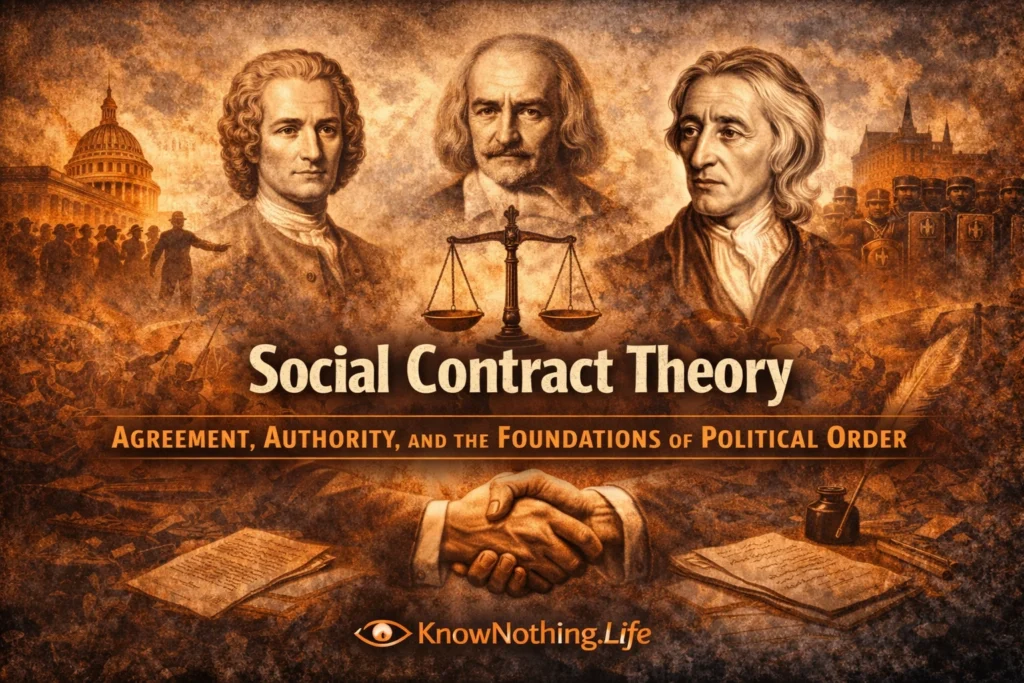
Social contract theory is one of the most influential frameworks in political philosophy, offering an account of how legitimate authority arises from the agreement of individuals. At its core, the theory proposes that political institutions are justified because rational individuals would consent to them under certain conditions. Rather than grounding authority in divine right, tradition, or sheer force, social contract theory locates its foundation in the voluntary agreement of free and equal persons seeking to organize their collective life.
The appeal of this framework lies in its attempt to reconcile individual freedom with social order. If individuals are naturally free, how can they be subject to authority without losing that freedom? The social contract provides an answer by suggesting that individuals give up certain liberties in exchange for the benefits of living in a structured society, such as security, cooperation, and mutual protection. This exchange transforms natural freedom into civil freedom, creating a system in which authority is both necessary and justified.
The State of Nature and the Origins of the Contract
A central concept in social contract theory is the “state of nature,” a hypothetical condition in which individuals exist without political authority. This idea is used to explore what human life would be like in the absence of government and to justify the need for a social contract. Thomas Hobbes provides one of the most famous accounts in Leviathan. For Hobbes, the state of nature is a condition of constant conflict, where individuals compete for resources and security. He describes life in this state as “solitary, poor, nasty, brutish, and short.”
Hobbes’s pessimistic view of human nature leads him to advocate for a powerful sovereign authority. According to his theory, individuals agree to surrender their rights to a central authority in order to escape the dangers of the state of nature. This agreement creates a social contract that establishes political order. For Hobbes, the legitimacy of authority rests on its ability to provide security and prevent chaos, even if this requires significant limitations on individual freedom.
Other thinkers offer more optimistic interpretations of the state of nature. John Locke, in Two Treatises of Government, argues that the state of nature is generally peaceful but lacks a reliable system for enforcing rights. Individuals possess natural rights to life, liberty, and property, but these rights are insecure without a common authority. The social contract, in Locke’s view, is formed to protect these rights, and its legitimacy depends on fulfilling this function.
Consent, Rights, and Limited Government
Locke’s version of social contract theory places a strong emphasis on consent and the protection of individual rights. Unlike Hobbes, who advocates for near-absolute authority, Locke argues that political power must be limited and accountable. Governments derive their legitimacy from the consent of the governed, and this consent can be withdrawn if the government fails to protect natural rights. This idea introduces a dynamic element to the social contract, allowing for the possibility of resistance and revolution.
Locke’s theory has had a profound impact on modern political thought, particularly in the development of liberal democracy. His emphasis on individual rights, limited government, and the rule of law provides a framework for evaluating political institutions. As he writes, “The end of law is not to abolish or restrain, but to preserve and enlarge freedom.” This statement captures the idea that legitimate authority enhances, rather than diminishes, individual liberty.
The concept of consent also raises important questions about how agreement is established in practice. Is consent explicit, as in the signing of a contract, or implicit, as in the acceptance of living under a particular system? These questions highlight the complexity of grounding political authority in agreement, especially in large and diverse societies where individuals may have differing views about the legitimacy of existing institutions.
Rousseau and the General Will
Jean-Jacques Rousseau offers a distinct and influential version of social contract theory in The Social Contract. Rousseau agrees that legitimate authority arises from agreement, but he redefines the nature of that agreement. Instead of focusing on the protection of individual rights, he emphasizes the concept of the general will—the collective interest of the community.
For Rousseau, the social contract transforms individuals into citizens who participate in the creation of laws. Freedom, in this framework, is not merely the absence of interference but the ability to take part in collective self-governance. He famously states, “Man is born free, and everywhere he is in chains,” highlighting the tension between natural freedom and social constraints. The goal of the social contract is to resolve this tension by creating a political order in which individuals obey laws they have helped to create.
Rousseau’s theory has inspired democratic and participatory models of governance, but it also raises concerns about the potential for collective authority to override individual rights. The idea of the general will can be difficult to define and may be interpreted in ways that justify coercion in the name of the common good. This tension reflects the broader challenge of balancing individual autonomy with collective decision-making.
Modern Developments and Justice as Fairness
In the twentieth century, social contract theory is revitalized and transformed by John Rawls in A Theory of Justice. Rawls introduces the concept of the original position, a hypothetical scenario in which individuals choose principles of justice behind a veil of ignorance, unaware of their own social status or personal advantages. This framework is designed to ensure fairness by eliminating bias and self-interest.
Rawls’s version of the social contract shifts the focus from historical agreement to rational justification. The contract is not an actual event but a thought experiment that reveals what principles free and equal individuals would agree to under fair conditions. This leads to his two principles of justice: equal basic liberties for all, and inequalities arranged to benefit the least advantaged. As Rawls states, “Justice is the first virtue of social institutions.”
This modern interpretation expands the scope of social contract theory, applying it not only to political authority but also to the distribution of resources and opportunities. It provides a powerful framework for addressing issues of inequality and fairness, while maintaining the core idea that legitimacy arises from agreement among individuals.
Critiques of Social Contract Theory
Despite its influence, social contract theory has been subject to significant criticism. One major objection is that the contract is hypothetical rather than actual, raising questions about its relevance to real-world political systems. Critics argue that individuals have not explicitly agreed to the terms of their government, and therefore the notion of consent may be more symbolic than literal.
David Hume challenges the idea of consent as the basis of political obligation, arguing that most governments are established through force or historical processes rather than agreement. In his essay “Of the Original Contract,” Hume suggests that the appeal to consent is often a retrospective justification rather than an actual foundation of authority.
Other critiques focus on the assumptions underlying the theory, such as the idea of individuals as rational and self-interested agents. Feminist and communitarian thinkers argue that this model overlooks the social and relational aspects of human life, emphasizing that individuals are shaped by their communities and cannot be understood in isolation. These critiques highlight the limitations of social contract theory while also prompting its refinement and development.
The Enduring Significance of the Social Contract
Social contract theory remains a foundational concept in political philosophy because it provides a compelling account of how authority can be justified in a world of free and equal individuals. It offers a framework for evaluating political institutions, emphasizing the importance of consent, fairness, and mutual agreement. By grounding authority in the will of the people, it challenges traditional sources of power and promotes a more egalitarian vision of political order.
At the same time, the theory continues to evolve in response to new challenges and perspectives. Issues such as global governance, environmental responsibility, and social inequality require rethinking the terms of the contract and the scope of political obligation. These developments demonstrate that the social contract is not a fixed doctrine but a dynamic framework that adapts to changing conditions.
Ultimately, social contract theory is about more than the origins of political authority. It is about the principles that should guide our collective life and the conditions under which individuals can coexist in a just and stable society. By exploring these questions, the theory provides a foundation for understanding both the possibilities and the limits of political order.