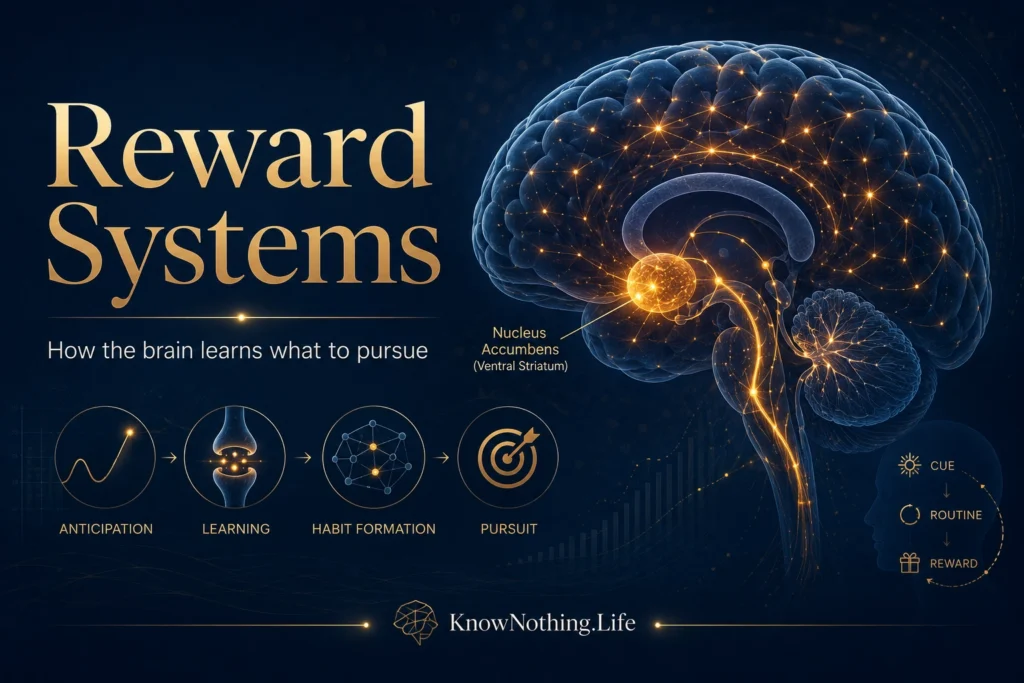
Reward systems are interconnected brain processes that help organisms recognize valuable outcomes, learn how to obtain them, and decide whether those outcomes are worth pursuing. Food, safety, social approval, money, achievement, novelty, and relief from discomfort can all function as rewards under the right conditions. A reward is not merely something pleasurable. In neuroscience, it is an outcome that can influence learning, attention, motivation, and future behavior.
The brain does not contain a single reward center that produces every form of satisfaction. Reward depends on communication among the ventral tegmental area, striatum, nucleus accumbens, orbitofrontal cortex, prefrontal cortex, amygdala, hippocampus, hypothalamus, and other regions. Different parts of this network contribute to anticipation, pleasure, memory, action selection, effort, and evaluation. Human imaging studies have shown that both appetitive learning and reward anticipation engage distributed neural systems rather than one isolated structure.
The Discovery of Neural Reinforcement
The modern study of reward systems was transformed by James Olds and Peter Milner’s 1954 paper, “Positive Reinforcement Produced by Electrical Stimulation of Septal Area and Other Regions of Rat Brain.” In their experiments, rats repeatedly returned to locations where they had received electrical brain stimulation and learned to press a lever to obtain further stimulation. The behavior demonstrated that activating particular neural pathways could strongly reinforce an action, even when the reward did not come from food, water, or another external object.
The discovery was initially interpreted as evidence for a pleasure center, but that description proved too simple. Electrical stimulation can activate fibers connecting several regions, and the resulting behavior may reflect motivation, reinforcement, arousal, or the urge to continue stimulation rather than pure pleasure. The experiments nevertheless established a central principle of behavioral neuroscience: activity within the brain can change the probability that an action will be repeated.
Dopamine and Reward Prediction
Dopamine is closely associated with reward, but it is not simply a chemical form of pleasure. Dopamine-producing neurons help the brain detect important events, update expectations, energize behavior, and learn which cues predict valuable outcomes. These neurons originate mainly in midbrain regions such as the ventral tegmental area and substantia nigra and project to the striatum, prefrontal cortex, and other areas involved in learning and action.
In their influential 1997 paper “A Neural Substrate of Prediction and Reward,” Wolfram Schultz, Peter Dayan, and P. Read Montague described a pattern now known as reward-prediction error. Dopamine neurons responded strongly to unexpected rewards. As learning occurred, the response shifted toward a cue that predicted the reward. If an expected reward failed to arrive, activity decreased around the time it should have appeared. The signal therefore represented the difference between what was expected and what actually happened.
Human research has found comparable learning signals. In a 2003 experiment, John O’Doherty and colleagues used functional magnetic resonance imaging while participants learned that a cue predicted a pleasant taste. Activity in the ventral striatum and orbitofrontal cortex tracked the prediction errors described by computational learning models. The study helped connect animal electrophysiology with human learning, showing how the brain continuously revises the value assigned to cues and outcomes.
Anticipation, Wanting, and Liking
Rewards influence behavior before they are received. A smell, advertisement, notification, familiar location, or expression of approval can trigger anticipation because earlier learning has connected the cue with a desirable outcome. Brian Knutson and colleagues demonstrated in 2001 that anticipating increasing monetary rewards recruited the nucleus accumbens, supporting the idea that reward anticipation has a distinct neural signature. The brain can become highly activated by the possibility of a reward even before the final outcome is known.
Neuroscientists distinguish motivational wanting from hedonic liking. Wanting makes a reward or its cues attractive and capable of provoking pursuit. Liking refers to the pleasurable reaction produced by receiving or consuming the reward. These processes normally occur together, but they can be separated. A person may strongly want something that produces little satisfaction, or enjoy something without feeling compelled to obtain it repeatedly.
Experiments by Susana Peciña and Kent Berridge identified a small “hedonic hot spot” within the medial shell of the nucleus accumbens. Stimulating mu-opioid receptors in this region increased positive facial reactions to sweetness as well as food consumption. The findings showed that pleasure is generated through specialized mechanisms within the broader reward network and cannot be equated with all activity in the nucleus accumbens or with dopamine release alone.
Reward, Effort, and Cost
A valuable outcome does not automatically produce action. The brain must also evaluate how much work, time, uncertainty, or risk stands between the person and the reward. A meal across the room and the same meal at the top of a mountain have identical nutritional value but very different motivational costs. Reward systems therefore interact with circuits that regulate effort, persistence, and behavioral activation.
John Salamone and colleagues demonstrated this distinction in a 1991 experiment involving rats choosing between pressing a lever for a preferred food and eating freely available but less preferred food. Blocking dopamine receptors or depleting dopamine in the nucleus accumbens reduced lever pressing while increasing consumption of the freely available alternative. The animals still ate and still appeared to value food, but they became less willing to perform the effortful action required to obtain the preferred option.
These findings show why low motivation cannot always be explained as a lack of desire or pleasure. A person may value an outcome while experiencing the required effort as overwhelming. Depression, fatigue, chronic stress, and some neurological disorders can affect the systems that convert value into action. Motivation depends not only on whether a reward matters, but also on whether the brain judges its cost to be manageable.
From Goal-Directed Action to Habit
Reward learning initially helps people choose actions according to expected outcomes. Someone studies because they expect to pass an examination, exercises because they value health, or takes a particular route because it leads efficiently to work. These actions are goal-directed because their performance depends on the current value of the outcome and an understanding of the relationship between behavior and consequence.
With repetition, control can gradually shift toward habit systems. Habits allow familiar actions to occur efficiently without requiring extensive deliberation each time. In a 2004 study, Henry Yin, Barbara Knowlton, and Bernard Balleine found that lesions of the dorsolateral striatum prevented normal habit formation in rats while preserving knowledge about expected outcomes. The findings provided direct evidence that the dorsolateral striatum contributes to habitual behavior, whereas other systems support flexible, outcome-sensitive action.
Habits are not inherently negative. They reduce cognitive demand and make stable routines possible. Problems arise when cues continue to trigger an established action after the outcome has lost value or begun to produce harm. Reward systems can therefore support both adaptable learning and behavioral rigidity, depending on which neural processes dominate.
Social and Abstract Rewards
Human reward systems respond to more than biological necessities. Money, status, reputation, fairness, knowledge, beauty, and achievement can become rewarding because people learn their social and personal significance. These rewards may be abstract, but they still influence attention, emotion, and behavior through neural mechanisms that overlap with those used to process tangible outcomes.
Keise Izuma, Daisuke Saito, and Norihiro Sadato investigated this overlap in a 2008 functional imaging study. Participants received monetary rewards and information indicating that other people viewed them favorably. Acquiring a good reputation activated reward-related areas of the striatum that also responded to money. The researchers proposed that different kinds of rewards may be translated into a partially shared neural currency, allowing the brain to compare outcomes that have no common physical form.
This shared valuation system helps explain why social approval can become intensely motivating. Praise, attention, public recognition, and online feedback may influence behavior even when they provide no direct material benefit. Their value is shaped by culture, personal goals, relationships, and learning, demonstrating that reward systems are biological but not socially isolated.
Reward Systems and Addiction
Addiction reveals how reward learning can become separated from long-term well-being. Drugs and drug-associated cues can acquire powerful motivational significance, while repeated use strengthens habits and narrows attention toward immediate reward. This does not mean that addiction is caused by a permanently activated pleasure center. Craving, pleasure, withdrawal, habit, stress, and impaired control involve overlapping but distinguishable processes.
Anna Rose Childress and colleagues used positron emission tomography in a 1999 study of people with cocaine dependence. Cocaine-related videos produced craving and altered activity in limbic regions, including the amygdala and anterior cingulate cortex, compared with neutral videos. Nora Volkow and colleagues later found that cocaine cues increased dopamine in the dorsal striatum and that these changes were associated with craving. Such findings demonstrate how learned environmental cues can activate motivational systems even when the drug itself is absent.
Reward systems remain necessary for ordinary life. They make learning, curiosity, relationships, work, eating, and goal pursuit possible. The problem is not that the brain seeks rewards, but that particular rewards or cues can gain disproportionate control over attention and behavior. Understanding addiction therefore requires examining learning, motivation, habits, stress, and self-regulation rather than reducing the condition to pleasure or weak willpower.
Understanding the Rewarding Brain
Reward systems help the brain answer several connected questions: What matters? What predicts it? How can it be obtained? Is it worth the effort? Should the action be repeated? Dopamine contributes to prediction and motivated action, opioid systems help generate some forms of pleasure, the striatum supports reinforcement and habits, and prefrontal networks help compare immediate rewards with future goals.
There is no single reward signal that explains every pleasurable or motivated behavior. Reward is a process through which the brain integrates bodily needs, memories, expectations, social meanings, costs, and changing circumstances. The same systems that allow people to learn from success can also reinforce destructive patterns. Their central function is not simply to make life feel good, but to teach the organism what deserves attention and what it should do next.