Dopamine is one of the most widely discussed chemicals in psychology and neuroscience, but it is also one of the most commonly misunderstood. Popular culture often calls dopamine the “pleasure chemical,” as if its main purpose were simply to make people feel good. That description is too narrow. Dopamine is deeply involved in reward, but it is also central to motivation, learning, attention, movement, habit formation, prediction, and the pursuit of goals. It helps the brain decide what matters, what is worth approaching, what should be remembered, and what actions should be repeated. In that sense, dopamine is not merely about pleasure; it is about the organization of desire and behavior.
The reward system refers to a network of brain structures that help organisms learn from rewarding and punishing experiences. Major regions include the ventral tegmental area, nucleus accumbens, prefrontal cortex, amygdala, hippocampus, and parts of the basal ganglia. Researchers such as Wolfram Schultz, Kent Berridge, Terry Robinson, Nora Volkow, George Koob, Roy Wise, and Jaak Panksepp have shaped modern understanding of dopamine and reward. Schultz’s work on reward prediction error showed that dopamine neurons respond strongly when rewards are unexpected, while Berridge and Robinson distinguished “wanting” from “liking,” a crucial insight for addiction psychology. The dopamine system is therefore best understood as a learning and motivation system that helps connect cues, actions, rewards, and future behavior.
The Reward System and Survival
The reward system evolved because organisms need to seek things that support survival and reproduction. Food, water, social connection, sex, safety, novelty, and successful problem-solving can all activate reward-related circuits. When an experience is rewarding, the brain learns that the actions and cues surrounding it may be worth repeating. This system helps animals and humans move toward beneficial opportunities and away from danger. Without reward learning, behavior would be less adaptive, less flexible, and less responsive to changing environments.
Jaak Panksepp, in Affective Neuroscience, described emotional systems in the brain that organize basic motivational states. His work emphasized that seeking is a fundamental process, not an optional extra. The brain is built to explore, pursue, and anticipate. Dopamine is strongly involved in this seeking system. It energizes movement toward possible rewards and helps make the world feel filled with opportunities. This is why dopamine is linked not only to pleasure after a reward but to anticipation before the reward arrives. The chase can become psychologically powerful even when the final reward is brief, disappointing, or uncertain.
Dopamine, Motivation, and “Wanting”
One of the most important distinctions in reward science is the difference between “wanting” and “liking.” “Liking” refers to the pleasurable impact of a reward: the enjoyment of food, the comfort of relief, the pleasantness of a social experience. “Wanting,” by contrast, refers to incentive salience—the motivational pull that makes something feel desirable, urgent, or worth pursuing. Kent Berridge and Terry Robinson’s incentive-sensitization theory of addiction argues that dopamine is more closely tied to wanting than liking. In their framework, a person can intensely want something even if they no longer truly enjoy it.
This distinction is essential for understanding addiction, craving, and compulsive behavior. A person may crave a drug, gamble, scroll, shop, or binge even after the behavior has stopped producing much pleasure. The wanting system can become sensitized, especially to cues associated with reward. This means that desire can grow stronger even as enjoyment fades. Berridge has described dopamine’s role as making rewards “wanted,” not necessarily “liked.” That insight corrects the popular myth that addiction is simply the pursuit of pleasure. Often, addiction is the pursuit of relief, compulsion, or cue-triggered wanting long after genuine enjoyment has diminished.
Reward Prediction and Learning
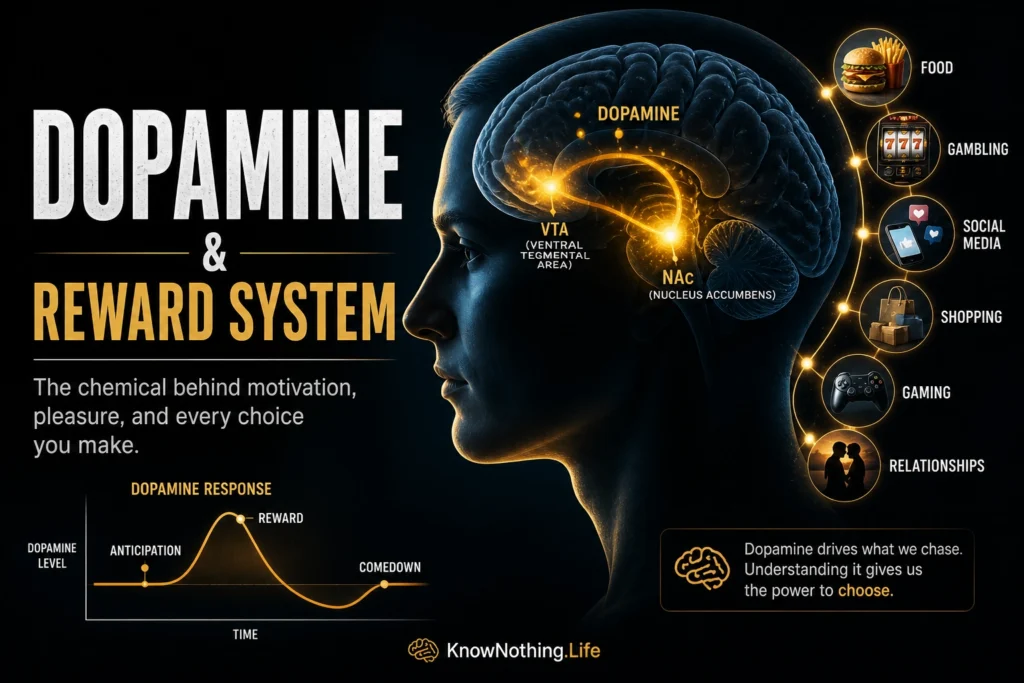
Dopamine helps the brain learn from prediction. Wolfram Schultz’s research on dopamine neurons showed that dopamine activity is closely related to reward prediction error. When a reward is better than expected, dopamine activity increases. When a reward is fully predicted, the dopamine response shifts from the reward itself to the cue that predicts it. When an expected reward fails to appear, dopamine activity drops. This pattern helps the brain update expectations and learn which cues and actions are valuable.
Reward prediction error is central to habit formation, consumer behavior, gambling, addiction, and learning. If a person receives an unexpected compliment, wins money, gets a social media notification, or tastes something surprisingly good, the brain marks the experience as important. Over time, the cues that predict the reward become motivating in themselves. A casino sound, phone vibration, coffee smell, familiar route, or brand logo can trigger anticipation because the brain has learned its connection to reward. Dopamine therefore helps transform neutral cues into motivational signals. The world becomes psychologically organized around what has previously predicted reward.
The Main Brain Pathways
Dopamine operates through several major pathways, each associated with different functions. The mesolimbic pathway, running from the ventral tegmental area to the nucleus accumbens and related limbic structures, is strongly involved in reward, motivation, and reinforcement. The mesocortical pathway connects dopamine activity with the prefrontal cortex, influencing planning, decision-making, attention, and self-control. The nigrostriatal pathway is involved in movement and habit, and its degeneration is central to Parkinson’s disease. The tuberoinfundibular pathway regulates hormonal processes, particularly prolactin.
The reward system is not a single “pleasure button.” It is a distributed network connecting emotion, memory, motivation, action, and executive control. The nucleus accumbens helps translate motivation into action. The amygdala attaches emotional significance to cues. The hippocampus links reward to memory and context. The prefrontal cortex helps evaluate consequences and regulate impulses. Nora Volkow’s work on addiction emphasizes that addiction affects not only reward, but also memory, motivation, stress, and control systems. This broader view is important because reward-driven behavior is never purely chemical; it is also cognitive, emotional, contextual, and social.
Dopamine and Reinforcement
Dopamine is closely connected to reinforcement, the process by which behavior becomes more likely after rewarding consequences. B. F. Skinner’s behavioral psychology showed that consequences shape behavior, and neuroscience later helped explain how reward circuits support that process. When an action leads to a rewarding result, dopamine helps strengthen the association between the action and the outcome. This is one reason repeated behaviors can become habits. The brain learns not only what feels good, but what actions produce desirable effects.
Reinforcement can be positive or negative. Positive reinforcement occurs when a behavior produces something rewarding, such as pleasure, excitement, approval, or achievement. Negative reinforcement occurs when a behavior removes something unpleasant, such as anxiety, boredom, pain, shame, or withdrawal. In addiction psychology, negative reinforcement becomes especially important. George Koob’s work on the “dark side” of addiction shows how repeated use can shift motivation from seeking pleasure to avoiding distress. Dopamine is part of this larger motivational system, but addiction also involves stress systems, withdrawal, emotional pain, and impaired regulation.
Dopamine, Habit, and Compulsion
As behaviors repeat, they can move from deliberate choice into habit. Early in a behavior pattern, a person may consciously decide to pursue a reward. Over time, repeated cue-action-reward cycles can become automatic. The basal ganglia play an important role in this shift from goal-directed behavior to habitual behavior. This is useful in everyday life because habits reduce mental effort. Driving a familiar route, brushing teeth, making coffee, or checking a routine task does not require constant deliberation. However, the same habit system can become harmful when it locks people into behaviors that damage their goals.
Compulsion occurs when behavior continues despite conscious desire to stop. In addiction, cues can trigger strong motivational states before reflective control fully engages. A person may know that a behavior is harmful, yet still feel pulled toward it. Daniel Kahneman’s distinction between fast and slow thinking is useful here: fast, cue-driven responses can override slower reflection. Dopamine helps explain why certain cues feel powerful and urgent, but compulsion is not dopamine alone. It is the interaction of sensitized wanting, habit learning, emotional distress, environmental triggers, and weakened self-regulation.
Dopamine, Addiction, and Tolerance
Addictive substances and behaviors can strongly affect reward systems. Drugs such as cocaine, methamphetamine, nicotine, opioids, and alcohol influence dopamine pathways either directly or indirectly, while behaviors such as gambling, gaming, pornography, shopping, and social media can also engage reward learning. Repeated high-intensity reward can change how the brain responds to ordinary pleasures. Natural rewards may feel less satisfying, while drug- or behavior-related cues become increasingly salient. This imbalance helps explain why addiction narrows life around the addictive target.
Tolerance and dependence complicate the reward picture. Over time, the same substance or behavior may produce less pleasure, leading the person to seek more intense stimulation or use simply to feel normal. Koob’s allostatic model describes this shift as a movement away from ordinary reward balance. The brain adapts to repeated stimulation, and the absence of the substance or behavior produces distress. Addiction can therefore move from “I want this because it feels good” to “I need this because I cannot feel okay without it.” Dopamine remains important, but addiction also involves stress, memory, withdrawal, mood, and identity.
Dopamine and Modern Digital Life
Modern digital environments are especially skilled at engaging reward systems. Social media platforms, video games, online shopping, streaming services, dating apps, and gambling apps often use cues, novelty, variable rewards, and rapid feedback. A notification may or may not contain something rewarding. A feed may or may not deliver something interesting. A game may offer the next achievement, level, or loot reward. This uncertainty can be motivating because unpredictable rewards are especially effective at sustaining behavior.
This does not mean technology is automatically addictive or harmful. Many digital tools are useful, social, educational, and entertaining. The psychological issue is design. Systems built around infinite scrolling, autoplay, streaks, likes, rankings, and variable reinforcement can encourage repeated engagement beyond the user’s original intention. Sherry Turkle, in Alone Together, warned that technology can offer connection while sometimes leaving deeper needs unmet. Dopamine is not the whole story of digital overuse, but reward prediction, novelty seeking, and cue-triggered checking help explain why people often feel pulled back to screens even when they planned to stop.
Misconceptions About Dopamine
One major misconception is that dopamine equals pleasure. Pleasure involves many systems, including opioid and endocannabinoid mechanisms, sensory processing, emotion, memory, and context. Dopamine is more closely involved in motivation, learning, and salience. Another misconception is that dopamine is bad. Without dopamine, people would struggle with movement, motivation, learning, attention, and goal pursuit. The problem is not dopamine itself, but when reward systems are overstimulated, hijacked, dysregulated, or organized around harmful patterns.
The phrase “dopamine detox” can also be misleading. People cannot detox from dopamine in the way they might detox from a substance. The brain needs dopamine to function. What people usually mean is reducing exposure to high-stimulation behaviors and rebuilding sensitivity to ordinary rewards. A more accurate goal is reward system recalibration: creating healthier routines, reducing compulsive cues, improving sleep, exercising, building relationships, practicing focused attention, and engaging in meaningful work. The goal is not to eliminate dopamine but to restore balance between wanting, choosing, and well-being.
Dopamine, Recovery, and Healthy Reward
Recovery from addiction or compulsive behavior often requires building new reward patterns. It is not enough to remove the addictive target if life remains empty, painful, or unstimulating. The brain needs alternative sources of reward, connection, mastery, purpose, and relief. Exercise, social bonding, creative work, therapy, skill-building, meaningful goals, nature exposure, and stable routines can help reshape motivational systems. These rewards may feel weaker at first compared with intense addictive stimulation, but repeated engagement can gradually restore their value.
Neuroplasticity is central to hope. The same brain that adapts to addictive reward can adapt to recovery. Marc Lewis, in The Biology of Desire, emphasizes that addiction reflects learning and brain change, which also means change remains possible. Recovery involves weakening old cue-reward associations and strengthening new ones. Dopamine does not disappear from the story; it becomes redirected. Healthy motivation is not the absence of desire but the reorganization of desire around values, relationships, and long-term flourishing.
Conclusion
Dopamine and the reward system are central to human motivation, learning, habit, and addiction. Dopamine helps the brain identify what matters, predict rewards, pursue goals, and repeat behaviors that have produced value in the past. It is not simply the chemical of pleasure. It is deeply involved in wanting, anticipation, salience, reinforcement, and behavioral learning. This is why dopamine can support healthy ambition, curiosity, love, creativity, and growth, while also contributing to craving, compulsion, and addiction when reward systems become dysregulated.
Understanding dopamine more accurately helps correct simplistic myths about pleasure and self-control. People are not merely chasing dopamine; they are responding to learned cues, emotional needs, reward predictions, habits, and environments. The reward system is powerful because it is designed to organize life around what appears valuable. The challenge is to ensure that what feels valuable in the moment does not destroy what is valuable over time. A healthy reward system does not eliminate desire. It teaches desire where to go.