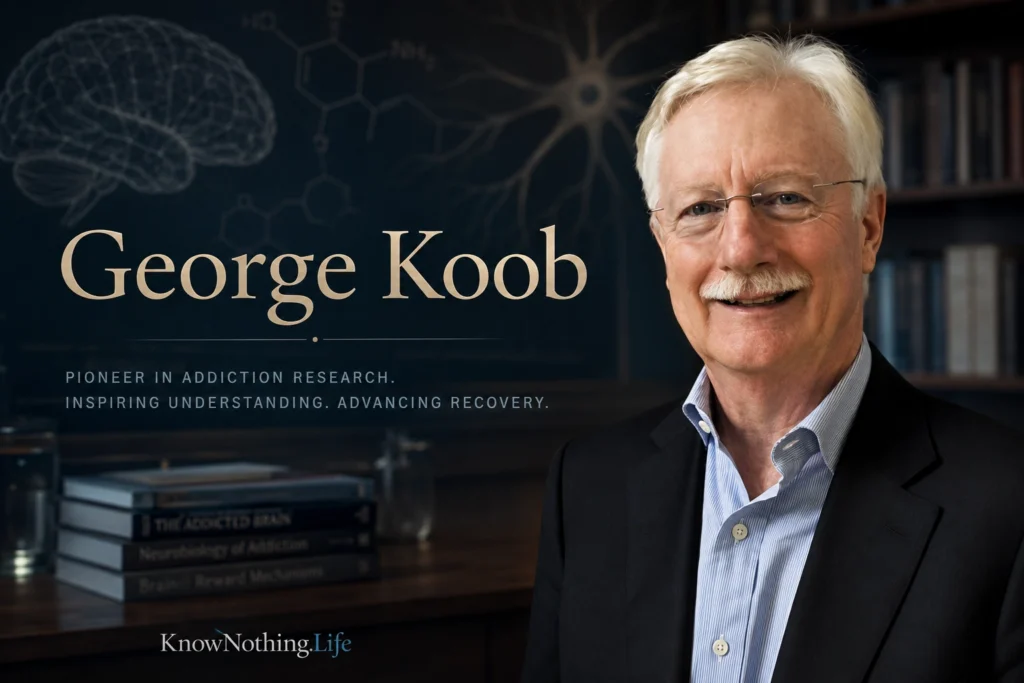
George F. Koob is an American behavioral neuroscientist whose research fundamentally changed how scientists understand addiction. Earlier accounts frequently emphasized the intense pleasure produced by alcohol and other drugs, suggesting that people continued using substances mainly because they wanted to repeat a rewarding experience. Koob demonstrated that this explanation captured only the beginning of the process. As addiction develops, substance use may become increasingly motivated by relief from anxiety, irritability, emotional pain, and withdrawal. The pursuit of pleasure gradually becomes an attempt to escape distress, creating what Koob has called the “dark side” of addiction.
Koob connected this psychological transition to measurable adaptations in the brain’s reward, stress, habit, and executive-control systems. His research helped establish the three-stage addiction cycle, the allostatic model of dependence, the concept of anti-reward, and the role of the extended amygdala in negative emotional states. He has coauthored major works including Neurobiology of Addiction and Drugs, Addiction, and the Brain, while publishing more than 800 scientific papers. He currently serves as director of the National Institute on Alcohol Abuse and Alcoholism, where he oversees research spanning basic neuroscience, epidemiology, prevention, diagnosis, and treatment.
Education and Early Scientific Formation
Koob earned a bachelor’s degree in zoology from Pennsylvania State University in 1969 and completed a doctorate in behavioral physiology at the Johns Hopkins University School of Public Health in 1972. He originally hoped to become an ethologist studying animal behavior, but his direction changed when he encountered research involving electrical stimulation of the brain’s reward pathways. Laboratory animals would repeatedly press a lever to stimulate regions associated with reinforcement, demonstrating the extraordinary power of neural reward mechanisms to organize behavior. Koob later described the attraction of this research by saying that he spent “the first half of my career studying why we feel good.”
After completing his doctorate, Koob conducted research at the Walter Reed Army Institute of Research, where he studied brain stimulation, lesions, behavior, neurochemistry, and psychopharmacology. From 1975 to 1977, he completed postdoctoral work with Susan and Leslie Iversen in the Department of Experimental Psychology and the Medical Research Council Neurochemical Pharmacology Unit at the University of Cambridge. This training brought together behavioral observation, anatomy, pharmacology, and neurochemistry. Rather than treating emotion as an abstract mental state, Koob approached it as a function emerging from identifiable circuits and chemical systems.
From Reward Research to the Neurobiology of Addiction
In 1977, Koob joined the Salk Institute for Biological Studies as a staff scientist at the Arthur Vining Davis Center for Behavioral Neurobiology. He became involved with an alcohol research center directed by neuroscientist Floyd Bloom, beginning a long-term investigation of how alcohol and other drugs alter motivation. When members of the program moved to the Scripps Research Institute during the 1980s, Koob continued developing a multidisciplinary addiction-research program. He became a professor at Scripps, directed its Alcohol Research Center from 1995 to 2014, and chaired the Committee on the Neurobiology of Addictive Disorders from 2006 to 2014.
His early studies examined the neural systems responsible for the acute reinforcing effects of drugs. Alcohol, opioids, stimulants, nicotine, and other substances influence different molecular targets, but they can converge upon circuits governing reward, motivation, learning, and emotional arousal. Koob’s work helped explain why these effects encourage repeated use while also showing that the addicted brain is not merely experiencing an exaggerated version of normal pleasure. Repeated exposure produces adaptations that change the individual’s emotional baseline, making ordinary rewards less satisfying and periods without the drug increasingly uncomfortable.
Allostasis and the Dark Side of Addiction
Working closely with French neuroscientist Michel Le Moal, Koob developed an allostatic account of addiction. Homeostasis describes the maintenance of stability around a normal biological level. Allostasis refers to achieving temporary stability through change, especially when an organism must repeatedly adapt to stress. A substance may initially produce pleasure or relief, but the brain responds by activating opposing processes. With repeated use, reward function can become weakened while stress systems become increasingly active. The person then requires more of the substance to experience the same effect, while sobriety brings a lower mood and greater emotional discomfort.
Koob and Le Moal described this condition as a reward deficit and stress surfeit. Addiction is maintained not only by the memory of intoxication but by the desire to escape dysphoria, anxiety, irritability, and emotional pain. Koob memorably called this process “the devil in the dysphoria.” Drug use becomes negatively reinforced because taking the substance temporarily removes or reduces an aversive state. The relief strengthens future use, even when intoxication is no longer especially pleasurable and the person recognizes its damaging consequences.
The Three-Stage Addiction Cycle
Koob and Nora Volkow organized these changes into a three-stage addiction cycle: binge and intoxication, withdrawal and negative affect, and preoccupation and anticipation. During the binge stage, substances activate reward and habit circuitry involving structures within the basal ganglia. Repeated reinforcement makes drug-seeking responses increasingly automatic and gives substance-related cues unusual motivational power. Places, people, objects, smells, and emotional states associated with past use can begin attracting attention and triggering behavior before the person makes a fully deliberate decision.
The withdrawal stage recruits the extended amygdala and other systems involved in stress and negative emotion. The preoccupation stage involves craving, impaired judgment, and reduced control associated partly with disrupted frontal-cortex function. These stages do not always occur in a neat sequence, and different substances or individuals may emphasize different components. The framework nevertheless provides a bridge between observable symptoms and underlying neurobiology. It also suggests that treatment may need to address habit formation, negative emotionality, and executive dysfunction rather than relying upon one universal intervention.
The Extended Amygdala and Hyperkatifeia
A major focus of Koob’s laboratory has been the extended amygdala, a functional system that includes the central nucleus of the amygdala, the bed nucleus of the stria terminalis, and portions of the nucleus accumbens. These interconnected areas participate in reward, fear, stress, and motivated behavior. Koob investigated chemical messengers such as corticotropin-releasing factor, norepinephrine, dynorphin, neuropeptide Y, orexin, and opioid peptides. His research showed how repeated substance exposure can recruit brain-stress systems that intensify withdrawal and contribute to compulsive seeking.
Koob introduced the term hyperkatifeia to describe heightened sensitivity to negative emotional experiences during withdrawal and prolonged abstinence. A person may feel stress, disappointment, physical discomfort, or interpersonal conflict more intensely than before dependence developed. This state can make substance use feel like an urgently needed coping response rather than an optional source of pleasure. The concept also helps explain connections among addiction, pain, trauma, anxiety, sleep disturbance, and relapse, while offering potential targets for medications designed to reduce stress-system overactivity.
Books, Public Service, and Alcohol Research
Koob and Le Moal synthesized decades of research in Neurobiology of Addiction. The book examines animal models, individual drug classes, neuroimaging, molecular processes, neural circuits, and the transition from controlled use to addiction. Koob later collaborated with Michael Arends and Le Moal on Drugs, Addiction, and the Brain, which presented addiction across molecular, cellular, behavioral, and neurocircuitry levels. These works helped establish a common scientific framework for studying substances that differ pharmacologically but produce overlapping patterns of compulsive behavior and neuroadaptation.
Koob became director of NIAAA in 2014, explaining that he wanted to “translate the basic research into [information that] people need.” His leadership has emphasized evidence-based public resources, treatment access, medical education, recovery research, individual differences, and the health effects of alcohol throughout the body. Koob has argued that “Alcohol use disorder is not just a brain disorder. It’s a body disorder,” highlighting alcohol’s effects on organs, cancer risk, injuries, sleep, mental health, and social functioning.
Major Works and Lasting Influence
Koob’s foundational publications include “Cellular and Molecular Mechanisms of Drug Dependence,” “Drug Abuse: Hedonic Homeostatic Dysregulation,” “Drug Addiction, Dysregulation of Reward, and Allostasis,” “Neurocircuitry of Addiction,” and “Neurobiology of Addiction: A Neurocircuitry Analysis.” His honors include election to the National Academy of Medicine, the E. M. Jellinek Memorial Award, the NIAAA Mark Keller Award, the Research Society on Alcoholism Distinguished Investigator Award, and appointment as a Knight of France’s Legion of Honor for strengthening scientific cooperation between France and the United States.
Koob’s enduring contribution is the recognition that addiction changes what substances accomplish for the person using them. Early use may be organized around excitement, reward, or social reinforcement, but dependence increasingly involves emotional escape and the restoration of a damaged equilibrium. This model replaces moral judgment with a dynamic account of vulnerability, learning, stress, and neuroadaptation without denying personal or social responsibility. By explaining how the search for pleasure can become a struggle to avoid pain, George Koob provided addiction science with one of its most influential and clinically useful frameworks.