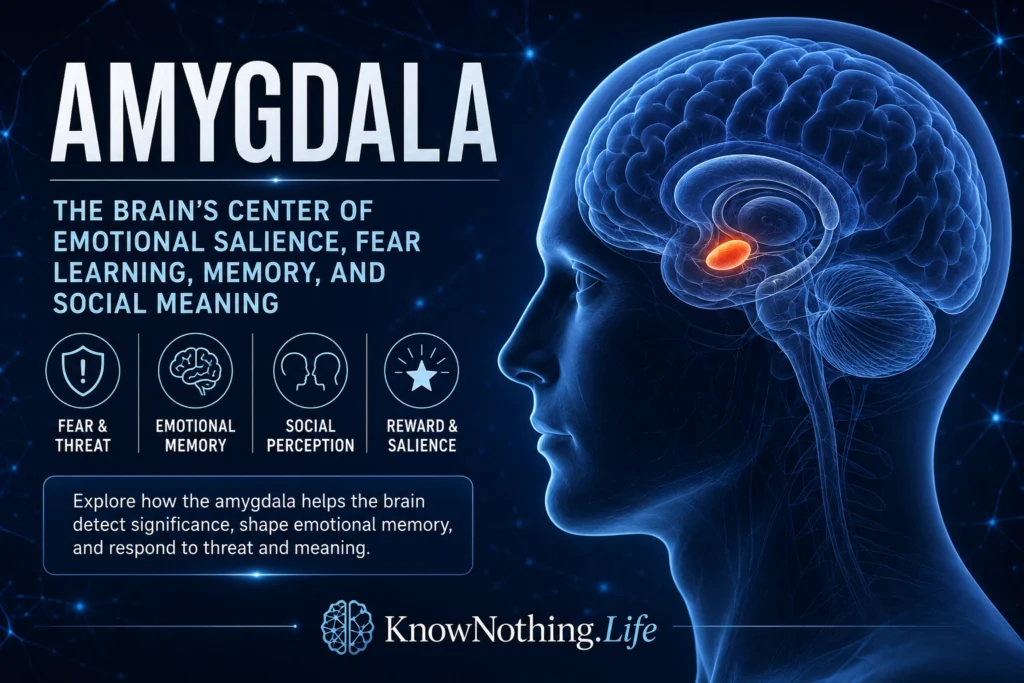
The amygdala is an almond-shaped group of nuclei located deep within the medial temporal lobe. Its name comes from the Greek word for almond, reflecting its small curved shape, but its influence on human experience is far larger than its size suggests. The amygdala is best known for its role in fear, threat detection, emotional learning, and emotional memory. However, it is not simply a “fear center,” as popular psychology often claims. It also participates in anxiety, aggression, reward learning, social cognition, attention, facial-expression processing, and the evaluation of emotional significance. The amygdala is involved in anxiety, aggression, fear conditioning, emotional memory, and social cognition.
The amygdala helps the brain decide what matters. A sudden sound in the dark, an angry face, a remembered trauma, a loved one’s voice, a risky opportunity, or a threatening situation can all become emotionally powerful because the brain marks them as significant. The amygdala does not create emotion by itself. Emotional life depends on wider networks involving the prefrontal cortex, hippocampus, hypothalamus, insula, thalamus, brainstem, sensory cortex, and body. Still, the amygdala is one of the brain’s most important systems for linking perception, memory, bodily arousal, and action. It helps turn neutral information into emotionally meaningful experience.
Anatomy and Major Amygdala Regions
The amygdala is not one uniform structure. It is made of several nuclei with different connections and functions. Major regions include the basolateral complex, central nucleus, medial nucleus, cortical nucleus, and intercalated cell masses. The basolateral amygdala receives sensory information from cortical and thalamic pathways and is heavily involved in learning associations between stimuli and emotional outcomes. The central nucleus sends output to hypothalamic and brainstem regions that help coordinate autonomic, hormonal, and behavioral responses. Through these pathways, the amygdala can influence heart rate, freezing, startle responses, stress hormones, attention, and readiness for action.
This organization helps explain why the amygdala is so influential. It sits at the intersection of perception and bodily response. It receives information about sights, sounds, smells, bodily states, memories, and social cues, then helps determine whether those signals should trigger attention, avoidance, approach, arousal, or learning. The amygdala has strong connections with the hippocampus, which provides context and memory; the prefrontal cortex, which helps regulate interpretation and response; and the hypothalamus, which helps translate emotional significance into bodily change. Emotion is therefore not a private feeling sealed inside the mind. It is a coordinated brain-body process, and the amygdala is one of its central hubs.
Fear Learning and Threat Detection
The amygdala became famous in neuroscience because of its role in fear conditioning, a form of learning in which a neutral stimulus becomes associated with danger. For example, if a tone is repeatedly followed by a shock in an experiment, an animal may eventually show defensive responses to the tone alone. Joseph LeDoux’s research helped map the pathways by which sensory information reaches the amygdala and becomes linked to defensive responses. In a major review, LeDoux concluded that fear-conditioning studies show the amygdala plays a critical role in linking external stimuli to defense responses.
This does not mean the amygdala is only about fear. It is better understood as a system for detecting and learning emotional salience, especially when something may require fast action. Threat detection is important because survival often depends on speed. A person does not have time to calmly analyze every rustle in the bushes or every dangerous facial expression before responding. The amygdala helps bias attention toward signals that may matter for safety. In modern life, this same system can be useful, but it can also become overactive or poorly regulated, contributing to anxiety, hypervigilance, trauma responses, and exaggerated threat perception.
Emotional Memory and the Hippocampus
The amygdala has a powerful relationship with memory. Emotionally intense events are often remembered more vividly than ordinary events, and the amygdala helps explain why. It interacts with the hippocampus and other memory-related systems to strengthen the storage of emotionally arousing experiences. Research by Larry Cahill and James McGaugh showed that the amygdala is not usually the storage site of explicit declarative memory itself, but it influences memory-storage processes in regions such as the hippocampus, striatum, and neocortex. Human studies confirmed that the amygdala is involved in enhanced declarative memory for emotionally arousing events.
This is why memory and emotion are so difficult to separate. A frightening accident, an embarrassing moment, a major achievement, or a deeply meaningful conversation can become unusually durable because emotional arousal changes how the brain prioritizes the event. This is adaptive when emotional memories help future survival or learning. Remembering danger can prevent repeated harm. Remembering love, reward, and social meaning can guide attachment and motivation. But emotional memory can also become painful when traumatic memories return involuntarily or when fear becomes attached to cues that are no longer dangerous. The amygdala helps make memory matter, but that same power can make some memories hard to escape.
The Amygdala and the Body’s Stress Response
The amygdala is closely connected with the hypothalamus and brainstem, which allows it to influence the body’s stress and defense responses. When the brain detects a threat, amygdala activity can help activate autonomic and hormonal systems. Heart rate may rise, breathing may change, muscles may tense, attention may narrow, and stress hormones may increase. These responses prepare the body for action, whether that action is freezing, fleeing, fighting, calling for help, or carefully monitoring the situation. The amygdala helps emotional meaning become physical readiness.
This connection between emotion and body is central to understanding anxiety and fear. People often experience fear not as an abstract thought but as a bodily state: tight chest, racing heart, sweating, trembling, stomach tension, or a sense of alarm. The amygdala does not act alone in producing these sensations, but it helps initiate and coordinate the systems that make emotion embodied. This is why calming fear often requires more than telling oneself “nothing is wrong.” The body may already be responding as if something matters. Effective regulation often involves prefrontal control, memory updating, breathing, safety learning, and repeated experiences that teach the amygdala that a cue is no longer dangerous.
Social Cognition and Facial Emotion
The amygdala is also important for social cognition. Humans constantly interpret faces, voices, gaze direction, body language, trustworthiness, emotional tone, and social context. The amygdala helps evaluate social signals, especially those that carry emotional or motivational importance. Ralph Adolphs has argued that the amygdala contributes to recognizing emotion from faces, social behavior, reward learning, and instrumental behavior. This makes sense because social life is full of signals that matter for survival: anger, fear, attraction, trust, dominance, rejection, threat, and attachment.
Facial-expression research has often connected the amygdala with fear recognition, but the broader picture is more complex. The amygdala may respond to uncertainty, relevance, ambiguity, novelty, threat, and emotional intensity rather than one emotion alone. Reviews of amygdala responses to faces suggest that it is involved in evaluating socially meaningful stimuli, especially when facial cues indicate threat or require attention. In ordinary life, this means the amygdala helps people rapidly interpret whether another person’s expression should be ignored, approached, avoided, questioned, or remembered.
Reward, Motivation, and Salience
Although fear has dominated popular descriptions of the amygdala, the structure also participates in reward and motivation. It helps the brain learn that some cues predict desirable outcomes and others predict danger or loss. The basolateral amygdala interacts with the nucleus accumbens, orbitofrontal cortex, and other reward-related regions to shape approach behavior, reinforcement learning, and decision-making. This is one reason the amygdala is relevant not only to fear and trauma, but also to addiction, desire, habit, preference, and emotional decision-making.
The deeper concept is salience. Salience means importance, relevance, or significance. The amygdala helps mark certain stimuli as worth noticing and learning from. A cue can be salient because it is dangerous, rewarding, surprising, socially meaningful, painful, beautiful, disgusting, or personally relevant. This view moves beyond the simplistic “fear center” label. The amygdala is better understood as part of a system that helps the brain assign emotional value. It helps answer the question: “Does this matter to me, and should I respond?”
Clinical Importance of the Amygdala
Amygdala dysfunction has been studied in relation to anxiety disorders, post-traumatic stress disorder, phobias, depression, autism spectrum conditions, aggression, temporal-lobe epilepsy, and emotional memory disturbances. In some cases, the amygdala may become overly reactive to threat cues. In others, its communication with regulatory regions such as the prefrontal cortex may be disrupted. Because the amygdala is involved in learning emotional associations, it is also central to extinction learning, the process by which a person learns that a previously feared cue is now safe. Human fear-extinction studies have supported the role of amygdala circuits in learned fear and safety updating.
Clinical cases involving amygdala damage also reveal its importance. People with bilateral amygdala damage may have difficulty recognizing fear in facial expressions, evaluating threat, or experiencing certain forms of fear in ordinary situations. However, the effects are not always simple, because fear, social behavior, and emotional awareness depend on wider networks. The amygdala is not the whole emotional brain. It is a crucial node in systems that include sensory processing, memory, bodily regulation, attention, and conscious interpretation.
Why the Amygdala Matters
The amygdala matters because it helps explain why the brain is not just a thinking machine. It is also a valuing machine. It does not merely detect information; it decides what is urgent, dangerous, rewarding, familiar, socially meaningful, or worth remembering. This is why emotional experiences can shape attention, memory, behavior, and identity so powerfully. The amygdala helps the brain learn from what matters most.
The amygdala also reminds us that emotion is not the enemy of reason. Emotion helps guide attention, learning, caution, motivation, and social understanding. The problem is not that the amygdala exists, but that emotional systems can sometimes become miscalibrated by trauma, stress, uncertainty, or repeated fear learning. A healthy brain does not eliminate emotional salience. It regulates it. To understand the amygdala is to understand one of the brain’s most important bridges between perception and feeling, memory and survival, social meaning and bodily response.