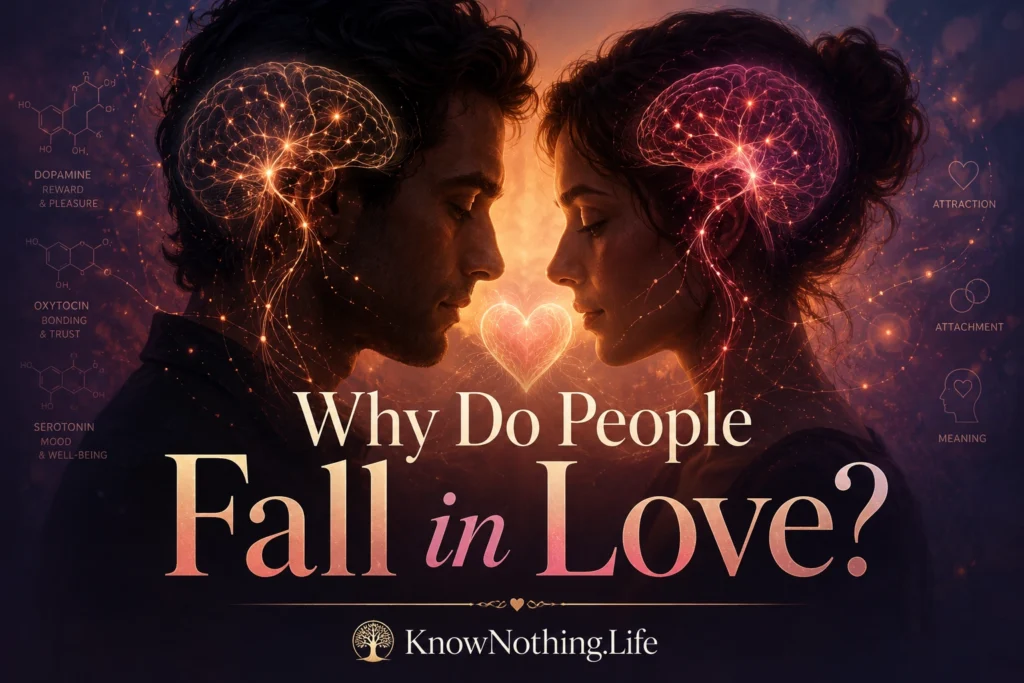
People fall in love when attraction, opportunity, emotional responsiveness, learning, and attachment begin to organize around one particular person. Although romantic love feels like a single overwhelming emotion, researchers describe several partly independent motivational systems. Sexual desire can direct attention toward potential partners, romantic attraction can concentrate energy on one individual, and attachment can transform repeated closeness into a durable sense of security. Helen Fisher, Arthur Aron, and colleagues proposed that lust, attraction, and attachment evolved as related but distinguishable systems. They often reinforce one another, but they do not always appear together: someone may desire a person without loving them, remain attached after passion weakens, or experience profound romantic affection without intense sexual desire.
There is therefore no single hormone, personality trait, or formula that makes two people fall in love. A potential relationship must first become psychologically possible. Two people require enough contact to notice each other, sufficient interaction to form an impression, and some reason to experience the other as rewarding, meaningful, safe, or unusually compatible. Culture, sexual orientation, personal history, social opportunity, and relationship goals all influence who enters this field of possibility. Love feels mysterious partly because the mind does not consciously calculate every influence that contributes to attraction.
Attraction Begins With Attention and Opportunity
People cannot fall in love with every compatible person they might theoretically meet. Proximity helps determine who becomes familiar enough to matter. Experimental research has found that closer physical distance can increase interpersonal liking, partly because nearby individuals feel more psychologically accessible. Schools, workplaces, neighborhoods, social groups, dating platforms, and recurring online conversations create different forms of proximity, but the underlying principle remains similar: affection has more opportunities to develop when two lives repeatedly intersect. Familiarity can lower uncertainty while revealing humor, warmth, intelligence, kindness, and other qualities that cannot be judged from a profile or photograph alone.
Physical attractiveness frequently influences initial attention, but it does not determine whether love develops. In a speed-dating study of 108 participants, Shanhong Luo and Guangjian Zhang found that a partner’s physical attractiveness was the strongest predictor of immediate attraction for both women and men, while similarity and reciprocity received more limited support during those brief encounters. A later analysis of more than 6,600 speed dates found that both generally desirable qualities and each pair’s unique sense of compatibility predicted subsequent interest, messages, dates, and relationship formation. Some characteristics appeal broadly, but the feeling that one particular person is unusually compatible remains a powerful part of romantic development.
Similarity, Reciprocity, and Emotional Connection
Similarity can make a relationship easier to begin because shared values, interests, goals, and lifestyles create immediate points of understanding. This does not mean enduring partners must possess identical personalities. Research involving dating and married couples found that similarity in emotional experience helped explain the relationship between personality similarity and relationship quality. Emotional convergence over time was also associated with marital satisfaction. What matters may be less about matching on every trait than developing compatible ways of interpreting events, regulating emotion, solving problems, and sharing daily life.
Reciprocity matters because being valued changes the emotional meaning of attraction. Interest from another person can signal that intimacy is possible and that emotional investment may be returned. Uncertainty, however, can sometimes intensify early preoccupation. Erin Whitchurch and colleagues found that female participants were more attracted to men when they were uncertain whether those men liked them than when they knew the men liked them moderately or strongly. This does not mean inconsistency produces healthy love. It suggests that unresolved social rewards can occupy attention. Stable love is built less through suspense than through responsiveness—the repeated experience of being understood, valued, and treated with care.
The Brain Turns One Person Into a Powerful Reward
Early romantic love strongly engages systems involved in reward, motivation, learning, and focused pursuit. In a functional MRI study, Arthur Aron and colleagues showed photographs of a beloved partner to 17 people who described themselves as intensely in love. Viewing the partner activated the ventral tegmental area and caudate nucleus, dopamine-rich regions associated with reward and motivation. Activity within part of the caudate also correlated with reported passion intensity. The beloved is therefore not merely evaluated as pleasant or attractive. That person becomes a highly prioritized goal capable of capturing attention and motivating persistent behavior.
Dopamine is sometimes described as a love chemical, but it participates broadly in motivation and reward learning. Romantic attraction recruits this older system and attaches exceptional importance to one person’s face, voice, messages, approval, and presence. This helps explain the energy, optimism, concentrated attention, and recurring thoughts associated with falling in love. It also helps explain why romantic rejection can be so difficult to accept. Imaging research involving recently rejected participants found continued activity in reward, motivation, and craving-related systems when they viewed former partners, suggesting that conscious awareness of a breakup does not immediately deactivate a deeply learned motivational bond.
Attachment Makes a Partner Feel Like Safety
As romantic involvement deepens, a partner may become an attachment figure—someone sought for closeness, reassurance, comfort, and security. Cindy Hazan and Phillip Shaver’s influential 1987 research applied attachment theory to adult love. Their studies suggested that secure, anxious, and avoidant adults differed predictably in their experiences of intimacy, trust, dependence, and romantic relationships. Earlier experiences do not rigidly determine whom a person will love, but internal expectations about closeness can influence how quickly trust develops and how someone responds to uncertainty, dependence, separation, or conflict.
The safety value of a partner can be observed in the nervous system. James Coan and colleagues found that married women displayed reduced neural responses to the threat of electric shock while holding their spouse’s hand, with stronger effects among those reporting higher marital quality. Another imaging experiment found that viewing a long-term partner’s photograph reduced reported pain and pain-related brain activity while activating a region involved in signaling safety. A loved partner eventually becomes more than a desired reward: the brain may treat that person’s presence or mental representation as evidence that danger, pain, and effort are more manageable.
Oxytocin and the Biology of Pair Bonding
Oxytocin is widely called the love hormone, but this nickname oversimplifies its functions. The neuropeptide participates in reproduction, parental behavior, stress regulation, social attention, and affiliation. In a study of new couples, Inna Schneiderman and colleagues found higher plasma oxytocin among people in the early stages of romantic attachment than among unattached controls. Higher levels were also associated with mutual gaze, affectionate touch, positive emotion, and coordinated interactions between partners. These findings suggest that oxytocin participates in bonding, but an oxytocin measurement cannot determine whether someone is in love or whether a relationship will succeed.
Animal research offers possible explanations for how bonding systems operate. In female prairie voles, simultaneous oxytocin and dopamine activity within the nucleus accumbens is necessary for normal partner-preference formation. This interaction may help connect the sensory features of a particular partner with the rewards of mating, touch, and companionship. Human love, however, also depends on language, autobiographical memory, cultural meanings, moral commitments, and conscious choices. Oxytocin may support conditions that encourage affiliation, but it cannot manufacture compatibility or override consent, experience, and judgment.
Love Expands the Sense of Self
One reason falling in love feels transformative is that a close relationship changes how people understand themselves. Self-expansion theory proposes that individuals are motivated to increase their knowledge, perspectives, abilities, identities, and possibilities. A romantic partner can become incorporated into this expanding self. New relationships often introduce unfamiliar interests, friendships, places, routines, and possible futures. Life may appear larger and more interesting because the other person provides access to experiences that were previously unavailable or unimagined.
Novelty can continue to influence established relationships. Across daily-experience, longitudinal, and experimental studies, Amy Muise and colleagues found that engaging in self-expanding activities with a partner was associated with greater sexual desire and, in turn, greater relationship and sexual satisfaction. Long-term love does not require constant emotional intensity, but shared discovery can keep partners from becoming entirely predictable roles in each other’s lives. Growth is most likely to strengthen a bond when the partners continue developing both individually and together.
Why Some Romantic Love Lasts
Passionate love does not inevitably disappear. Bianca Acevedo and colleagues studied 17 people who had been married for an average of more than 21 years and reported remaining intensely in love. Viewing photographs of their spouses activated dopamine-rich reward regions also associated with new romantic love, along with areas connected to attachment and pair bonding. Long-term love can therefore retain motivation and attraction while acquiring the calm, familiarity, shared history, and safety of a durable attachment. The experience changes over time, but change does not necessarily mean decline.
People fall in love because several conditions converge. Another person captures attention, becomes emotionally rewarding, responds in ways that support trust, and is gradually woven into memory, identity, bodily regulation, and imagined future plans. Biology supplies capacities for desire, reward learning, attachment, and caregiving, while experience determines how those capacities become organized around a particular individual. No single quality guarantees love, and no brain scan can determine whether a relationship is healthy or sustainable. Romantic love is both biological and interpretive: a motivational state produced by the brain and a bond continually shaped by what two people do together.