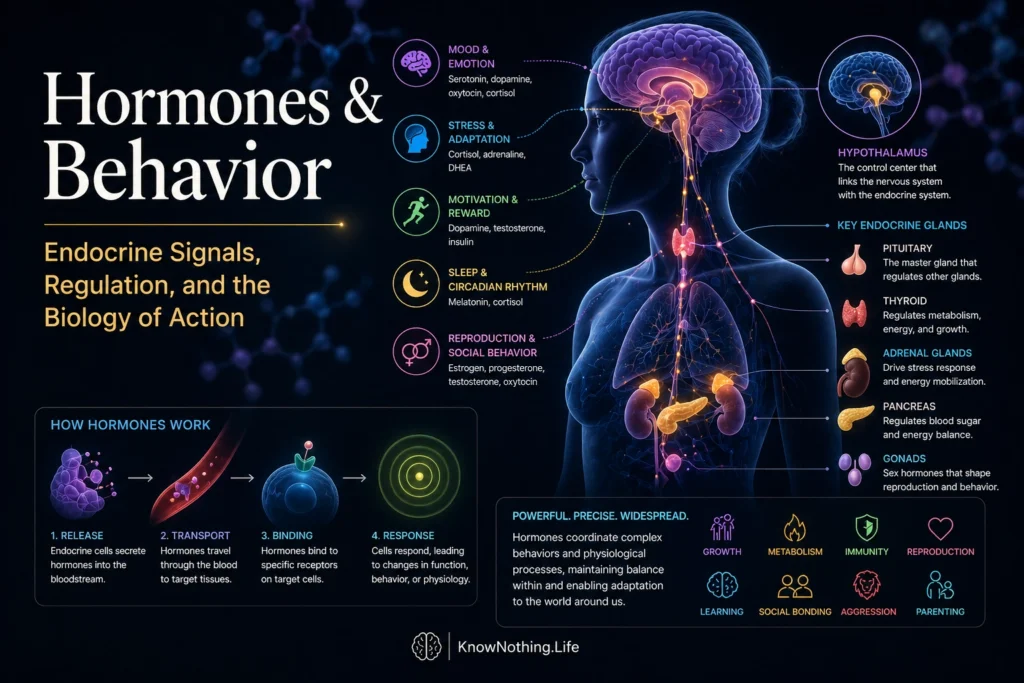
Hormones are chemical messengers released by the endocrine system that travel through the bloodstream to regulate physiology and behavior. While neurotransmitters act across microscopic synapses, hormones exert broader, slower, and often longer-lasting effects, coordinating processes such as growth, metabolism, reproduction, stress response, and emotional regulation. The study of hormones and behavior examines how these chemical signals shape patterns of action, influence psychological states, and interact with neural systems to produce the complexity of human experience.
The integration of endocrine and neural processes reflects a fundamental principle of biology: behavior emerges from the coordination of multiple systems. Early work in physiology laid the foundation for this understanding, while modern research has revealed intricate feedback loops between the brain and endocrine glands. As physiologist Walter Cannon observed in his work on homeostasis, the body maintains stability through dynamic regulation, with hormones playing a central role in this balance.
The Endocrine System: Structure and Function
The endocrine system consists of a network of glands that secrete hormones directly into the bloodstream. Major glands include the pituitary, thyroid, adrenal glands, pancreas, and gonads, each producing hormones that target specific tissues and organs. The pituitary gland, often referred to as the “master gland,” regulates other endocrine organs through the release of signaling hormones, coordinating the activity of the entire system.
The hypothalamus, a small but critical structure in the brain, serves as the primary link between the nervous and endocrine systems. It monitors internal conditions and releases hormones that control the pituitary gland, creating a feedback loop that allows the brain to regulate bodily processes. This connection highlights the integration of neural and hormonal signaling, ensuring that behavior and physiology are aligned with environmental demands.
Hormones operate through complex feedback mechanisms that maintain balance within the body. For example, the release of a hormone may inhibit further production once a certain level is reached, preventing excessive activity. These feedback loops are essential for maintaining homeostasis, allowing the body to adapt to changing conditions while preserving internal stability.
Hormones and the Regulation of Behavior
Hormones influence behavior by altering the activity of target tissues, including the brain. They can affect mood, motivation, aggression, sexual behavior, and stress responses, often in subtle but pervasive ways. Unlike rapid neural signaling, hormonal effects unfold over longer time scales, shaping patterns of behavior rather than moment-to-moment actions.
One of the most studied examples is the role of sex hormones—such as testosterone and estrogen—in regulating reproductive behavior and secondary sexual characteristics. These hormones influence not only physical development but also social and emotional behavior, contributing to differences in aggression, mating strategies, and parental care. However, their effects are not deterministic; they interact with environmental and social factors to produce a wide range of outcomes.
Endocrinologist Frank A. Beach emphasized the interaction between hormones and experience, noting that hormonal influences on behavior are shaped by learning and context. This perspective challenges simplistic interpretations that reduce behavior to biological causation, highlighting the dynamic interplay between internal and external factors.
Stress, Cortisol, and Adaptation
The body’s response to stress provides a clear example of how hormones regulate behavior. When an individual perceives a threat, the hypothalamus activates the hypothalamic-pituitary-adrenal (HPA) axis, leading to the release of cortisol from the adrenal glands. Cortisol mobilizes energy, increases alertness, and prepares the body for action, enabling the individual to respond effectively to the challenge.
This response is adaptive in the short term, but chronic activation of the stress system can have negative effects. Prolonged exposure to elevated cortisol levels is associated with anxiety, depression, impaired memory, and physical health problems such as cardiovascular disease. The balance between activation and recovery is therefore crucial for maintaining well-being.
Physiologist Hans Selye, who pioneered the study of stress, described this process in terms of the “general adaptation syndrome,” emphasizing the body’s attempt to cope with prolonged demands. He famously defined stress as “the nonspecific response of the body to any demand,” highlighting its broad impact on both physiology and behavior.
Hormones, Emotion, and Mood
Hormones play a significant role in shaping emotional experience. For example, fluctuations in serotonin and other neurochemicals are often linked to mood disorders, but hormones such as cortisol, oxytocin, and thyroid hormones also contribute to emotional regulation. Oxytocin, sometimes referred to as the “bonding hormone,” is associated with social attachment, trust, and empathy, influencing interpersonal relationships.
Thyroid hormones, which regulate metabolism, can also affect mood and energy levels. Hypothyroidism is often associated with depression and fatigue, while hyperthyroidism can lead to anxiety and irritability. These examples illustrate how hormonal imbalances can manifest as psychological symptoms, underscoring the connection between body and mind.
Neuroscientist Candace Pert explored the relationship between chemical signaling and emotion in Molecules of Emotion, arguing that emotional states are not confined to the brain but are distributed throughout the body. She wrote, “Your body is your subconscious mind,” suggesting that hormones and other signaling molecules play a central role in shaping subjective experience.
Development and Lifespan Changes
Hormones are essential for development, guiding processes such as growth, puberty, and aging. During puberty, the release of sex hormones triggers physical and behavioral changes that mark the transition to adulthood. These changes include the development of secondary sexual characteristics, as well as shifts in social behavior and identity.
Throughout the lifespan, hormonal changes continue to influence behavior. For example, aging is associated with changes in hormone levels that can affect cognition, mood, and physical health. The decline in estrogen during menopause and testosterone in later life can have significant psychological and physiological effects, highlighting the ongoing role of hormones in shaping experience.
Developmental psychologist Arnold Gesell emphasized the interaction between biological maturation and environmental factors, noting that development unfolds through a combination of internal processes and external influences. Hormones provide the biological framework for this process, while experience shapes its expression.
Interaction with the Brain and Behavior
The relationship between hormones and the brain is bidirectional. While hormones influence brain activity, the brain also regulates hormone release through the hypothalamus and pituitary gland. This interaction creates a feedback system that allows behavior to be adjusted in response to internal and external conditions.
For example, social interactions can influence hormone levels, which in turn affect future behavior. Positive social experiences may increase oxytocin levels, promoting bonding and trust, while negative experiences may elevate stress hormones, leading to avoidance or defensive behavior. This dynamic interplay illustrates the complexity of the relationship between biology and behavior.
Neuroscientist Robert Sapolsky has extensively studied the interaction between stress hormones and behavior, particularly in primates. In Why Zebras Don’t Get Ulcers, he explains how chronic stress can disrupt both physical and psychological functioning, emphasizing the importance of understanding hormonal systems in context.
Conclusion
The study of hormones and behavior reveals the intricate connections between the body’s chemical systems and the patterns of action that define human life. Hormones regulate not only physiological processes but also emotions, cognition, and social interactions, providing a biological foundation for behavior.
At the same time, hormonal influences are not deterministic; they interact with neural processes, environmental factors, and individual experience to produce diverse outcomes. Understanding this complexity is essential for advancing both scientific knowledge and clinical practice. As research continues to evolve, the study of hormones will remain central to the exploration of how biology shapes behavior, offering deeper insight into the unity of mind and body.