The stress response is a coordinated set of neural, hormonal, and bodily changes that prepares a person to meet a demanding situation. Stress can begin with physical danger, pain, illness, uncertainty, social evaluation, financial difficulty, conflict, or even the anticipation of a future problem. The response is not automatically harmful. In the short term, it can increase alertness, redirect energy, strengthen attention to important cues, and prepare the body for rapid action. Problems are more likely to arise when the response is repeatedly activated, remains active after the challenge has ended, or becomes poorly matched to the actual situation.
Hans Selye helped establish the biological study of stress with his 1936 paper “A Syndrome Produced by Diverse Nocuous Agents.” After exposing laboratory animals to different harmful conditions, Selye observed a partly shared pattern of physiological reactions. His work supported the idea that organisms produce a general adaptive response to many different challenges rather than responding only through mechanisms unique to each threat. Modern neuroscience has expanded this view by showing that the brain does not merely receive the consequences of stress. It evaluates what is threatening, initiates the response, and determines how long the response continues.
How the Brain Detects a Stressor
A stress response begins with interpretation. The brain must determine whether an event is dangerous, controllable, familiar, socially threatening, or relevant to an important goal. Sensory systems provide information about the environment, while memories and expectations influence what that information means. A raised voice may be ignored in one setting but interpreted as a serious warning in another. Stress therefore depends not only on the event itself but also on the individual’s appraisal of available resources, uncertainty, and possible consequences.
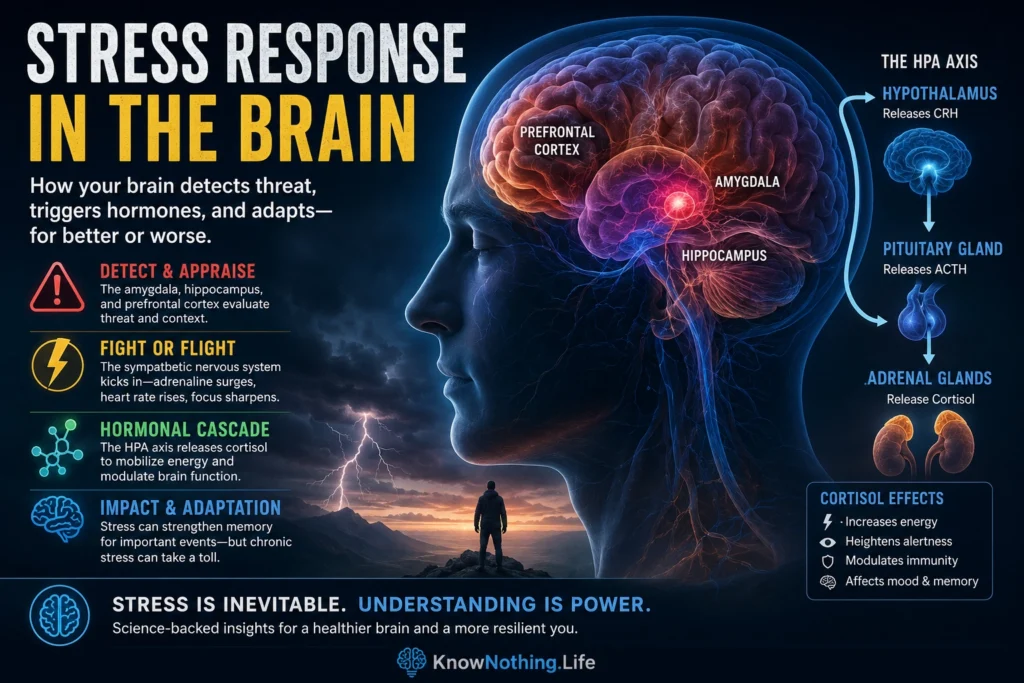
The amygdala helps assign emotional and motivational significance to events, especially when they involve uncertainty, conflict, or potential danger. The hippocampus supplies contextual and autobiographical information, helping distinguish a threat occurring now from one associated with a different time or place. Prefrontal regions contribute to evaluation, planning, inhibition, and the reinterpretation of stressful events. In a study of 239 participants completing the Montreal Imaging Stress Task, activity in several prefrontal regions and the amygdala varied with physiological and subjective responses to psychosocial stress, demonstrating that individual stress reactions reflect coordinated brain networks rather than a single “stress center.”
These regions also help regulate hormonal responses. Human lesion research has shown that the hippocampus contributes to the cortisol response to psychosocial stress, indicating that it participates in stress regulation as well as memory. The effects of the hippocampus, amygdala, and prefrontal cortex depend on their patterns of interaction with the hypothalamus and brainstem. The brain’s response is therefore shaped by the balance among systems that detect significance, provide context, initiate action, and limit unnecessary activation.
The Immediate Sympathetic Response
Once a threat or challenge has been identified, the brain can rapidly activate the sympathetic branch of the autonomic nervous system. Signals from the hypothalamus and brainstem increase activity in the heart, lungs, blood vessels, muscles, and adrenal glands. Adrenaline and noradrenaline help raise heart rate and blood pressure, increase the availability of energy, sharpen sensory vigilance, and prepare the body to fight, flee, freeze, or take another urgent action. These changes can occur within seconds.
This immediate response prioritizes survival-related functions over activities that are less urgent in the moment. Digestion may slow, muscles become more prepared for movement, and attention narrows toward information that appears relevant to the threat. Noradrenaline also acts within the brain, influencing arousal, attention, memory, and decision-making. Moderate activation may improve readiness, but intense or uncontrollable stress can make behavior more reflexive and less flexible by weakening prefrontal control while strengthening emotional and habitual responses.
The short-term response is useful precisely because it is temporary. After the danger has passed, parasympathetic processes help reduce arousal and restore ordinary bodily activity. When a person continues to anticipate danger, ruminate about the event, or encounter repeated demands, the brain may keep reactivating the same emergency systems even though immediate physical action is no longer necessary.
The HPA Axis and Cortisol
A slower hormonal pathway is known as the hypothalamic–pituitary–adrenal axis, or HPA axis. Stress-related signals stimulate neurons in the paraventricular nucleus of the hypothalamus to release corticotropin-releasing hormone. This signal causes the pituitary gland to release adrenocorticotropic hormone into the bloodstream, which then stimulates the adrenal cortex to produce cortisol. Experiments have shown that both single and repeated stressors can increase the synthesis and release of hypothalamic corticotropin-releasing factor, demonstrating how the brain initiates the endocrine response.
Cortisol helps mobilize energy, influence immune activity, support cardiovascular function, and alter attention and memory. It also travels back to the brain, where it acts on receptors in the hippocampus, amygdala, prefrontal cortex, hypothalamus, and other regions. Through negative feedback, cortisol normally helps signal that the response can be reduced. The stress system is therefore a loop: the brain initiates hormonal activity, hormones alter brain function, and the brain uses hormonal information to regulate the next stage of the response.
The Trier Social Stress Test, introduced by Clemens Kirschbaum, Karl-Martin Pirke, and Dirk Hellhammer in 1993, became an important laboratory method for examining this system in humans. Participants typically prepare and deliver a speech and perform mental arithmetic in front of an evaluative panel. The combination of social judgment, uncertainty, and lack of control reliably produces measurable changes in cortisol and other stress indicators, illustrating the power of psychological and social conditions to activate a biological response.
Acute Stress, Attention, and Decision-Making
Acute stress can help a person concentrate on an immediate threat, but it may also narrow thinking. The prefrontal cortex supports working memory, impulse control, flexible attention, and the ability to compare present actions with future consequences. Under severe stress, increased catecholamine activity can weaken the coordinated neural firing required for these functions. A person may become quicker to react while becoming less capable of considering alternatives or updating a plan.
Conor Liston, Bruce McEwen, and B. J. Casey examined the effects of psychosocial stress on human attention and prefrontal function. Their 2009 study found that stress disrupted attentional control and communication within a frontoparietal network that included the dorsolateral prefrontal cortex. Importantly, the impairments and changes in functional connectivity were reversible after the stressful period ended. The findings showed that stress can temporarily reorganize cognitive control rather than simply reducing overall brain activity.
This shift can be adaptive during immediate danger. Slow deliberation may be less useful than rapid action when a threat is clear. The same shift becomes problematic in situations that require patience, creativity, emotional restraint, or long-term planning. Stress can therefore improve performance on some simple or urgent tasks while interfering with complex decisions that depend on flexible prefrontal processing.
Stress, Cortisol, and Memory
Stress does not have one uniform effect on memory. It can strengthen memory for emotionally important information while weakening the ability to retrieve unrelated details or combine information flexibly. The outcome depends on when the stress occurs, how intense it is, whether the material is emotionally arousing, and whether researchers are measuring encoding, consolidation, or retrieval. Cortisol and noradrenaline can interact within the amygdala to strengthen the encoding of emotional experiences, giving threatening events lasting priority in memory.
The hippocampus is especially important for episodic and contextual memory, but it is also highly sensitive to stress hormones. Acute cortisol administration has been associated with impaired retrieval of autobiographical memories, while other research has found that cortisol can enhance the encoding or consolidation of emotionally meaningful material under particular conditions. Stress may therefore preserve information that appears central to survival while reducing access to details that seem less immediately relevant.
This helps explain why a stressful experience may be remembered vividly but incompletely. A person may clearly recall the most frightening image or emotionally charged moment while having difficulty reconstructing the sequence of surrounding events. Strong emotional memory is not necessarily complete or perfectly accurate; it reflects the priorities of a brain attempting to learn from potential danger.
How Chronic Stress Changes Neural Circuits
When stress becomes chronic, neural systems repeatedly adapt to high levels of hormones, neurotransmitters, and excitatory activity. These adaptations can alter synapses, dendrites, gene expression, and communication among brain regions. The effects are not identical throughout the brain. Some networks become less complex or less flexible, while others become increasingly responsive to threat.
Ajai Vyas and colleagues demonstrated this contrast in a 2002 animal study. Chronic immobilization stress caused dendritic shrinkage in hippocampal CA3 neurons but produced dendritic growth in neurons of the basolateral amygdala. These opposing patterns were accompanied by increased anxiety-like behavior. The results suggested that chronic stress may simultaneously weaken systems involved in contextual memory while strengthening circuits that promote emotional vigilance and threat sensitivity.
Research by John Radley and colleagues found that repeated behavioral stress caused dendritic reorganization in pyramidal neurons of the medial prefrontal cortex. Related studies have linked chronic stress with impaired prefrontal-dependent cognition and disrupted attentional flexibility. Most detailed cellular evidence comes from animal models, so it should not be interpreted as proof that every stressed human experiences identical structural changes. Nevertheless, human research also indicates that prolonged stress can affect prefrontal function and connectivity.
Allostasis and the Cost of Adaptation
Bruce McEwen used the concept of allostasis to describe how the body maintains stability by changing its activity to meet demands. Heart rate, cortisol, immune signaling, and attention do not remain constant; they adjust according to circumstances. This flexibility is protective. The accumulated cost of repeated activation, inadequate recovery, or poor regulation is called allostatic load. Stress becomes damaging not because adaptation itself is abnormal, but because adaptive systems are used too frequently or fail to shut down efficiently.
Human evidence connects prolonged cortisol elevation with differences in memory and hippocampal structure. In a longitudinal study of older adults, Sonia Lupien and colleagues found that participants with persistently increasing cortisol levels had smaller hippocampal volumes and poorer performance on hippocampus-dependent memory tasks than participants with moderate cortisol levels. Because many factors influence brain structure and cognition, cortisol should not be treated as a single cause, but the findings supported concern about long-term exposure to poorly regulated stress hormones.
Allostatic load also extends beyond the brain. Stress systems interact with metabolism, cardiovascular function, immune activity, sleep, and behavior. Poor sleep can increase stress reactivity, while stress can further disturb sleep. Similar feedback loops can involve inactivity, substance use, social isolation, or persistent worry. Chronic stress is therefore best understood as a whole-body process coordinated by the brain rather than as an emotion existing only in the mind.
Individual Differences and Recovery
People exposed to the same event can show very different stress responses. Genetics, early experience, health, sleep, social support, previous trauma, perceived control, and the meaning of the situation all influence reactivity. Even in standardized laboratory tasks, some people produce strong cortisol increases while others show little hormonal response. Brain-imaging studies also find substantial individual differences in how amygdala and prefrontal activity relate to reported distress, heart rate, skin conductance, and cortisol.
Recovery is as important as reactivity. A healthy stress response rises when needed and declines when the challenge has ended. Prefrontal regulation, contextual information from the hippocampus, hormonal feedback, and parasympathetic activity all contribute to this return toward baseline. Stress resilience does not mean never becoming aroused. It means that the response remains proportionate, flexible, and capable of ending.
The brain’s stress response is therefore neither an enemy nor a simple alarm. It is an adaptive system that links perception, memory, emotion, hormones, and bodily action. Acute activation can help people meet immediate challenges, but persistent activation can reshape cognition and emotional behavior. Understanding stress requires attention not only to cortisol or the amygdala, but to the entire cycle through which the brain interprets demands, mobilizes the body, learns from experience, and eventually restores balance.