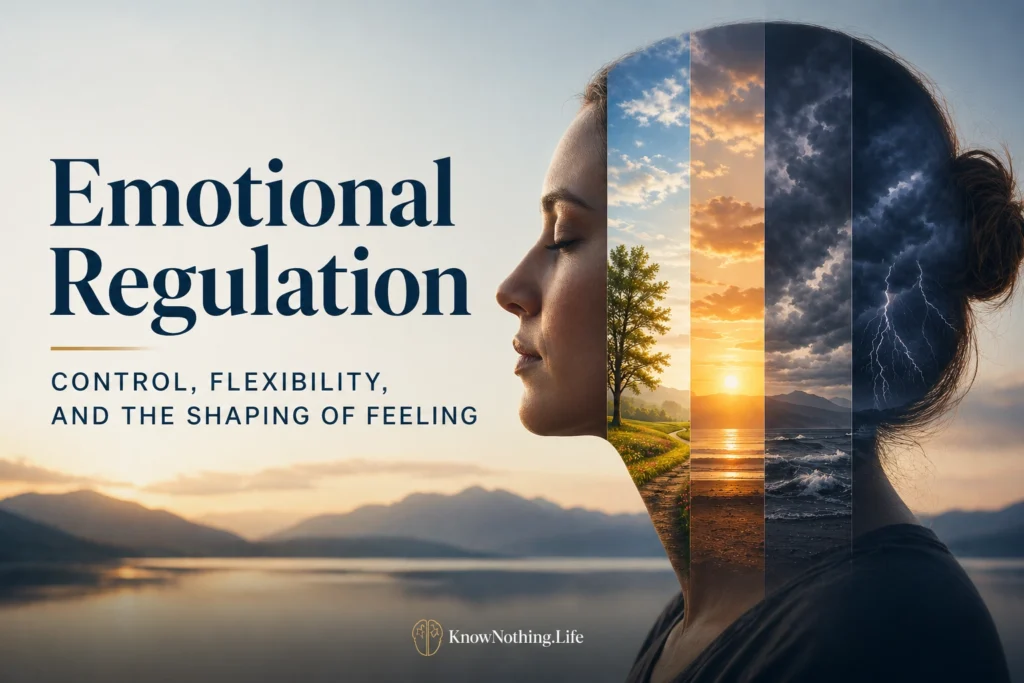
Emotional regulation refers to the processes through which individuals influence which emotions they experience, when they experience them, and how those emotions are expressed. It is a central component of psychological functioning, affecting everything from decision-making and relationships to mental health and resilience. Rather than eliminating emotion, regulation involves managing emotional responses in ways that are adaptive to context and goals.
The importance of emotional regulation has been increasingly recognized across psychology, neuroscience, and clinical practice. Psychologist James J. Gross, a leading figure in the field, defines emotional regulation as “the processes by which individuals influence which emotions they have, when they have them, and how they experience and express them.” This definition captures the breadth of the concept, encompassing both conscious strategies and automatic processes that shape emotional life.
Theoretical Foundations
The study of emotional regulation builds on broader theories of emotion, particularly those that emphasize the role of cognition and interpretation. Early perspectives often treated emotion as something to be controlled or suppressed, reflecting a dichotomy between reason and feeling. Contemporary approaches, however, view regulation as an integral part of emotional functioning, not an external force imposed upon it.
Gross’s process model of emotion regulation is one of the most influential frameworks. It distinguishes between different stages at which regulation can occur, including situation selection, situation modification, attentional deployment, cognitive change, and response modulation. This model highlights that regulation is not a single process but a sequence of potential interventions, each influencing emotion in different ways.
The theoretical foundation of emotional regulation also draws on cognitive appraisal theories, such as those developed by Richard Lazarus. Lazarus emphasized that emotions arise from evaluations of events, suggesting that changing these evaluations can alter emotional responses. This insight provides a basis for many regulation strategies, particularly those that involve reframing or reinterpretation.
Strategies of Emotional Regulation
Emotional regulation involves a range of strategies, each with different effects on experience and behavior. One of the most widely studied strategies is cognitive reappraisal, which involves changing the way a situation is interpreted in order to alter its emotional impact. For example, viewing a stressful event as a challenge rather than a threat can reduce anxiety and enhance coping.
Another common strategy is suppression, which involves inhibiting the outward expression of emotion. While suppression can be useful in certain contexts, research suggests that it often comes at a cost, increasing physiological arousal and reducing emotional clarity. In contrast, reappraisal tends to be associated with more positive outcomes, including better psychological well-being and social functioning.
Other strategies include attentional deployment, such as distraction or focusing on different aspects of a situation, and problem-solving, which involves addressing the source of emotional distress. The effectiveness of these strategies depends on context, timing, and individual differences, highlighting the importance of flexibility in emotional regulation.
Neural and Biological Mechanisms
Emotional regulation is supported by complex interactions between brain regions involved in emotion and cognition. The prefrontal cortex plays a key role in regulating emotional responses, exerting top-down control over the amygdala, which is involved in the detection of threat and the generation of emotional reactions.
Neuroscientist Antonio Damasio has emphasized the integration of emotion and cognition, arguing that regulation involves the coordination of multiple neural systems. Functional imaging studies have shown that strategies such as reappraisal are associated with increased activity in the prefrontal cortex and decreased activity in the amygdala, illustrating how cognitive processes can modulate emotional responses.
Hormonal and physiological systems also contribute to regulation. The autonomic nervous system, particularly the balance between sympathetic and parasympathetic activity, influences how emotions are experienced and managed. This biological foundation underscores that regulation is not purely cognitive but involves the entire organism.
Development of Emotional Regulation
Emotional regulation develops over time, shaped by both biological maturation and social experience. Infants initially rely on caregivers to regulate their emotions, a process known as co-regulation. Through interactions with caregivers, children learn to identify, express, and manage their emotions, gradually developing independent regulatory skills.
Attachment theory, developed by John Bowlby, highlights the importance of early relationships in this process. Secure attachment provides a foundation for effective regulation, as children learn that their emotional needs will be met. In contrast, insecure attachment can lead to difficulties in managing emotions, increasing the risk of psychological problems.
As individuals mature, they acquire a broader repertoire of regulation strategies, influenced by cultural norms and personal experience. Adolescence is a particularly important period, as the development of cognitive control systems enhances the ability to regulate emotions, though it also brings increased emotional intensity.
Emotional Regulation and Mental Health
Difficulties in emotional regulation are central to many psychological disorders. Conditions such as anxiety, depression, and borderline personality disorder are characterized by patterns of dysregulation, including excessive emotional reactivity, difficulty managing distress, and maladaptive coping strategies.
Understanding these patterns has led to the development of therapeutic approaches that focus on improving regulation skills. Dialectical behavior therapy (DBT), developed by Marsha M. Linehan, emphasizes the balance between acceptance and change, teaching skills for managing intense emotions and reducing self-destructive behaviors. Similarly, cognitive-behavioral therapy (CBT) often involves identifying and modifying thought patterns that contribute to emotional distress.
Research has shown that improving emotional regulation can lead to significant improvements in mental health. This highlights the central role of regulation in psychological well-being, suggesting that the ability to manage emotions effectively is a key component of resilience.
Social and Cultural Dimensions
Emotional regulation is not only an individual process but also a social and cultural one. Cultural norms influence how emotions are expressed and managed, shaping expectations about appropriate behavior. For example, some cultures emphasize emotional restraint, while others encourage open expression.
Social contexts also play a role in regulation. Interactions with others can facilitate or hinder the management of emotions, depending on factors such as support, communication, and conflict. The concept of emotional labor, introduced by Arlie Russell Hochschild, highlights how individuals regulate their emotions to meet social expectations, particularly in professional settings.
These social dimensions underscore that emotional regulation is embedded within broader systems of meaning and interaction. Understanding these contexts is essential for a comprehensive view of how emotions are managed in everyday life.
Conclusion
Emotional regulation is a fundamental aspect of human psychology, shaping how individuals experience, express, and respond to emotion. It involves a complex interplay of cognitive, biological, and social processes, reflecting the integration of multiple systems within the individual.
By understanding the mechanisms and strategies of regulation, researchers and clinicians can develop more effective approaches to enhancing well-being and addressing psychological disorders. Ultimately, emotional regulation is not about controlling or eliminating emotion but about cultivating flexibility and awareness, allowing individuals to navigate the complexities of life with greater balance and resilience.