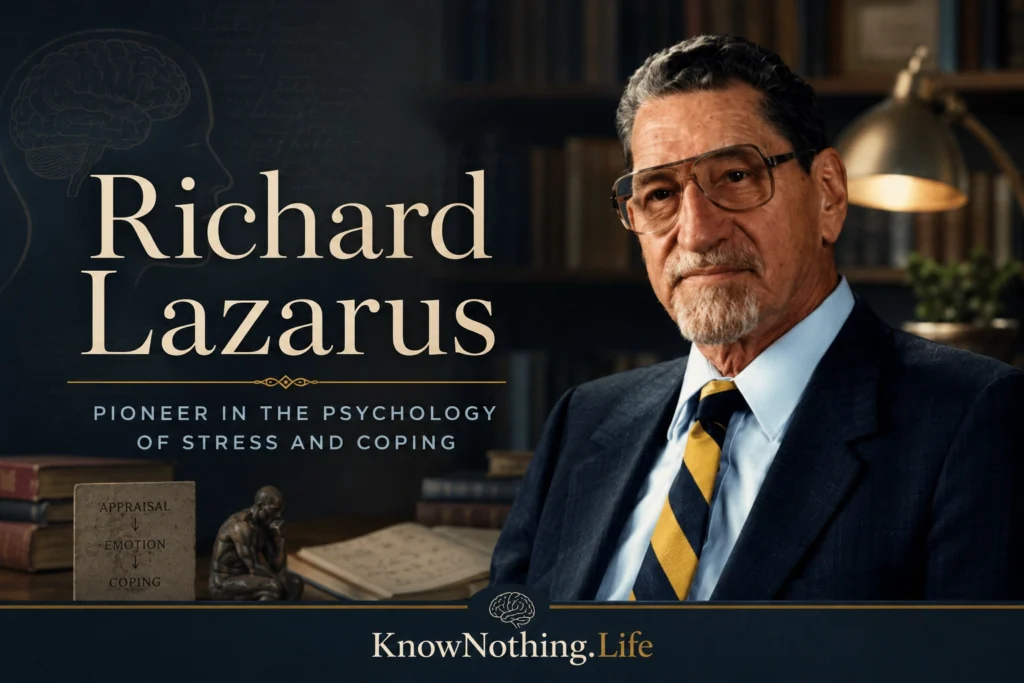
Richard S. Lazarus was an American psychologist whose research transformed the study of stress, coping, and emotion. At a time when psychology often described stress as a direct response to external pressure, Lazarus argued that events do not affect everyone in the same way. What matters is the relationship between a person and a situation: whether the event threatens important goals, what resources appear available, and how the person interprets what is happening. Stress was therefore neither entirely inside the individual nor simply imposed by the environment. It emerged through a continuing transaction between them.
This perspective placed meaning at the center of psychological adaptation. A demanding task may be experienced as a threat by one person, a manageable challenge by another, and an irrelevant inconvenience by someone else. Lazarus’s major works—including Psychological Stress and the Coping Process, Stress, Appraisal, and Coping, Emotion and Adaptation, Passion and Reason, and Stress and Emotion: A New Synthesis—provided an integrated vocabulary for explaining these differences. His theories influenced clinical, health, personality, social, organizational, and medical psychology.
Early Life, War, and Academic Formation
Richard Stanley Lazarus was born in New York City on March 3, 1922. He graduated from the City College of New York in 1942 and then served for three and a half years in the United States Army during the Second World War. After returning to academic life, he completed his doctorate at the University of Pittsburgh in the late 1940s. His early career included faculty appointments at Johns Hopkins University and Clark University before he joined the University of California, Berkeley, in 1957.
Lazarus entered psychology during a period dominated by behaviorism, learning theory, and attempts to explain complex conduct through relatively simple associations. Stress interested military researchers, but emotion received limited attention in many academic departments. Lazarus believed that psychological science could not adequately explain human adaptation without examining thought, evaluation, goals, and personal meaning. At Berkeley, he helped advance the cognitive revolution by demonstrating that what people believe about a situation can alter their emotional and physiological responses to it.
Film Experiments and the Power of Appraisal
During the late 1950s and 1960s, Lazarus conducted influential laboratory experiments using stressful films. Participants viewed disturbing material while researchers measured subjective reactions and physiological changes. Before or during the films, different groups received narratives that encouraged them to interpret the scenes in contrasting ways. Some descriptions emphasized pain and danger, while others encouraged intellectual distance, denial, or detached observation. The framing of the same visual material altered the level of stress participants experienced.
These experiments demonstrated the importance of cognitive appraisal—the process through which a person evaluates the significance of an encounter for personal well-being. The film itself mattered, but its psychological effect depended partly on the meaning assigned to it. Appraisal did not always require slow, deliberate reasoning; it could occur rapidly, automatically, or outside full awareness. Lazarus later defended the strong position that “appraisal is a necessary as well as sufficient cause of emotion,” emphasizing that emotion depends upon an event’s interpreted personal significance.
Psychological Stress and the Coping Process
Lazarus presented his emerging framework in Psychological Stress and the Coping Process, published in 1966. The book challenged models that treated stress as a property of a stimulus or a uniform bodily reaction. A difficult event becomes psychologically stressful when it is evaluated as relevant to something the person values and as potentially harmful, threatening, or demanding. This relational view explained why apparently minor events can produce intense distress while severe circumstances may sometimes be managed without psychological collapse.
Lazarus distinguished primary appraisal from secondary appraisal. During primary appraisal, the person evaluates whether the encounter is irrelevant, beneficial, harmful, threatening, or challenging. Secondary appraisal concerns available options: what can be done, whether help is accessible, how much control is possible, and what consequences different responses may produce. These processes continually influence each other. As circumstances change or new information becomes available, people reappraise the situation, altering both emotional experience and coping behavior.
Susan Folkman and the Transactional Model of Coping
Lazarus’s collaboration with psychologist Susan Folkman produced Stress, Appraisal, and Coping in 1984, one of the most influential books in modern stress research. They defined psychological stress as a relationship between a person and an environment judged to tax or exceed available resources and threaten well-being. This definition rejected the idea that stress could be measured adequately by counting difficult events without considering how those events were experienced. Personal commitments, beliefs, health, skills, social support, and material resources all shaped appraisal.
Lazarus and Folkman described coping as “constantly changing cognitive and behavioral efforts” used to manage demanding circumstances. They distinguished problem-focused coping, which attempts to alter the source of difficulty, from emotion-focused coping, which regulates distress or changes its meaning. Neither category is inherently healthy or unhealthy. Problem solving may be useful when action is possible, while acceptance, emotional regulation, or reinterpretation may be more adaptive when the situation cannot be changed. Successful coping often involves a flexible combination of both.
Emotion, Goals, and Core Relational Themes
In Emotion and Adaptation, published in 1991, Lazarus developed a cognitive-motivational-relational theory of emotion. The theory was cognitive because appraisal involved meaning, motivational because emotions reflected goals and commitments, and relational because they expressed a person’s changing relationship with the environment. Emotions were not disruptive additions to rational life. They communicated how important personal concerns were progressing. As Lazarus and Bernice Lazarus later wrote in Passion and Reason, “Everything important that happens to us arouses emotion.”
Lazarus proposed that each emotion is organized around a core relational theme. Anxiety involves uncertain or ambiguous danger; sadness reflects an irrevocable loss; anger arises from a demeaning offense or perceived blame; guilt concerns violation of a moral standard; pride follows valued achievement; and hope involves fearing the worst while desiring improvement. These themes explain why the same event can generate different emotions in different people and why similar bodily reactions do not necessarily reveal what someone is feeling.
Daily Hassles, Health, and Adaptation
Lazarus also questioned the emphasis researchers placed on major life events such as bereavement, divorce, illness, or job loss. His Berkeley research group examined daily hassles and uplifts: recurring irritations, pressures, satisfactions, and positive experiences woven into ordinary life. Studies found that hassles could predict psychological symptoms more effectively than simple totals of major events. Repeated conflicts, time pressures, caregiving demands, financial concerns, and minor frustrations may gradually affect well-being even when no single event appears catastrophic.
This research strengthened the connection between psychology and behavioral medicine. Appraisal and coping offered mechanisms through which social conditions could influence emotion, behavior, bodily arousal, and health over time. Lazarus resisted simplistic claims that a positive attitude alone prevents illness. People confront real environmental constraints, unequal resources, and problems that cannot be solved through thought. His transactional approach instead examined the fit between demands and resources while recognizing that both individuals and circumstances can change.
Major Works and Lasting Influence
Lazarus continued refining his ideas after retiring from Berkeley in 1991. With his wife, Bernice, he wrote Passion and Reason: Making Sense of Our Emotions, translating appraisal theory for general readers through stories of anger, anxiety, shame, envy, love, gratitude, hope, and compassion. Stress and Emotion: A New Synthesis reunited subjects that researchers often treated separately, while Fifty Years of the Research and Theory of R. S. Lazarus gathered major papers and reflected on the development of his thought.
Lazarus died on November 24, 2002, at the age of eighty. He left more than 150 scholarly publications and approximately twenty books, along with a conceptual system that remains central to research on stress and emotion. His lasting contribution was the recognition that human beings respond not merely to events, but to what those events mean for their goals, identities, relationships, and futures. By connecting appraisal with coping, Lazarus explained why stress is deeply personal without treating it as merely subjective—and why changing either the situation or its meaning can alter the emotional course of a life.